The global production of plastics is increasing, and environmental protection is of great importance and significant concern. Microplastics have been detected in aquatic, terrestrial, and atmospheric environments (the aquatic environment being the most explored), as well as in biota. Plastic consumption and production have followed an exponential growth trend since the 1950s and are projected to reach approximately 1,800 million tons by 2050 (Tirkey et al., 2022). Around 90% of global plastic production consists of PET, HDPE, PVC, LDPE, PP, PS, and PUR (Phuong et al., 2016). For instance, global plastic production was 270 million metric tons in 2010, increased to 348 million metric tons in 2017, and reached 367 million metric tons by 2020 (Shi et al., 2023a). The annual worldwide production of PET is approximately 40 million tonnes and is growing at ca. 7% per year. Of these, approximately 65% are used to make fibers, 5% films, and 30% packaging.
Annually, between 4 and 12 million tons of plastics are released into the oceans, and it is estimated that over 250 Mt of plastics will be accumulated in the oceans by 2025. The rest of the waste, between 22% and 43%, ends up at landfills, and only approximately 20% of this waste is recycled or incinerated. However, most of the plastic waste is non-biodegradable and the decomposition could take up to 500 years (Tourinho et al., 2019). It is estimated that at least 14 million tons of plastic end up in the ocean annually. Plastic debris is the most abundant type of litter in the ocean, constituting approximately 80% of all marine debris (Chassignet et al., 2021). This includes various plastic items, such as bottles, bags, packaging materials, fishing gear, and microplastics, which come from land-based sources, including rivers. The current state-of-the-art prediction is that between 1.15 and 2.41 million tons of plastics flow from the global river system into the oceans each year. Over 90% of the plastic inputs to the oceans come from 103 rivers located in Asia, 8 in Africa, 8 in South and Central America and 1 in Europe. Asia accounts for more than two-thirds (67%) of the global annual input of plastics to the oceans (Zhang et al., 2023). It is estimated that the ocean already contains over 150 million tons of plastic (Eriksen et al., 2014), and this amount is projected to nearly double to 250 million tons by 2025 (Jambeck et al., 2015).
Plastic waste is a major threat due to its accumulation in rivers and subsequently in the seas and oceans (Naqash et al., 2020). The presence of microplastics in the environment is becoming a crucial global and significant environmental and health problem. Plastic waste is usually generated (i) by inhabitants, varying according to their habits, geographic location, and existing infrastructure; (ii) by waste management and treatment; and (iii) by industrial and manufacturing plants. Once microplastics enter the environment, they are transported by wind, washed off from land by rainfall, and subsequently transported in fresh water and seawater. Land-based microplastics are introduced into water bodies through wastewater treatment plant effluents and industrial discharges. Microplastics are found in both natural and human-made water cycles, including municipal sewage and wastewater treatment plants, where they come from various sources, such as domestic washing and personal care products (Omidi and Kakanejadifard, 2018; Omidi and Kakanejadifard, 2018; Lin et al., 2020a).
Microplastics (MPs) pollute aquatic, terrestrial, and atmospheric environments and are interconnected via diverse networks of source-pathway-sink connections that influence the flux and retention of MPs in the environment. Nevertheless, most studies conducted in last decades are aimed at the aquatic pollution(Amelia et al., 2021a; Lacerda et al., 2019; Kukkola et al., 2021). These studies confirm the distribution of microplastics from tropical regions to polar regions. Microplastics have also been found in icy snow samples at the summit of Mount Everest, as well as in the deep sea (Napper et al., 2020; Mishra et al., 2021). These facts confirmed that microplastics could be transported to aquatic and terrestrial environments, as well as to the atmosphere, including the most remote and seemingly undisturbed areas. This is a serious problem that requires further research and effort to combat microplastic pollution and protect our planet.
Based on the size of the plastic part, plastics can be divided into macroplastics (> 25 mm), mesoplastics (5–25 mm), large microplastics (1–5 mm), small microplastics (20 µm − 1 mm) and nanoplastics (< 0.1 µm) (Boyle and Örmeci, 2020). Plastic debris can be divided into four categories: megaplastic (> 50 cm), microplastic (5 − 50 cm), mesoplastic (0.5 − 5 cm) and microplastic (< 0.5 cm) (Boyle and Örmeci, 2020). These particles are often further degraded into smaller particles – nanoplastics (Tang et al., 2020; Zon et al., 2018; Brennecke et al., 2016). The International Organization for Standardization has defined nanoparticles as objects with their external dimensions falling into nanoscale (1 − 100 nm). MPs come in various shapes (pellets, fragments, and fibers) and colors. Polyethylene (PE), polypropylene (PP), and polystyrene (PS) are among the most used polymers. (Amelia et al., 2021b; Holmes et al., 2012; Binda et al., 2021). The size, shape, color, and density of microplastics are important for their bioavailability and degradation. The shape, size, and density of microplastics affect their dispersal through natural currents, with large, dense particles sinking easily, irregular-shaped particles remaining underwater, and spherical-shaped particles remaining on the surface. Most of these micro-fragments can accumulate in the central oceanic regions (termed “gyres” - a system of ocean currents that move in a circular pattern). So-called “Stokes drifts” generate the transport of MPs from the open sea to shallow coastal waters. A phenomenon of biofouling is often observed as organisms colonise the surface of plastic fragments and form biofilms, which results in aggregates forming and the speed of sedimenting increasing rapidly (da Costa et al., 2017a; Amelia et al., 2021b; Binda et al., 2021; Brennecke et al., 2016; Omidi and Kakanejadifard, 2018).
The four main factors that can play a role in MPs degradation are biodegradation, hydrolysis, photodegradation and thermooxidative degradation. Biodegradation has been studied extensively in recent years as a promising method for degrading MPs. It is defined as the breakdown of complex polymers by microorganisms (archaea, bacteria, and fungi) into nontoxic products that are reintroduced into biogeochemical cycles. These mechanisms include biodeterioration, biofragmentation, assimilation, and mineralization.
Plastic degradation in the environment can be influenced by both abiotic and biotic factors simultaneously. Typical abiotic degradation is mechanical due to weather and climate change (e.g., freezing, thawing, pressure changes, water turbulence, abrasion, and mechanical damage activities), and only morphological changes occur without the impact of molecular bonds. The molecular bond breakage is caused by chemical degradation through photooxidation (UV 290–400 nm and VIS 400–700 nm), thermal oxidation (150 to 800°C), hydrolysis and changes of alkalinity and salinity (Shah et al., 2013; Yang et al., 2015; Auta et al., 2018; Auta et al., 2018; Zhang et al., 2020a; Chen et al., 2020; Corcoran, 2021; Enfrin et al., 2020). The negative effects of plastic debris on biota are both of physical and chemical nature, therefore, plastic debris potentially acts as a multiple stressor to organisms. Physical negative effects include ingestion, entanglement and smothering (Bai et al., 2020; Chamas et al., 2020; Dong et al., 2020). The negative chemical effects are a result of the presence of chemicals of two types: (i) additives and polymeric raw materials and (ii) chemicals absorbed from the surrounding ambience (Huang et al., 2021a).
Several studies on aquatic organisms have shown harmful, if not lethal, effects of microplastics at the individual, cellular, and molecular levels. Aquatic organisms and aquatic-dependent wildlife can be selective in the types, forms, colors, and sizes of plastics they ingest, depending on their foraging techniques and diet. The toxicity of microplastics may depend on their size, shape, and surface coating. Unmodified polymers were shown to affect cell viability, inflammatory gene expression, and cell morphology in vitro. The ability to interfere with cell processes is greatly enhanced when charge is introduced to the MNPs particles (Mao et al., 2020; Ta and Babel, 2020; Tunali et al., 2020; da Costa et al., 2017b; da Costa et al., 2016; Guo et al., 2020a; Brennecke et al., 2016) .
It is well-known that a wide range of wild animals (amphipods, copepods, lugworms, barnacles, mussels, decapod crustaceans, seabirds, fish, and turtles) confuse plastic debris for food and ingest it. Low-density (i.e., buoyant) microplastics are ingested by pelagic filter feeders, whereas high-density microplastics tend to be ingested by benthic deposit feeders. In most cases, MPs are excreted rapidly, however, for very small MNPs, translocation from the GIT to the circulatory system was observed. Microplastics transfer throughout the food chain, however, there are no data demonstrating their bioaccumulation or biomagnification (Tunali et al., 2020; Barros and Seena, 2021; Naqash et al., 2020).
Recent studies have confirmed the key role of microplastics as significant contaminant vectors in aquatic and terrestrial ecosystems. MPs function as vectors of pollutants that can transport, distribute, and release various pollutants in the environment including heavy metals, old contaminants (polychlorinated biphenyls, polycyclic aromatic hydrocarbons polybrominated diphenyl ethers) and new pollutants (pharmaceuticals, polyfluoroalkyl substances)(Kumar et al., 2021; Sall et al., 2020; Yu et al., 2019). These contaminants originate from industrial discharge, urban runoff, and other pollution sources (Aghilinasrollahabadi et al., 2021; Zhang et al., 2020b). The coexistence of plastic debris and heavy metal pollutants in the ecosystem is a matter of concern (Liu et al., 2022; Liu et al., 2021). The adsorption of heavy metals onto plastics and their potential desorption play a crucial role in understanding the ecological risks associated with microplastics in the environment.
The adsorption process occurs when hazardous metal ions meet the microplastic surface, and electrostatic interactions or chemical bonding cause them to adhere to plastic particles(Cao et al., 2021a; Zou et al., 2020; Huang et al., 2021b; Guo and Wang, 2019; Zou et al., 2020; Guo et al., 2020b). This adsorption phenomenon can vary (Huang et al., 2021b), depending on the type of plastic (Mao et al., 2020; Santos-Echeandía et al., 2020), crystallinity (Fred-Ahmadu et al., 2020; Torres et al., 2021), size differences (Ta and Babel, 2020; Leiser et al., 2020), the composition of the surrounding environment, and the characteristics of the metal ions. The small size and large surface area of microplastics provides ample opportunities for heavy metals to adsorb onto their surfaces (Cao et al., 2021a; Zou et al., 2020; Xie et al., 2021; Ta and Babel, 2020; Sarkar et al., 2021).
Once heavy metals are adsorbed onto microplastics, they may remain attached or have the potential to desorb back into the surrounding environment. Adsorption and desorption can be influenced by various factors, including changes in environmental conditions, such as pH, temperature, salinity, and the coexistence of other ions (causing more serious composite pollution). It is essential to understand the desorption kinetics and mechanisms to assess the potential release of heavy metals from microplastics back into the ecosystem (Naqash et al., 2020; Zou et al., 2020; Wang et al., 2020; Zou et al., 2020; Lin et al., 2021; Shen et al., 2021; Huang et al., 2021c; Tang et al., 2020).
The presence of heavy metals in microplastics and their potential desorption can pose ecological risks to organisms in the environment. If microplastics with adsorbed heavy metals are ingested by aquatic organisms, the metals may be released into their digestive tracts, potentially causing toxic effects. It has been reported that the combined exposure of MPs and heavy metals has negative effects on aquatic organisms such as microalgae, fish, mussels, and oysters (Tunali et al., 2020; Yang et al., 2020; Lin et al., 2020b; Fernández et al., 2020; Petersen and Hubbart, 2021).
Despite growing awareness of microplastics as pollutant carriers, there is a lack of detailed mechanistic understanding of how PET microplastics interact with heavy metals in different aquatic environments. Specifically, the influence of particle size and ionic strength on adsorption capacity and polymer integrity is underexplored. This knowledge gap limits our ability to assess the long-term environmental risks posed by PET microplastics in freshwater and marine systems.
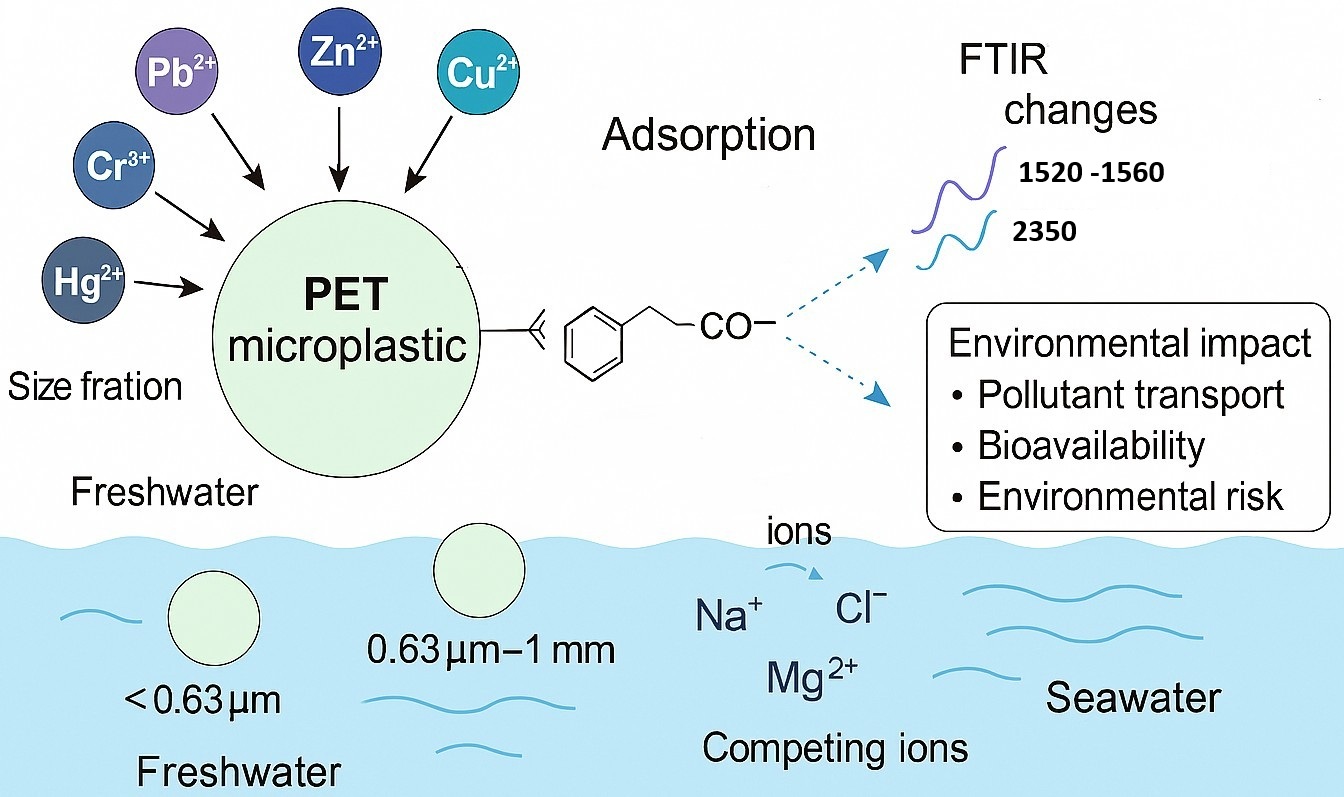
The aims of this study were to (1) analyse the adsorption mechanism of hazardous metals Pb, Cr, Zn, Cu, and Hg on PET microplastic particles under laboratory conditions, (2) compare the adsorption characteristics of five heavy metals on PET, and (3) apply isotherm models to predict risk assessment. This study is crucial in identifying the environmental risks associated with the concurrent presence of heavy metals and PET in the environment. It also aims to elucidate the mechanisms and roles of microplastics (MPs) in contributing to long-term global pollution. The novelty of this research lies in its comprehensive and mechanistic approach to understanding the interactions between PET microplastics and multiple toxic metals under conditions that are environmentally relevant. To the best of our knowledge, no prior study has concurrently investigated six hazardous metals across two particle size fractions and two water chemistries, while also incorporating adsorption modelling, thermodynamic analysis, and FTIR-based structural assessment.