Time is a crucial factor for patient care both in clinical and economical aspects. Bacterial infections may be life-threatening and thus require immediate diagnostics and treatment. Simultaneously, a major goal in health care is shortening the time a patient is hospitalized. Optimizing the treatment and minimizing the time a patient spends in hospital have become more important as expenses of health care rise and the numbers of qualified staff decreases.
Mucosal and dermal barriers efficiently sustain homeostasis and sterility from environmental microbes and as a result, clinical samples, such as deep tissue swabs, peritoneal or synovial fluids are normally sterile. However, after injury, operation or infection, normally sterile tissue may become infected with mono- or multiflora. In these instances, rapid detection of bacteria is important for initiation of appropriate antibacterial treatment. Traditionally, this has been done by culture-based methods which take 1–2 days with subsequent antibiotic sensitivity assays taking further several days for slow growing bacteria. The development of PCR methodology has enabled rapid detection of bacterial genomes. Recently, multiplexed assays to detect pathogens from a single sample have been developed and are in use in clinical laboratories worldwide2–5.
One challenge with both culture-based and traditional PCR methods is the need for well-trained laboratory personnel. For this, commercial providers have launched a variety of automated PCR systems which significantly simplify the PCR workflow by removing the need for separate extraction of nucleic acids and PCR set-up and analysis. In addition, such automated platforms may include an open channel for Laboratory Developed Tests (LDTs). Fully automated platforms with multiplex assay capability hold an exciting potential to be used for rapid screening of bacterial presence in normally sterile body fluids. However, at present there is no assay which could be used to rapidly analyze samples for possible bacterial presence without the need for specialized trained professionals
The performance of pan-pathogen PCR assays has been evaluated by many groups. There are studies of the performance of 16S rDNA amplification as a tool for diagnosis in microbial infections6–9. Similarly, culture-free methods have been developed for fungi10. These methods are based on extraction of nucleic acids followed by nucleic acid amplification and 16S rDNA sequencing. The performance of these assays as measured by their capability to identify pathogens in culture negative samples has varied from 4.3% 6 to 42.9 % 7. A pointed out above, these methods require highly skilled personnel and specific instrumentation and therefore may represent a challenge for microbiology laboratories in routine screening for bacterial infections.
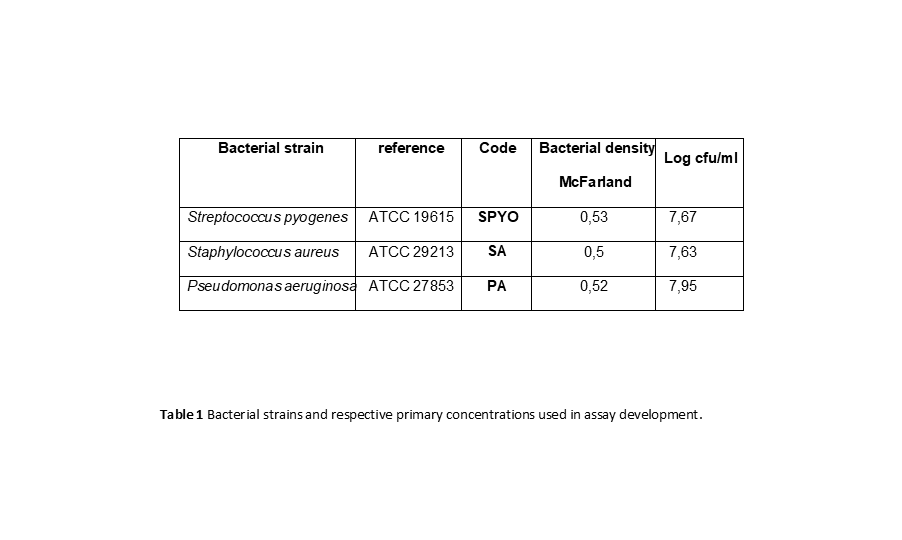
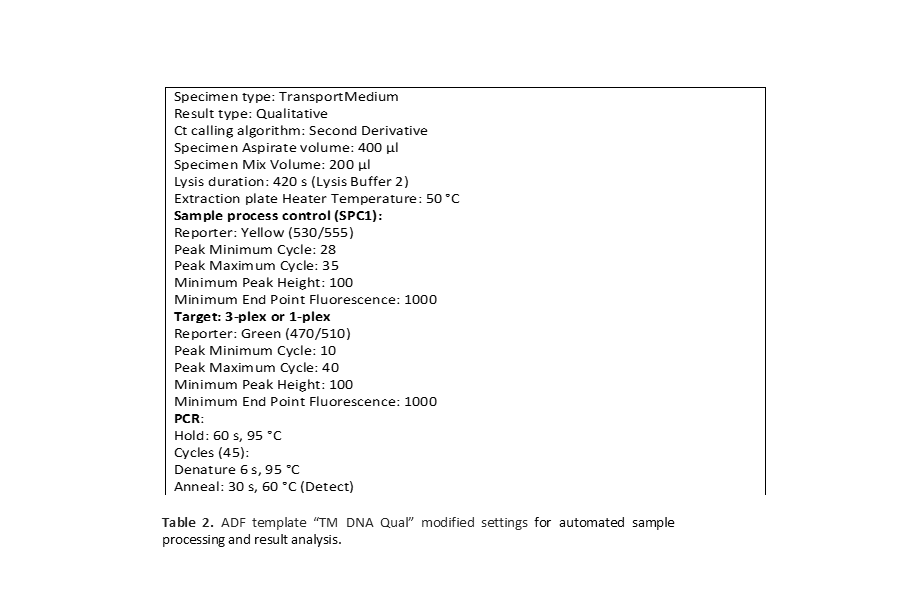
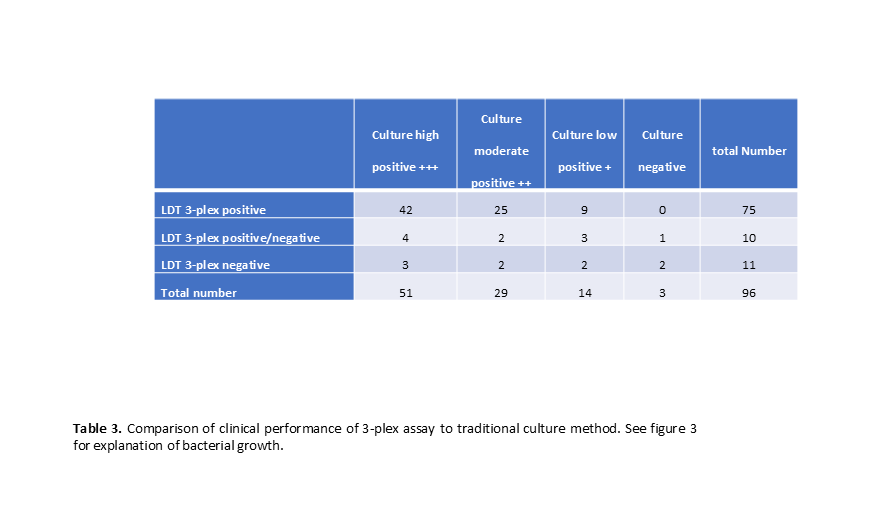
We describe here a technical proof of concept for a novel real-time PCR based screening method which allows a shorter Turn Around Time (TAT) using the fully automated Laboratory Developed Test (LDT) mode function (Fig. 1). As model organisms we used Pseudomonas aeruginosa, Staphylococcus aureus and Streptococcus pyogenes which are common causes of bacterial infections11,12,13. We also demonstrate that DNA from these bacteria can be detected in clinical samples using the fully automated LDT mode.