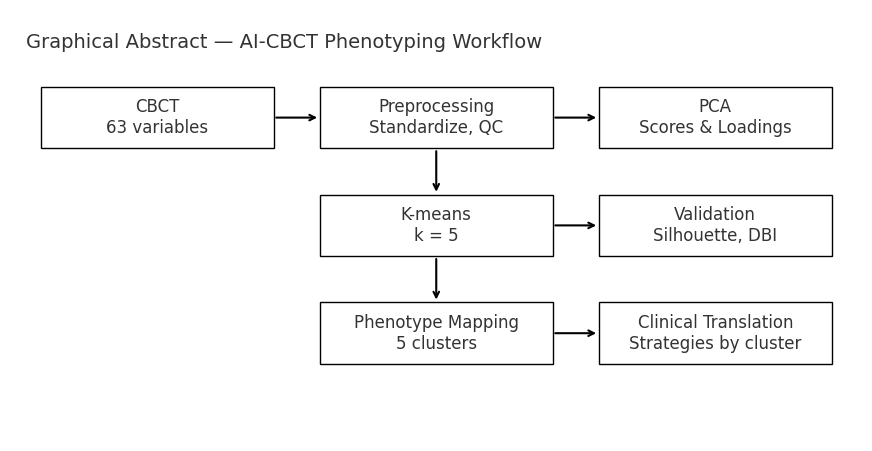
Background: Cone-beam computed tomography (CBCT) enables three-dimensional assessment of craniofacial structures; however, translating multiple inter‑correlated measurements into diagnostic insight remains challenging. Objective: To present an explainable engineering workflow combining principal component analysis (PCA) and K‑means clustering to identify skeletal Class II phenotypes in adults.
Methods: Sixty‑three CBCT variables from 120 Yemeni adults were standardized, reduced via PCA, and clustered (k = 2–8). Internal validity was evaluated with silhouette and Davies–Bouldin indices and stability across multiple random starts; phenotypes were mapped to clinical strategies.
Results: Seven components explained ≈60% of variance. A five‑cluster solution balanced cohesion, separation, and clinical interpretability, delineating deep‑bite and open‑bite tendencies, mandibular retrusion patterns, and incisor‑protrusive phenotypes. Solutions were stable across seeds and simple demographic strata.
Conclusions: The PCA→K‑means pipeline provides a transparent, reproducible framework for AI‑assisted orthodontic diagnosis and phenotype‑based treatment planning, aligning with biomedical imaging and radiomics workflows.