The increase in pesticide use in the agricultural sector has significantly impacted environmental quality, especially on water resources (Teklu et al., 2022; Tudi et al., 2021). Pesticide residues that pollute water bodies harm aquatic ecosystems and pose health risks to humans (Ali et al., 2021; Pawan Kumar et al., 2023). Therefore, developing effective and efficient technology for the degradation of pesticide contaminants in water is a top priority in efforts to mitigate environmental pollution (Jatoi et al., 2021; Rajmohan et al., 2020). Various methods have been designed to deal with pesticide contamination, from physical to chemical to biological processes (Ahmed et al., 2021; Hassaan & El Nemr, 2020; Saleh et al., 2020). However, conventional techniques are often less effective, expensive and cause unwanted side products.
Diazinon is an organophosphate pesticide widely used in agriculture to control insect pests on various crops. Although effective in protecting crops, excessive and uncontrolled use of diazinon has raised serious concerns regarding environmental and human health impacts (Al-Otaibi et al., 2019; Mena et al., 2020; X. Wu et al., 2021). Diazinon contamination in surface and groundwater can cause poisoning in aquatic organisms and land animals and potentially enter the human food chain (Glinski et al., 2018; Hajirezaee et al., 2017). The persistent and toxic nature of diazinon makes it challenging to remove from the environment using conventional methods (Barjasteh-Askari et al., 2022a; Dehghani et al., 2024; X. Wu et al., 2021). Therefore, an effective and efficient innovative technology is needed to degrade diazinon in water (Bikash Baruah, 2022; Zhu et al., 2023). One promising approach is using nanozymes, namely nanomaterials with a catalytic activity that resembles natural enzymes.
Enzymes play an essential role in environmental monitoring and remediation, but the fragile performance of naturally occurring enzymes significantly limits their broader use in complex matrices (Al-Sakkaf et al., 2023; Sanjay Parethe et al., 2022; S. K. Singh et al., 2021). In environmental monitoring and remediation, nanozymes have emerged as a powerful alternative to natural enzymes, thanks to their catalytic capabilities that withstand harsh environmental conditions (Ballesteros et al., 2021; Mishra et al., 2022; J. Wu et al., 2019). The advantages of nanozymes in catalytic signal amplification enable them to detect various contaminants effectively (Ballesteros et al., 2021; Diao et al., 2024; Su et al., 2022). In contrast, their superior catalytic properties provide great potential for the degradation of pollutants (Ballesteros et al., 2021; Diao et al., 2024). Recent research highlights significant advances in using nanozymes to detect and remove environmental pollutants, demonstrating the great potential of this technology in more efficient pollution control and environmental protection (Ballesteros et al., 2021; Mishra et al., 2022). This critical study examines various applications of nanozymes in detecting contaminants such as toxic ions, phenolic pollutants, antibiotics, and pesticides and summarizes degradation strategies involving nanozymes (Diao et al., 2024; Wei et al., 2019; Wong et al., 2021; X. Zhang et al., 2019). Additionally, opportunities and challenges in further developing nanozyme catalysis are presented to guide future efforts in this field.
Nanozymes, while functioning similarly to natural enzymes, exhibit distinct structural differences. Unlike natural enzymes, which feature uniquely designed catalytic sites optimized for catalysis, nanozymes are often synthesized through random processes, leading to lower catalytic efficiencies than their natural counterparts (R. Singh et al., 2023; Y. Zhang et al., 2021). Efforts in research aim to enhance nanozymes to achieve catalytic capabilities that match or surpass those of natural enzymes. This requires a comprehensive exploration of their structural characteristics and relationship to catalytic activity compared to natural enzymes. Integrating the catalytic mechanisms found in natural enzymes into the rational design of nanozymes can significantly improve production strategies (Huang et al., 2019; Sheng et al., 2024). By employing bioinspired approaches, recent advancements have led to the development nanozymes that exhibit catalytic activities that approach or exceed those of natural enzymes. As a result, pursuing highly active, bioinspired, and carefully engineered nanozymes has emerged as a prominent area of interest, paving the way for various strategies to enhance catalytic performance and specificity (Y. Zhang et al., 2021).
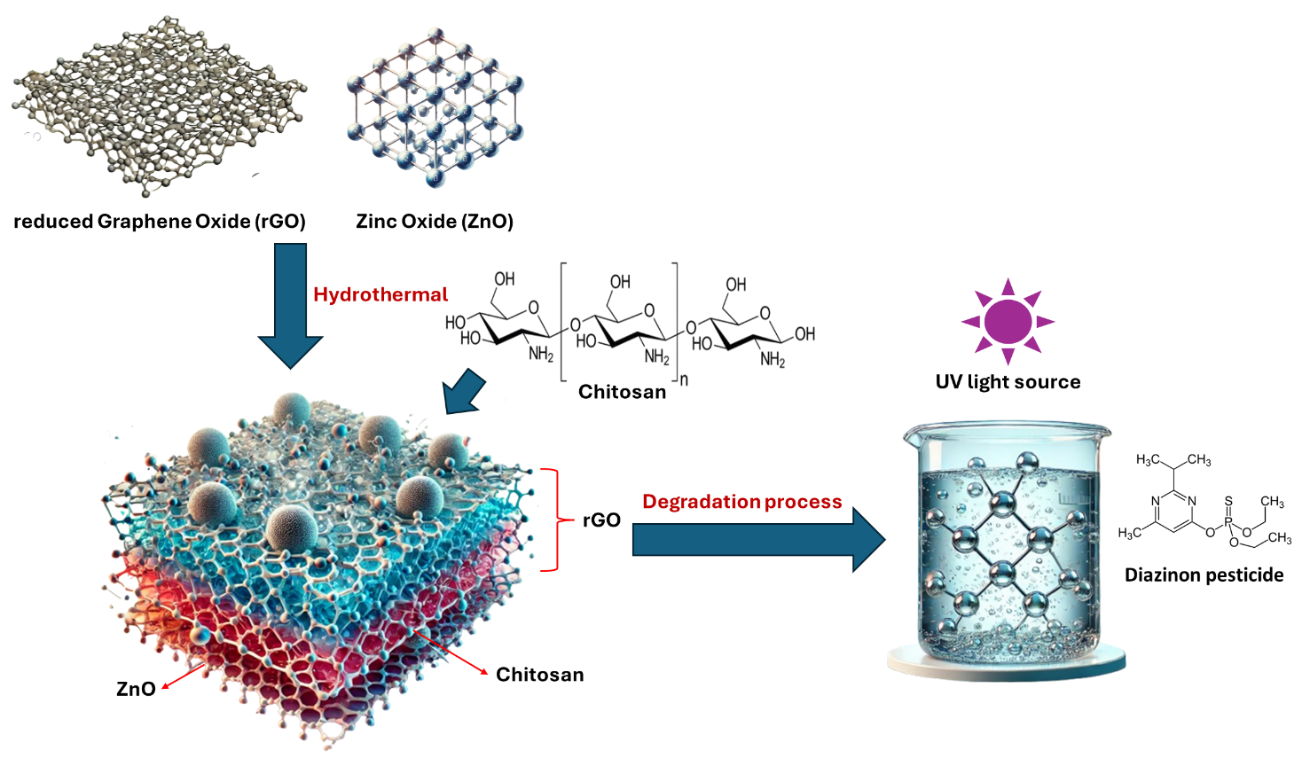
Enzyme-mimicking nanomaterials encompass metals, metal oxides, or carbon-based materials, exhibiting catalytic behaviours akin to peroxidase, superoxide dismutase (SOD), catalase, or oxidase. The catalytic efficacy of nanozymes hinges on factors such as atomic composition, size, morphology, solution pH, surface coating, and surface chemistry of the nanomaterials (Adeyemi et al., 2018; Navya & Daima, 2016). Among these crucial physicochemical attributes, the composition, surface chemistry, and surface modifications of enzyme-mimicking materials significantly influence their inherent nanozyme activity (Huang et al., 2019; J. Wu et al., 2019). The selection of appropriate materials is crucial for designing complex nanozymes that exhibit photocatalytic properties in degrading contaminants. Photocatalytic nanoparticles such as zinc oxide (ZnO) and graphene are extensively utilized today. ZnO is highly valued for its direct bandgap energy, binding energy of 60 MeV, stability against chemical corrosion, non-toxic nature, insolubility, ability to degrade toxic organic compounds, capability to absorb various electromagnetic waves, and efficient photocatalytic properties. It is recognized as a critical semiconductor material (Handayani et al., 2022; Nisar et al., 2022). Recent research has highlighted its effectiveness in the photocatalytic degradation of diazinon from aqueous solutions (Jonidi-Jafari et al., 2015; Maleki et al., 2020). Graphene oxide (GO), known for its extensive surface area and exceptional photocatalytic abilities, maintains these traits when reduced to reduced graphene oxide (rGO), making it a potent catalyst for diazinon degradation (Dehghan et al., 2022; Mohammadi et al., 2023). The electrons in rGO's conduction band play a crucial role in generating hydroxyl radicals (⋅OH), which are instrumental in mineralizing organic substances (Afreen et al., 2020; Byzynski et al., 2018). ZnO enhances this process by also contributing to the generation of ⋅OH radicals (Sultana et al., 2020). The rGO and ZnO can augment the enzymatic activity involved in diazinon degradation. For instance, the ⋅OH radicals produced during photocatalysis can activate enzymes that break down diazinon into less harmful compounds (Barjasteh-Askari et al., 2022b; Salehzadeh et al., 2024).
Recent studies have shown that achieving stability in nanozymes can be effectively accomplished by applying diverse coating materials, including small organic molecules, polymers, and inorganic substances (Ballesteros et al., 2021). Specifically, research highlights chitosan (CS) as a promising coating material capable of enhancing magnetic nanoparticle stability and catalytic efficiency (Liu, Huang, et al., 2024; Nikoshvili et al., 2023). The synergistic combination of rGO, ZnO, and CS in nanozymes offers a promising solution for pesticide degradation (Handayani et al., 2022; Nisar et al., 2022). These nanozymes capitalize on rGO's high surface area and adsorption capabilities, ZnO's robust photocatalytic properties, and CS's biocompatibility and stability. Coating these materials enhances their strength and catalytic performance, which is crucial for the efficient degradation of pesticides like diazinon. Further advancements in structural and surface engineering can optimize the exposure of active catalytic sites, thereby boosting degradation efficiency. This innovative rGO/ZnO/CS nanozyme holds excellent potential for various environmental applications, including the detection and decomposition of pesticide contaminants, thanks to its enhanced photocatalytic activity, electron transfer mechanisms, and enzymatic capabilities.