A full factorial experimental design (2^4) was performed to study the impact of the sampling and handling processes on the analysis of gasoline samples. Four independent variables were selected based on the most critical parameters to control during sampling. Vapor pressure determination and distillation curve were chosen as response variables, and the data collected were assessed by analysis of variance as a statistical approach. There were statistically significant differences related to the sample container's material and the sample's storage time in the laboratory before the analysis. Also, the measurement variance was estimated at 0.11 from the contributions of the variance of the sampling process and the variance of the analysis process considering vapor pressure results (kPa), which allows the evaluation and control of the random error associated with the sampling process.
Research Article
Systematic study on the variability in the gasoline sampling process at service stations and its contribution to the measurement variance
https://doi.org/10.21203/rs.3.rs-3320954/v1
This work is licensed under a CC BY 4.0 License
Journal Publication
published 22 Jan, 2024
Read the published version in Accreditation and Quality Assurance →
You are reading this latest preprint version
gasoline
sampling process
variance
experimental design
Fossil fuels have powered world economies for more than 150 years. They are the primary energy source, supplying approximately 80 percent of the world's energy [1]. Many petroleum products, such as motor gasoline, fuel oil and jet fuel, are used for transportation. Quality control tests and inspections for these refined products are constantly performed in chemical laboratories according to accepted industry standards [2].
Determination of crucial fuel quality parameters is usually carried out following different procedures that range from methods developed and validated by laboratories to standardized chemical analysis methods, including the American Society for Testing and Materials (ASTM International), the Association of Official Agricultural Chemists (AOAC International), and other international protocols.
The general analysis process to verify the physicochemical parameters of fuels derived from petroleum begins with collecting samples at different distribution spots of the commercial product. It ends with a lab report showing the main results. Although the uncertainty of the lab result must be indeed determined by the systematic and random contribution in each of the stages of the overall process, it is common to underestimate the influence that the collection of samples has on the measurement variance to ensure the reliability of the analytical results [3].
Even though many experts point out that the contribution of sampling is significant in the variance of the analysis, it is often difficult to estimate its magnitude since various forms of heterogeneity in the process of collecting and handling samples can generate errors that lead to a questionable sampling precision or even a sampling bias [4–6]. To estimate the contribution of sampling to overall measurement uncertainty, it is first necessary to determine which variables significantly affect the result and then estimate the variance of these parameters and their contribution to the total measurement variance. In addition, the uncertainty arising from handling, preservation, storage and transport of the samples from the site to the laboratory must be considered [7].
The International Organization of Standardization (ISO), under the new version of ISO/IEC 17025 published in 2017, places greater emphasis on sampling processes due to their importance in contributing to uncertainty [8]. The requirement of a sampling plan for quality assurance evidences a greater awareness in the analytical sciences sector of the factors that must be controlled to guarantee the validity of results.
Usually, the measurand is a concentration of an analyte in a target matrix, so the combined uncertainty should be considered in the simplest form as the analysis process contribution –analytical uncertainty– plus the sampling procedure contribution –sampling uncertainty–[9]. However, in fuel quality control, most analyses are physical determinations such as density, viscosity, flash point, and vapor pressure. In these determinations measuring the precision of the total sampling process is crucial in describing the quality of the measurements [10].
This study aims to statistically measure the impact of service station gasoline sampling and handling processes on measuring physical and chemical parameters and its variability contribution to the total measurement variance in an accredited method at a laboratory according to ISO/IEC 17025 standards.
1.1 Materials and methods
One-liter plastic or glass bottles were used to collect the gasoline samples. HOBO data loggers were utilized to record temperature changes over time during sample transport and storage. The transport and storage time of the samples were measured with Fisher Scientific stopwatches. An ice bath was used to transport the samples at around 0°C.
1.2 Sampling process
The gasoline samples were collected from a fuel dispenser at a service station, considering the flow of gasoline from the storage tank to the sampling container according to ASTM methodology [11–13]. Enough gasoline was sampled to ensure the requirements of the experimental design. The selected service station was located within a 5 km radius of the laboratory in Montes de Oca, Costa Rica.
To adequately control the experimental design factors, all samples in both plastic and glass containers, were taken from a single fuel station. The sampling, transport and storage conditions were simulated in the laboratory for each level of the variable under study.
1.3 Experimental design
A full factorial two-level design (2^4) was selected to estimate the impact of the sampling and handling process on the uncertainty of physicochemical measurements for gasoline such that all two-level interactions may be effectively investigated. Four independent variables were selected as the most critical factors for the sampling process, as shown in Table 1.
| Variable | Interpretation | (-) | (+) |
|---|---|---|---|
| A | Sample transportation time to the laboratory | Minimum time (2 h) | Maximum time (72 h) |
| B | Material of the sample container | Plastic bottle | Glass bottle |
| C | Temperature of the sample during the transportation | Minimum temperature (0.11°C) | Maximum temperature (19.15°C) |
| D | Storage time of the sample in the laboratory before the analysis | Minimum time (2 h) | Maximum time (72 h) |
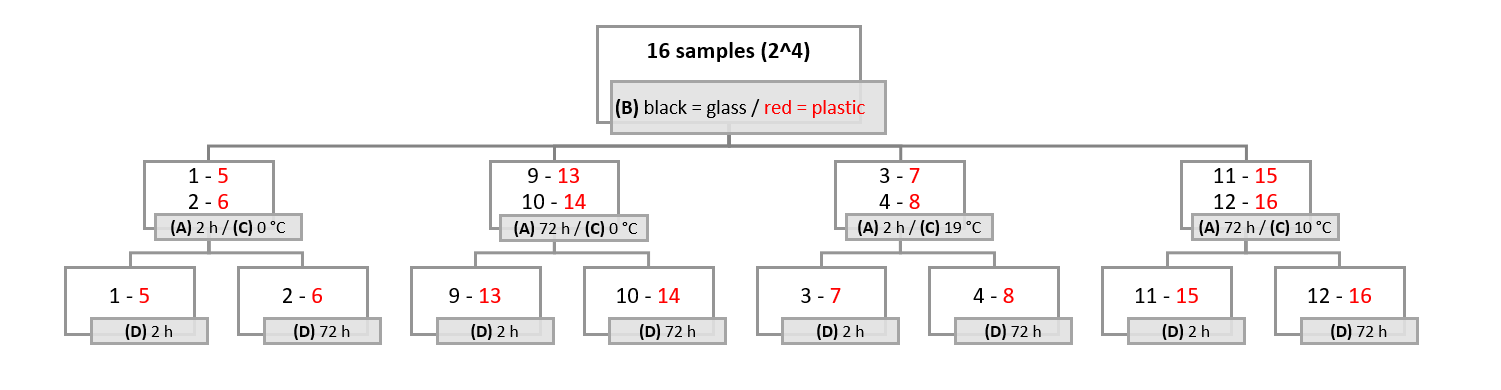
Three variables were selected as the response (dependent variable) for the mathematical models: vapor pressure, initial boiling point and final boiling point. The experimental design was carried out randomly (Scheme 1).
1.5 Physicochemical analyses
ASTM D7345 was followed to determine the micro-distillation characteristics of the fuel samples. Initial and final boiling points were recorded using an ISL PMD110 instrument [14]. Vapor pressure was measured by the ASTM D5191 mini method (dry vapor pressure equivalent, DVPE) using the instrument Herzog HVP 972 [15].
1.6 Statistical analyses:
The experimental design was analyzed using R package FrF2, DOE, ggplot2 and ggDoE. Three models were obtained using each dependent variable as a response, and an analysis of variance (ANOVA) was conducted on the data to investigate the main effects and the two-level interactions. The assumptions for the ANOVA analysis were checked.
The contribution of factors to measurement variability was estimated using the likelihood profile method, using R package lme4.
The factor levels of the independent variables shown in Table 1 were selected according to the type of sampling, the handling process and the sample's chain of custody, from fuel stations throughout the country to the research center (CELEQ) at the Universidad de Costa Rica. Minimum and maximum values of the factorial design were assigned based on the historical sampling record of the Hydrocarbon Analysis Laboratory.
Because of its sensibility and ability to detect alterations in the analysis matrix related to losses of the most volatile components of fossil fuels, three response variables were selected: the measurement of the vapor pressure of liquid fuel and the determination of the initial and final boiling points of a distillation curve. Table 2 depicts the factorial design matrix and the analytical results for the three response variables.
| Run | Independent variables | Analytical results | |||||
|---|---|---|---|---|---|---|---|
| Sample | (A) Transport time | (B) Sample container | (C) Sample temperature | (D) Storage time | Vapor pressure (kPa) | Initial boiling point (°C) | Final boiling point (°C) |
| 1 | - | + | - | - | 63.8 | 35.2 | 193.2 |
| 2 | - | + | - | + | 63.6 | 34.5 | 192.2 |
| 3 | - | + | + | - | 63.9 | 33.1 | 193.1 |
| 4 | - | + | + | + | 63.5 | 34.0 | 191.0 |
| 5 | - | - | - | - | 63.7 | 34.6 | 193.5 |
| 6 | - | - | - | + | 63.3 | 34.9 | 192.0 |
| 7 | - | - | + | - | 63.8 | 34.2 | 193.7 |
| 8 | - | - | + | + | 63.4 | 33.4 | 192.5 |
| 9 | + | + | - | - | 64.1 | 32.0 | 192.6 |
| 10 | + | + | - | + | 63.7 | 34.7 | 191.9 |
| 11 | + | + | + | - | 63.8 | 31.9 | 191.7 |
| 12 | + | + | + | + | 63.8 | 33.1 | 194.4 |
| 13 | + | - | - | - | 63.7 | 32.4 | 192.9 |
| 14 | + | - | - | + | 63.5 | 32.0 | 192.8 |
| 15 | + | - | + | - | 63.5 | 32.0 | 193.5 |
| 16 | + | - | + | + | 63.0 | 35.4 | 191.7 |
Figure 1 shows the box plot for vapor pressure as a response variable versus factors at the two-level full factorial design. A homogeneous data distribution is observed for both levels of each factor, in which the statistical averages –median and mean– are found to be close to each other. The Shapiro-Wilk test evidences the sample’s fit to a normal distribution (p = 0.52). The box plots for distillation results are presented in the supplementary information (Fig. S1 and Fig. S2).
Three physicochemical responses were analyzed for the factorial design due to their importance in gasoline tests: the vapor pressure, the initial point of the distillation curve and the final point of the distillation curve. The analysis of variance applied to the two-level factorial design matrix with a significance level of α = 0.05 (Table S1) showed two significant main effects only in the model that used Vapor Pressure as a response variable. That is, vapor pressure results for variables B (sample container) and D (storage time) exhibited significant statistical differences between levels (p-value < 0.05), as evidenced in Table S1 and Fig. 2. The relationship between the response variables and the magnitude of the experiment’s effects are shown in Table S2.
In Fig. S3 of the supplementary information, the magnitude of the effect on the vapor pressure results according to the levels of each independent variable is shown. For factor B, the results are higher when glass bottles are used. For factor D, the effect is negative between 2 h to 72 h storage times. In this case the results are lower for the samples stored in the lab for 72 h. These results are consistent when matrices containing highly volatile components, such as gasoline, are analyzed. The sample's integrity depends on both the material that contains it and the storage time.
To define the measurement variability is required to analyze the data globally and estimate the contribution of the variance proper to the sampling factors using Vapor Pressure as the response variable as the sum of the analysis variance and the sampling variance [5], as shown in Eq. 1:

| Response factor | Analysis variance | Factor B variance | Factor D variance | Measurement variance |
|---|---|---|---|---|
| Vapor pressure (kPa) | 0.024 | 0.038 | 0.046 | 0.11 |
The analysis variability (\({{\sigma }}_{analysis}^{2}\)) of the vapor pressure (kPa) results was 0.024 and the measurement variability (\({{\sigma }}_{measurement}^{2}\)) was estimated at 0.11. Since the measurement variance is the sum of the variances of the analysis and sampling process, as seen in Eq. 1, it is evidenced that the magnitude of the sampling variance (\({{\sigma }}_{sampling}^{2}\)), which contemplates \({{\sigma }}_{Factor B}^{2}+ {{\sigma }}_{Factor D}^{2}\) based on the data set in Table 3, is significant; it may be considered the most important contributor of measurement variability for vapor pressure determinations. This measurement variance value is appropriate to guarantee sampling and laboratory analysis decision-making. No significant contribution to the overall variance was shown for the distillation data.
The experimental design depicted that the container material used and the storage time of the sample before its analysis, have a significant effect on the measurement response. Therefore, these conditions must be controlled during the sampling process. In addition, the intrinsic variability for each significant factor was estimated. The data analysis of the experimental design applied to the collected samples in service stations showed a significant sampling variance of around 75% of the measurement variance.
Acknowledgements
The authors would like to thank Hydrocarbon Analysis Laboratory at the CELEQ, Universidad de Costa Rica, for performing the physicochemical tests.
Conflicts of interest
The authors declare that there is no conflict of interest regarding the publication of this paper.
Funding
The work was funded by CELEQ, Universidad de Costa Rica.
Author contributions
Both authors contributed to the study’s conception and design. JGH performed the sampling. PFS carried out the statistical analysis of the data. JGH wrote the first draft of the manuscript. PFS reviewed and edited the manuscript.
- International Energy Ag(IEA), Key World Energy Statistics 2021, 2021. https://doi.org/https://doi.org/https://doi.org/10.1787/2ef8cebc-en.
- United Nations, Energy Statistics Pocketbook, 2021. https://unstats.un.org/unsd/energy/pocket/2018/2018pb-web.pdf.
- M. Thompson, Uncertainty of sampling in chemical analysis, Accredit. Qual. Assur. 3 (1998) 117–121. https://doi.org/10.1007/s007690050202.
- P.M. Gy, Introduction to the theory of sampling I. Heterogeneity of a population of uncorrelated units, Trends Anal. Chem. 14 (1995) 67–76. https://doi.org/10.1016/0165-9936(95)91474-7.
- EURACHEM / CITAC Guide Measurement uncertainty arising from sampling A guide to methods and approaches Second Edition 2019 Produced jointly with Eurolab, Nordtest, and RSC Analytical Methods Committee, n.d.
- K.C. Tsimillis, S. Michael, Uncertainty From Sampling, 2022. https://doi.org/10.4018/ijrqeh.295082.
- N. Guigues, M. Desenfant, B. Lalere, S. Vaslin-Reimann, D. Eyl, P. Mansuit, E. Hance, Estimating sampling and analysis uncertainties to assess the fitness for purpose of a water quality monitoring network, Accredit. Qual. Assur. 21 (2016) 101–112. https://doi.org/10.1007/s00769-015-1186-4.
- ISO, ISO/IEC 17025:2017 General requirements for the competence of testing and calibration laboratories, (2017). https://www.iso.org/standard/66912.html.
- A. Methods, C. Amctb, The role of accreditation in ensuring sampling quality, Anal. Methods. 11 (2019) 3358–3360. https://doi.org/10.1039/c9ay90095k.
- M. Bodnar, J. Namieśnik, P. Konieczka, Validation of a sampling procedure, TrAC - Trends Anal. Chem. 51 (2013) 117–126. https://doi.org/10.1016/j.trac.2013.06.011.
- ASTM D5854, Standard Practice for Mixing and Handling of Liquid Samples of Petroleum and, 96 (2015) 1–19. https://doi.org/10.1520/D5854-19A.
- ASTM D5842, Standard Practice for Sampling and Handling of Fuels for Volatility Measurement, (2008) 981-981–7. https://doi.org/10.1520/mnl10993m.
- ASTM D4057, Standard Practice for Manual Sampling of Petroleum and Petroleum Products, (2008) 628-628–18. https://doi.org/10.1520/mnl10928m.
- ASTM, Standard Test Method for Distillation of Petroleum Products and Liquid Fuels at Atmospheric Pressure, B. Stand. 05.01 (2015) 1–27. https://doi.org/10.1520/D7345-17.2.
- ASTM, Standard Test Method for Vapor Pressure of Petroleum Products (Mini Method—Atmospheric), Man. Hydrocarb. Anal. 6th Ed. (2008) 908-908–4. https://doi.org/10.1520/mnl10979m.
Scheme 1 is available in the Supplementary Files section
No competing interests reported.
- Scheme1.png
Scheme 1. Samples’ distribution according to the 2-level factorial experimental design. The random samples were numbered from 1 to 16 to simplify the item handling.
- Supplementaryinformation.docx