Phosphogypsum (PG) is a by-product of the industrial production of phosphoric acid and is generated at a mass ratio of 5/1. According to incomplete statistics, large quantities of PG are produced worldwide (approximately 300 million metric tons of PG is generated annually)[1]. In China, the annual PG is approximately 80 million tons, and the cumulative stockpile has exceeded 870 million tons, accounting for 14.5% of the global stockpile, but its utilization was still less than half in 2021according to the data released by the China Inorganic Salt Industry Association.China's total PG production is mainly located in the provinces Hubei, Yunnan, Guizhou, Sichuan, with Yunnan province contributing a significant portion [2].However, the produced PG and the resulting in situ emissions not only occupy land resources, but also pollute soil, water, and the general environment. Therefore, these PG-related problems need to be urgently solved.
Research has shown that PG, as an acidic fertilizer, adjusts pH, reducing alkalinity and sodium adsorption on soda-saline soil [3, 4]. A further study reported that PG contains a variety of nutrients such as phosphorus (P), sulphur (S), and others, which are needed for plant growth and have been shown to significantly promote crop growth[5, 6]. In addition, according to a report of the Institute of Soil Science, Chinese Academy of Sciences, PG application could increase the average tobacco yield by 14.6%. Therefore, it may be possible for PG to improve soil nutrient contents. However, PG is strongly acidic and contains a certain amount of harmful substances, such as arsenic (As), which harms both the growth of crops and the safety of agricultural products.
Arbuscular mycorrhizal fungi (AMF) are widespread throughout terrestrial ecology systemsand are rhizosphere microorganisms that can live symbiotically with more than 90% of land plants [7]. At present, more than 80% of terrestrial plants could form mycorrhizal with AMF. Mycorrhizal infection can increase nutrient absorption by the host plant in a greater range around the rhizosphere, and improves the spatial availability of soil nutrients, thus increasing mineral nutrient uptake by the host plant [8, 9]. AMF plays an important role for plant growth, increased yield, and quality [10–12]. Another study showed that mycorrhizal fungi also have the potential to remediate the stress environment around mines and to resist soil pollution caused by metals (such as Cd、Pb、As)[3, 13–15]. Especially, Funneliformismosseae (FM) symbiosis is effective in reducing the As concentration in leaves and roots of adult tobacco plants [16], while Glomus aggregatum (GA) inoculation reduced As toxicity symptoms and improved sunflower plant growth [17], andGlomusmosseae or Rhizophagus irregularis inoculation and phosphorusapplication alleviated the toxicity of As to maize cultivated on an arsenic-contaminated soil, respectively [18, 19].
Tobacco is one of the main economic crops of Yunnan Province, Southwest China, where it has a long history of cultivation. According to national statistical data, Yunnan province implemented a tobacco planting area of 0.468 million hectares by the end of 2011. “Yunyan87” accounted for 21.4% of the tobacco planting area of Yunnan Province in 2004. The study showed that the tobacco variety “NC297” has high ecological adaptability and good quality characteristics at different altitudes [20]. In addition, the quality of the central leaves of the variety KRK26 was as good as that of NC297 and the suction quality of both varieties was identical [20].Furthermore, tobacco variety MRGTH 1 and topping level at 18 leaves gave significantly the highest nicotine content compared to others [21].Therefore, we selected different tobacco varieties planted in Yunnan Province for this study.
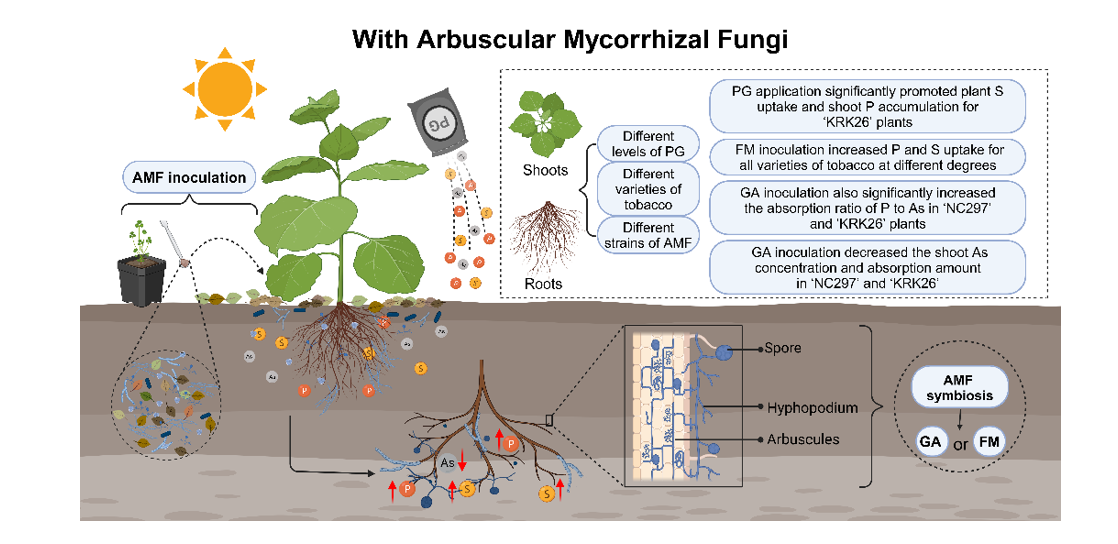
AMF can resist metal pollution to some extent. To solve the problem of PG storage and to reduce the accumulation risk of metals in agricultural production, protect the security of the agricultural ecological environment and its sustainable development, we used GA and FM for testing. Tobacco is one of the main economic crops of Yunnan Province. Therefore, we selected three tobacco varieties commonly planted in Yunnan Province as test materials. This study investigated the synergy of PG addition and AMF inoculation on the growth and nutrient uptake of tobacco and the ability to withstand the risk of arsenic pollution. It is expected to provide a new and more effective method for the use of PG in agricultural soils in southern China, especially in those agricultural soils with S and P deficiency in Yunnan Province.