Sugar beet pulp (SBP), a by-product of sugar production, is an abundant cellulose-rich, low-lignin biomass that has potential for value-added products in biorefineries. SBP consists, on a dry weight basis, of approximately 60 to 80% of polysaccharides, where 40% is cellulose, 30% hemicellulose, and 30% pectin. The two other major components are protein and lignin, which constitutes 9 and 4-6%, respectively. (1,2). Of this low-lignin biomass, the main phenolic components are gallic acid, epicatechin, and quercetin-3-O-rutinoside (3). In addition, ferulic acid decorates the arabinan and galactan side chains of pectin (4).
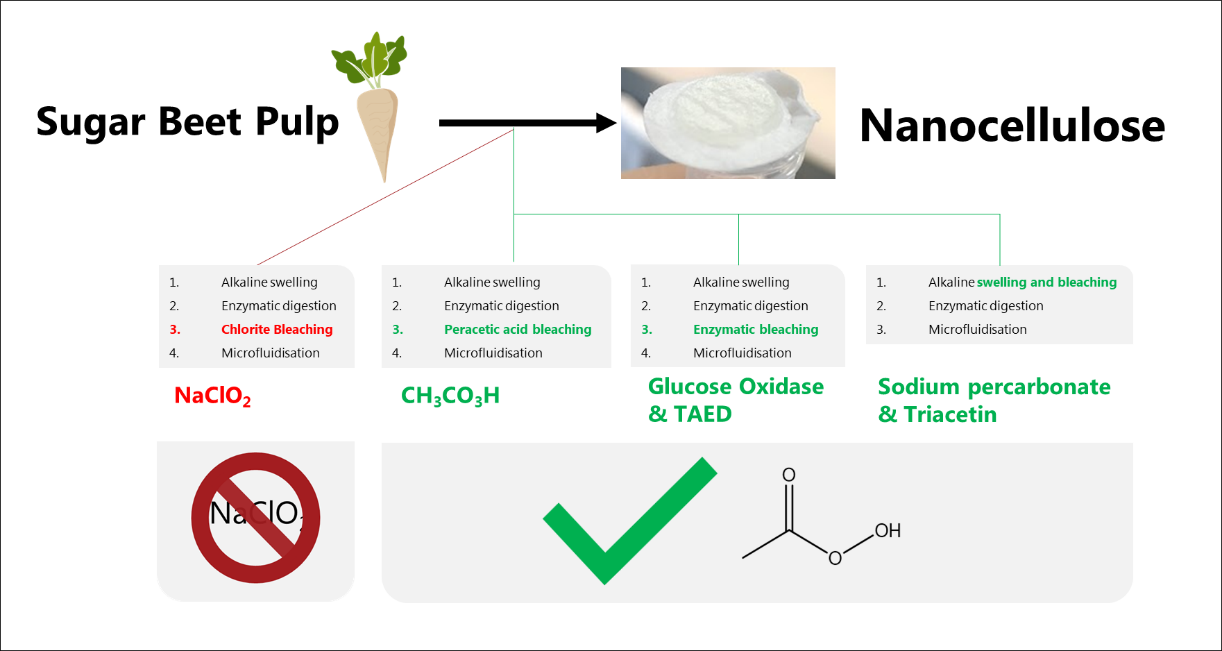
Cellulose, the main polymer in SBP, can be made into cellulose nanofibers (CNF) that can be used as thickeners, emulsion stabilisers, fillers in papers and biocomposites, among other applications (5). There are several methods to produce CNFs from SBP, with the differences being in pretreatments and methodology (6–8). An enzymatic approach published by Perzon et al. (2020) starts by swelling the SBP in sodium hydroxide, followed by digestion with mainly pectinases and hemicellulases, to be oxidised by sodium chlorite (SC), to lastly, being microfluidised. The oxidation, also known as bleaching, should remove lignin and molecules that are coloured or give rise to discoloration (9), and also helps with fibrillation (10). However, the use of chlorite is problematic due to production of chlorine gas which is why totally-free chlorine (TCF) methods, among other reasons, have been developed.
Among several different TCF methods, three common ones are the use of peracetic acid (PAA) (8), hydrogen peroxide (HP) (2), and hydroxyl radicals (11). Peracetic acid in solution creates a mixture of peracetic acid, acetic acid and hydrogen peroxide (12). Hydrogen peroxide oxidises ester bonds, introducing hydroxyl groups that can further be oxidised into carboxyl group like aldehydes and ketones (13,14). Hydrogen peroxide, in the presence of a catalyst like Fe2+ or Cu+, breaks down into hydroxyl radicals. This is also known as the Fenton reaction. Hydroxyl radicals can oxidise glycosidic bonds, both in pectin and hemicellulose (15,16) and can create peroxyl radicals in the presents of polysaccharides that cleave low-molecular polymers (17). Notably, the energy needed to cleave peracetic acid is lower than hydrogen peroxide, which is why hydroxyl radicals are easier created from peracetic acid than hydrogen peroxide (18). Nonetheless, hydroxyl radicals have a brief half-life and can only travel roughly the equivalent of two glucose residues in a cellulose chain (19). In comparison to peracetic acid and hydroxyl radical bleaching, sodium chlorite targets the phenolic groups, or the methyl and methylene groups in allylic position. Chlorite also oxidises the reducing ends of polysaccharides. (20)
It is also possible to generate the oxidising agent peracetic acid in situ. This is done by the usage of hydrogen peroxide and a hydrogen peroxide activator. The activators react with the hydrogen peroxide to produce peracids, which is favourable due to the peracids higher redox potential and stronger oxidising properties. Several activators have been researched and used, and two of them are tetraacetylethylenediamine (TAED) and triacetin. TAED is widely used in industrial processes but is more complex to synthesise and has lower solubility than triacetin. (21,22) Sodium percarbonate (SPC) can be used instead of pure hydrogen peroxide to generate peracid in situ with TAED or triacetate. In water, SPC slowly decompose into hydrogen peroxide. This creates a steady process of peracids instead of the short-lived reactive species hydrogen peroxide produces. Additionally, TAED reacts better in slight alkaline solutions, which SPC can offer. (21) Peracetic acid is also possible to create enzymatically in situ. While keeping the hydrogen peroxide activator in the solution, hydrogen peroxide is replaced with glucose oxidase, EC 1.1.3.4. Glucose oxidase catalyses the conversion of glucose to gluconic acid, whilst reducing molecular oxygen to hydrogen peroxide (23). Therefore, in the presents of SBP where glucose is available, glucose oxidase should generate small amount of hydrogen peroxide. This concept has been shown to work in previous studies of bleaching of cotton (24,25).
In this work to improve our previous CNF production method from SBP (7,26), it is hypothesised that sodium chlorite can be replaced with an environmentally friendly oxygen-based bleaching step, with little to no comparative loss in whitening or physical properties. To investigate this, peracetic acid and hydrogen peroxide, as a peroxyl and free-radical oxidants respectively, were compared to sodium chlorite oxidation for the production of CNF suspensions and their subsequent casted films. The bleaching of CNF was equal for peracetic acid and sodium chlorite; however, hydrogen peroxide darkened the suspension. This did not seem to affect the viscosity, where the three suspensions were similar. However, it could be seen that the elongation before the breakpoint of the film, where peracetic acid bleached CNF was used, decreased. Lastly, based on the above-mentioned findings, in situ generation of peracetic acid, both chemically and enzymatically, was tested and showed to bleach the CNF to the same whiteness as exogenously supplied peracetic acid.