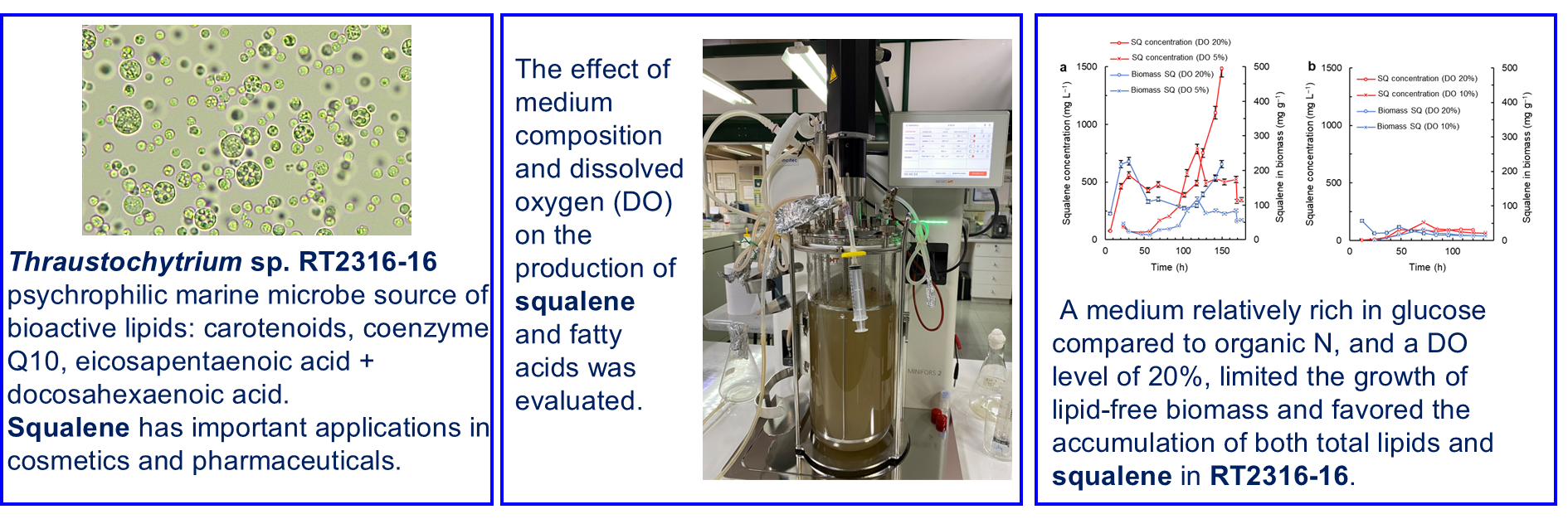
Some thraustochytrids accumulate lipids and other compounds of commercial interest, including the long-chain omega-3 polyunsaturated fatty acids such as EPA and DHA, and the triterpenoid hydrocarbon squalene. Some of these products are currently sourced from oils of wild-caught marine fish, a mode of production that is considered ecologically unsustainable (Chi et al., 2022). For example, most of the squalene is obtained from shark liver oil. Potentially sustainable alternative sources are microbial oils such as thraustochytrid lipids. Commercial production of thraustochytrid-derived DHA has proven successful (Chi et al., 2022), suggesting that other microbial oils have the potential to be commercialized. Hence the rationale for the present study on production of marine microbial lipids.
The quantity and composition of the lipids in microbial biomass is highly sensitive to the nutrients provided in the culture medium and the other culture conditions. In Thraustochytrium sp. RT2316-16, the focus of the present study, the culture conditions were previously shown to affect the production of EPA, DHA, carotenoids, and phospholipids in shake flasks (Leyton et al., 2022; Valdebenito et al., 2023). Shake flask culture does not typically allow any level of control of the concentration of dissolved oxygen (DO) in the medium. Therefore, the present work was carried out in a stirred tank bioreactor at various controlled concentrations of dissolved oxygen to elucidate the impact of oxygen concentration on the production of total lipids, fatty acids and squalene. As the concentration of metabolically active microbial biomass increased with growth, the volumetric oxygen consumption rate in the culture increased. To compensate for the increased consumption of oxygen, the oxygen transfer rate in the bioreactor was automatically increased to ensure that the measured dissolved oxygen concentration remained at the controlled value. A cascaded control combining increased agitation speed of the mixing impeller and the air flow rate was used to achieve effective control of the dissolved oxygen concentration.
The growth kinetics of the lipid-free biomass and the production of total lipids were found to be strongly influenced both by the DO concentration and the nutritional composition of the culture medium. For growth in the medium M1, a relatively high dissolved oxygen concentration (DO = 20% of air saturation) promoted accumulation of total lipids in the biomass (Table S1; see Supplemental Material) compared to lower oxygen levels. Although a lower DO (10% of air saturation) satisfactorily supported the growth of the lipid-free biomass, the total lipids in the biomass were reduced.
In oleaginous microorganisms, the accumulation of triacylglycerol lipids typically occurs after cell growth has ceased due to exhaustion of some key nutrient (e.g., nitrogen, phosphorus) other than the carbon source. Once a key non-carbon nutrient is missing, the available organic carbon can no longer support cell growth but continues to be used to build up reserves of lipids that do not contain the missing nutrient. For example, triacylglycerols are comprised of only carbon, oxygen and hydrogen. Similarly, squalene is comprised of only carbon and hydrogen. The cessation of growth of the lipid-free biomass in the medium M1 with the DO controlled at 20% was not due to a depletion of glucose or organic nitrogen (Or-N) although the uptake rates of both glucose and Or-N were affected once growth ceased (Fig. 1a). The observed cessation of growth may have been due to possible production of some growth-inhibitory metabolite, or generation of reactive oxygen species in a high-oxygen environment, and/or the depletion of some essential component in the Or-N fraction of the nitrogen source (yeast extract). The arrest of the lipid-free biomass growth was transient, and the growth resumed after a short period (Fig. 1a). A transient arrest of growth, or a diauxic growth (or diauxie) pattern, is consistent with complete consumption of a readily metabolizable nutrient such as a component of Or-N, followed by an adaptation period of little or no growth during which the microorganism builds the enzyme machinery necessary for metabolizing the other available nitrogen-containing components within the Or-N mixture.
Compared to the medium M1, the medium M2 had a higher concentration of Or-N but less glucose. In M2, the effect of the DO concentration on production of the lipid-free biomass was opposite to that seen in the medium M1, i.e. a higher concentration of dissolved oxygen (DO = 20%) promoted the growth of lipid-free biomass and the phenomenon of transient arrested growth did not occur. This concurred with the earlier inference that depletion of some component of Or-N was responsible for the temporarily arrested growth in the medium M1 that was low in Or-N compared to the medium M2. The relatively lower concentration of the lipid-free biomass in the medium M1 was an apparent effect of a limited supply of some essential component of Or-N, possibly an amino acid of the yeast extract. A higher concentration of Or-N alleviated this limitation in the medium M2. Amino acids contain both nitrogen and carbon and can be directly used for growth.
Regardless of the DO concentration and the initial concentrations of glucose and Or-N, the rate of consumption of Or-N showed sharp variations at certain times during the batch culture. This was likely related to preferential consumption of some components of the yeast extract, with the others being consumed after the preferred component was no longer available. These changes in the nitrogen components being metabolized may have promoted an increased accumulation of total lipids in the biomass (Fig. 1a) and may also have affected the composition of the fatty acids in the lipids.
In earlier studies in shake flasks without control of the dissolved oxygen concentration, the concentration of the lipid-free biomass in medium M1 was 4.3 g L–1 and the concentration of the total lipids was 1.7 g L–1 (Valdebenito et al., 2023). Also in shake flasks, the concentration of the lipid-free biomass in medium M2 was 3.7 g L–1 and the concentration of the total lipids was 0.4 g L–1 (Valdebenito et al., 2023). These concentrations were comparable to those obtained in the present work with a low dissolved oxygen concentration (DO = 5%) in medium M1 (i.e., lipid-free biomass concentration = 4.9 g L–1, and total lipids = 1.2 g L–1). In the less oxygenated environment (DO = 10%), in medium M2 in the present work, the lipid-free biomass concentration was 4.3 g L–1, and the total lipids concentration was and 0.5 g L–1. This comparison suggests that an accurate evaluation of the potential of thraustochytrids as producers of lipids requires controlled oxygen cultures; the conventional shake flask culture is unsatisfactory. As thraustochytrids are obligate aerobes, the oxygen concentration in a culture can reasonably be expected to critically influence their metabolism, as observed in the present work.
The data showed that the concentrations of EPA and DHA in cultures with a constant concentration of dissolved oxygen followed similar time-dependent variations. This may suggest that DHA was produced via elongation–desaturation pathway in which EPA is an intermediary; however, the elongation–desaturation pathway lacks certain omega-3 fatty acids (e.g., a-linoleic acid, C18:3D9,12,15; stearidonic acid, C18:4 D6,9,12,15; and eicosatetraenoic acid, C20:4 D8,11,14,17) which were not found in RT2316-16. Therefore, in RT2316-16 EPA and DHA were most likely synthesized from the omega-6 fatty acid arachidonic acid (C20:4 D5,8,11,14) as has been reported in some unrelated photosynthetic marine microorganisms (Guihéneuf et al., 2013). In RT2316-16 cultures, the highest concentrations of EPA and DHA occurred simultaneously during growth of the lipid-free biomass while Or-N was being consumed. This suggested a possible contribution of amino acid metabolism to the synthesis of polyunsaturated fatty acids, or a requirement of these fatty acids by actively growing cells. In fact, long-chain polyunsaturated fatty acids such as EPA and DHA are known to be essential for maintaining the required fluidity of the membranes of cold-water marine microbes (Yoshida et al., 2016), suggesting an essential requirement of these fatty acids for the cells to build the various internal and external membranes during multiplication.
Although a low Or-N concentration (< 1 g L−1) could stop growth of the lipid-free biomass (Fig. 1b, Fig. 3b), the conditions that triggered the accumulation of total lipids in the biomass seemed to depend on the DO concentration. The results did show an accumulation of the total lipids in the biomass after the Or-N had declined to less than 1 g L−1, and these lipids were rich in the fatty acids C16:0 and C18:1 (Fig. 1d; Fig. 3c, d; Fig. 5b). Glycerol proved to be a good carbon source for producing lipids rich in saturated fatty acids (C16:0 and C18:0). The high rates of production of these fatty acids (Fig. 3c, d) resulted in their accumulation in triacylglycerols as they could not undergo elongation and desaturation sufficiently rapidly. Hence, the concentrations of EPA and DHA increased relatively slowly. In a plausible scenario, the metabolism of glycerol may have promoted a more rapid consumption of the Or-N, as the latter could supply both carbon and nitrogen. A more rapid consumption of Or-N was apparent in the oxygen-rich (DO = 20%) environment in glycerol-based medium (Fig. 3). Once the Or-N had been depleted, glycerol was metabolized for producing C16:0.
When lupine extract was the source of Or-N, most of the Or-N was consumed within 24 h, and the subsequent consumption of glucose resulted in production of C16:0 (Fig. 5). Although this pattern was comparable to when yeast extract was used to provide Or-N, the glucose–lupine and glycerol–yeast extract cultures had some differences: the concentration of C16:0 was lower, and it was produced more slowly in the glucose–lupine culture.
Squalene is an intermediate metabolite in the sterol synthesis pathway. The products of this pathway influence properties of cell membranes such as fluidity and permeability. Thraustochytrids are known to produce sterols (Bi et al., 2023; Ishibashi et al., 2023; Menzorov et al., 2024), although there is no specific information on production of sterols by Thraustochytrium sp. RT2316-16. In related thraustochytrids such as Schizochytrium (now Aurantiochytrium; Chi et al., 2022) sp. S31, sterols such as cholesterol, stigmasterol, lanosterol, and cycloartenol are produced (Bi et al., 2023). The biosynthesis of sterols and fatty acids in some thraustochytrids appears to be co-regulated. For example, genetic modifications for increased production of DHA have reduced production of squalene and sterols in Schizochytrium (now Aurantiochytrium; Chi et al., 2022) sp. HX-308 (Ren et al., 2015). Conversely, modifications to the mevalonate pathway for increased production of squalene and carotenoids have reduced the amount of DHA in the biomass of in Schizochytrium sp. HX-308 (Huang et al., 2021).
In the absence of nutrient limitations (including oxygen limitation), squalene is unlikely to accumulate in the biomass as it does not participate in other metabolic pathways. Nonetheless, an imbalance between the rate of synthesis of squalene and its consumption through oxidation by squalene monooxygenase or squalene epoxidase (Bi et al., 2023) could result in accumulation of squalene. The rates of enzymatic reactions depend both on the concentrations of the enzymes and the concentrations of the substrates, farnesyl pyrophosphate and squalene in this case. Farnesyl pyrophosphate is produced in the mevalonate pathway in which 3-hydroxy-3-methylglutaryl-coenzyme A reductase (HMGR) is the rate limiting enzyme in Aurantiochytrium sp. 18W-13a (Yang et al., 2022). The HMGR activity in the strain 18W-13a strongly correlated with the squalene content. If a similar scenario applied to RT2316-16, anything that increased the flux through the mevalonate pathway (e.g., an excess of acetyl-CoA, the starting metabolite of the pathway), would promote accumulation of squalene. Availability excess acetyl-CoA is also necessary for accumulation of lipids. In RT2316-16 the conditions that promoted lipid accumulation were the medium M1 with a high oxygen level (DO = 20%) and the medium M3 with the DO levels of ≥10%.
Dissolved oxygen level and the composition of the culture medium substantially influenced the squalene content in the biomass (Fig. 6). The conditions that promoted the accumulation of total lipids (i.e., the medium M1 with either glucose, or glycerol, and a DO level of 20%), also promoted the accumulation of squalene. The highest observed concentrations of total lipids and squalene were 1485 ± 63 mg L–1 and 906 ± 45 mg L–1 (Fig. 6a), respectively. The effect of the dissolved oxygen concentration on the squalene content of the biomass of RT2316-16 was different compared to data reported for other thraustochytrids. For example, in the thraustochytrid ACEM 6063, possibly Schizochytrium (or Aurantiochytrium) sp.), a low level of dissolved oxygen (DO = 5%) promoted squalene accumulation to around 2 mg g–1 in the biomass (Lewis et al., 2001). Squalene accumulation under low oxygen was hypothesized to be associated with oxygen inhibition of certain downstream enzymes that consumed squalene to generate the other metabolites needed for the synthesis of sterols (Lewis et al., 2001).
When RT2316-16 was cultured in a medium that combined a high concentration of Or-N and a low concentration of glucose (i.e., the medium M2), the biomass was low in squalene and total lipids, irrespective of the dissolved oxygen concentration used, but the available nutrients did not limit the growth of the lipid-free biomass at the higher oxygen level (DO = 20%; Fig. 2a). The relatively high levels of EPA and DHA compared to the other fatty acids (C16:0, C18:0, C18:1cis; Fig. 2c) and the low squalene content of the biomass (Fig. 6b), suggested a combination of the medium M2 and a high dissolved oxygen level (DO = 20%) if the objective was to produce polyunsaturated fatty acids rather than squalene, as often wanted in thraustochytrid cultures (Ren et al., 2015).
The fed-batch culture (Fig. 4) with the tested feeding strategies did not prove useful for producing squalene-rich biomass, possibly because there was no nutrient limitation as was evidenced by a continuous increase in the concentration of the lipid-free biomass during the entire culture. The relatively low lipid content of the biomass produced under these conditions was also consistent with an absence of a growth limitation.
In studies with a different thraustochytrid (Schizochytrium sp. S31; Schütte et al., 2024) squalene production was compared among batch, fed-batch and continuous culture operations. Continuous culture implemented with a relatively high dilution rate (dilution rate = 0.025 h− 1) resulted in biomass with the highest squalene content (39.7 ± 1.3 mg g–1). In a steady-state continuous culture, the specific growth rate of the biomass is identical to the dilution rate (Chisti, 2010), meaning that the growth rate was high. In such high dilution rate cultures, the steady state concentrations of all nutrients in the culture vessel tend to be high, implying an absence of nutritional stress. Although the most squalene-rich biomass was produced in continuous culture, the highest concentration of squalene was produced in a fed-batch operation with pulsed feeding of glucose (Schütte et al., 2024). This suggests that a more comprehensive future evaluation of feeding strategies in fed-batch operations may be worthwhile for enhancing the productivity of squalene in Thraustochytrium sp. RT2316-16.