Materials
The brown rice (1st grade of Chinese National Standard 2424 (CNS, 2019)) was purchased from Golden Rice Castle Co., Ltd. (Chiayi, Taiwan). AGV Products Co. (Chiayi, Taiwan) was provided as the source of oat raw material for this study, the OBP (oats’ that originated in Australia and were harvested in 2022). Unless otherwise stated, all chemicals were purchased directly from Sigma-Aldrich® (Merck KGaA, Darmstadt, Germany) and used without further processing.
Extrusion processing parameters
The grains cake biscuit machine (Mibo-C1, YUAN CHUANG Food Machinery Co., Ltd., New Taipei City, Taiwan) was utilized in this study. The specific conditions were: mold hole diameter of 3 mm, screw speed of 50 HZ, feed rate at 16 rpm, sleeve temperature of 80°C, and cutter speed of 2 rpm. The above conditions were obtained through preliminary experiments.
Oat residues drying and extrusion treatment prior to processing
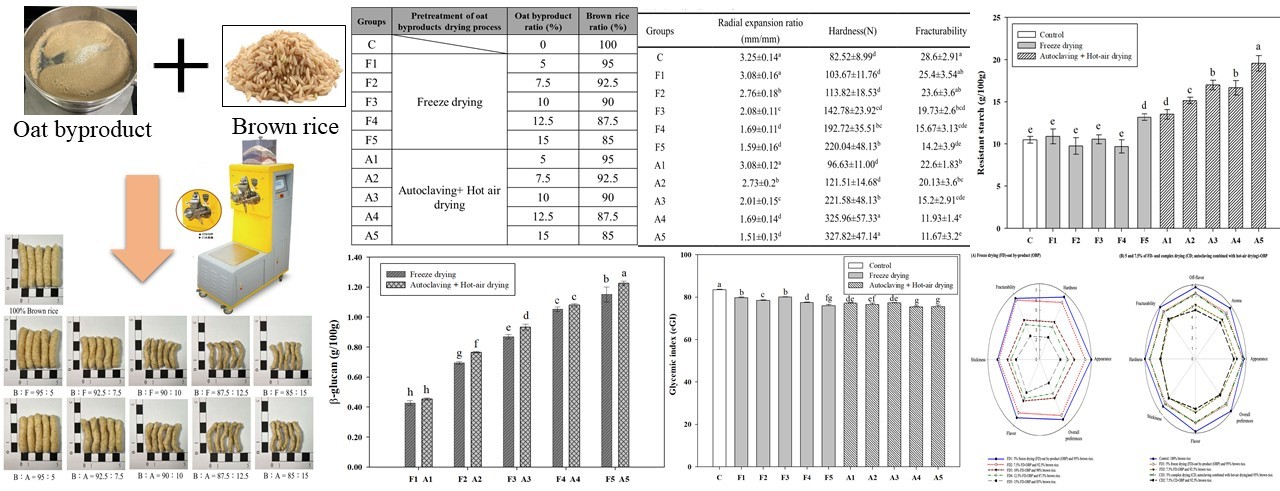
The raw material OBP in this study was dried by FD and CD, respectively, due to the high moisture content of OBP, both of which were controlled to less than 5%. The dried OBPs were packed in aluminum zipper bags with desiccant and stored in a desiccator. Subsequently, the raw material formulations of extrusion feed were mixed with brown rice in different ratios of OBP (5, 7.5, 10, 12.5, and 15%), respectively. Detailed grouping and composition as shown in Fig. 1.
Determination of radial expansion ratio (ER)
ER was determined following the method described by Cheng et al. (2024). Each group of random sampling (n = 20). Afterward, the diameter of the samples was measured using an electronic digital vernier caliper. The samples were rotated 90° and measured again while averaged to obtain the expanded diameter of the sample (mm). Finally, the ER (mm/mm) was calculated by dividing the average expansion diameter of each group by the hole diameter (3 mm) of the extruder.
Textural profiling analysis (TPA)
The TPA of the sample was determined utilizing the methodology described by Huang et al. (2023) and Lee et al. (2024), with some modifications. This study used a texture analyser (TA-XT2, Stable Micro Systems, Godalming, UK) with a P/50 probe (n = 20), and the specific parameters included compression mode; pre-test speed was 1 mm/sec; test speed was 2 mm/sec; post-test speed was 10 mm/sec; distance was 2 mm; and trigger force was 5 g. The hardness (N) and fracturability values were determined for the samples. The unit of fracturability was defined as the number of positive peaks within the sample.
Determination of bulk density (BD)
The sample’s BD was determined using the method described by Lin et al. (2023) with minor modifications. Glass beads of known volume (290 mL) and a measuring cylinder (500 mL) were prepared, followed by sampling (5 g of each group) and weighted. The glass beads were initially placed at the bottom of the cylinder. Next, one layer of glass beads and one layer of samples were stacked on each other. The highest part of the cylinder was covered in glass beads, and the space inside was filled with glass beads. The measurement of the height of the cylinder was recorded, resulting in the calculation of BD by dividing the weight by the volume.
Determination of β-glucan
The β-glucan in the samples was determined using the Megazyme β-glucan (Mixed Linkage) assay kit (Neogen Co. Lansing, MI, USA). The sample (100 mg) was weighed into a tube and extracted with 10 mL of 50% ethanol at 80°C for 10 min, then centrifugation (1,000 ×g for 10 min) with a centrifuge (Megafuge 16R, Thermo Fisher Scientific, Waltham, MA, USA) to remove the supernatant, repeating this procedure twice. Then, the residue was added with 50% ethanol 0.2 mL mixed by oscillation, and then 20 mM phosphate buffer solution 4 mL was added and remixed. Next, the solution was heated in a boiling water bath for 1 min, then taken out, oscillated evenly, then placed in a boiling water bath for 2 min, and oscillated evenly again. Equilibrate the tubes in a 50°C water bath, then add 0.2 mL of lichenase solution with shaking to mix, followed by reaction for 60 min in a 50°C water bath. During the reaction, oscillation was required every 15 min for the enzymatic reaction to be fully activated. Afterward, 5 mL of 20 mM sodium acetate buffer solution was added to each tube and shaken evenly, allowing it cooled to 25°C, then centrifuged (1,000 ×g for 10 min). Each sample was divided into 3 tubes (all containing 0.1 mL of the above supernatant), where 2 tubes continued to react with 0.1 mL β-glucosidase, while the remaining tube was added 0.1 mL of 50 mM acetic acid buffer solution as a blank value. Next, all tubes were added with 3 mL of glucose oxidase-peroxidase mixed buffer solution (glucose oxidase > 12,000 Unit (U)/L, peroxidase > 650 U/L, 4-aminoantipyrine (81.3 mg/L)), followed by a 50°C water bath reaction for 20 min. Finally, the absorbance of each sample at 510 nm was determined using a microplate spectrophotometer (BioTek Epoch 2, Agilent Technologies, Inc., Santa Clara, CA, USA). The following equations were used to calculate β-glucan content in the samples.
$$\:\beta\:-glucan\:content(\%,wet\:basis)=\varDelta\:E\times\:F\times\:94\times\:\frac{1}{1000}\times\:\frac{100}{W}\times\:\frac{162}{180}\left(1\right)$$
$$\:\beta\:-glucan\:content(\%,dry\:basis)=\frac{Equations\left(1\right)}{100-Moisture\:content\left(\%\right)}\left(2\right)$$
where,
△E: absorbance value of the reaction solution -absorbance value of the blank solution F: Conversion factor for glucose content (µg) (as 100 µg glucose/100 µg glucose absorbance)
94: Volume correction factor (0.1 mL of analytical solution from 9.4 mL)
1/1000: Conversion value of µg and mg.
W: weight of test sample (mg)
162/180: glucose conversion factor
Determination of resistant starch (RS) and non-RS
The RS and non-RS determination was performed using the Megazyme® RS assay kit (Neogen Co. Lansing, MI, USA) and following the standard operating procedures provided by the manufacturer. The sample (100 mg) was milled to 40 mesh, placed in a 50 mL centrifuge tube, and added 4 mL of pancreatic α-amylase reagent (10 mg/mL AMG). The mixture was mixed and reacted for 16 h at 37°C in a water bath. 4 mL of ethanol (99%) was added and centrifuged (6,000 ×g, 10 min), then the supernatant was collected. The residue was mixed with 8 mL of 50% ethanol, centrifuged at 6,000 ×g for 10 min, and then separated and collected from the supernatant. This step was repeated twice. The above residue was mixed with 2 mL of 2 M potassium hydroxide, stirred in an ice bath for 20 min, and then added into 8 mL of acetic acid buffer solution (1.2 M, pH 3.8). Subsequently, 0.1 mL of the supernatant was incorporated with 3 mL GOPOD reagent, then reacted at 50℃ for 20 min while the absorbance was measured using a microplate spectrophotometer (BioTek Epoch 2, Agilent Technologies, Inc., Santa Clara, CA, USA) at 510 nm. As mentioned above, the standard was 0.1 mL of 100 mg/mL glucose, and the procedures were repeated. Subsequently, the RS content of the sample was ascertained by utilizing the subsequent formula:
$$\:Resistant\:starch\left(RS<10\%;\frac{g}{100gsample}\right)=Absorbance\:value\:of\:the(Sample-Control)\times\:\raisebox{1ex}{$Absorbance\:value\:of100\mu\:gglucose$}\!\left/\:\!\raisebox{-1ex}{$100mg$}\right.\times\:9.27\left(3\right)$$
Regarding the determination of non-RS content, the above-prepared supernatant was repeated in the same manner as RS's, and the following equation calculated the non-RS content in the sample.
Determination of digestibility (In vitro)
The digestibility of the sample, which consisted of both rapidly digested starch (RDS), slowly digestible starch (SDS), and estimated glycemic index (eGI), was assessed using the methodology described by Wang et al. (2023). The mixture, consisting of 1.82 g of porcine pancreatic α-amylase reagent, was then supplemented with 6 mL of distilled water, subjected to stirring for 15 min, and centrifuged at 1,500 ×g for 10 min. Subsequently, 5 mL of supernatant and 62.5 µL of amyloglucosidase solution (AMG; 3,300 U/mL) were mixed uniformly for the preparation. Next, 100 mg of the sample was mixed with pH 5.2, 4 mL of 0.1 M sodium acetate buffer solution, and 1 mL of the amylase mentioned above. The mixture was placed in a water bath for 0, 20, 30, 60, 90, 120, 150, and 180 min (with 120 rpm shaking), followed by a sampling of 0.1 mL for each. Afterward, 0.9 mL of 95% ethanol was added to terminate the reaction. Then, centrifuged at 1,500 ×g for 10 min, 0.1 mL of the supernatant was taken, and 3 mL of glucose oxidase-peroxidase aminoantipyrine (GOPOD) reagent was added. The absorbance value was determined using a microplate spectrophotometer (BioTek Epoch 2, Agilent Technologies, Inc., Santa Clara, CA, USA) at a wavelength of 510 nm. The RDS, SDS and eGI of the sample were calculated using the following equations:
$$\:Rapidly\:digestible\:starch\left(RDS;\%\right)=\left(G20\right.-\left.G0\right)\times\:0.9\left(4\right)$$
$$\:Slowly\:digestible\:starch(SDS;\%)=\left(G120\right.-\left.G20\right)\times\:0.9\left(5\right)$$
$$\:Hydrolysis\:index\left(HI;\%\right)=Area\:below\:hydrolysis\:curve\:of\frac{Sample}{Standard}\times\:100\left(6\right)$$
$$\:Estimate\:of\:the\:glycemic\:index\left(eGI\right)=39.71+0.549\times\:HI\left(7\right)$$
Sensory evaluation
The sensory evaluation methods were based on the descriptions of Huang et al. (2024a) with minor modifications. For this study, 30 panelists were randomly recruited based on consumer type (individuals who were not food science professional-trained personnel) and then evaluated the products based on preference and purchase intention. The evaluation was based on a 9-point Hedonic Scale, which panelists the product's appearance, aroma, off-flavor, fracturability, hardness, stickiness, flavor, and overall preferences. The score includes one point for immensely dislike, five for no comment (not about liking or disliking), and nine for extremely like. Before conducting sensory evaluations, we ensured that participants were given clear instructions regarding informed consent. We informed them of our adherence to established ethical guidelines and obtained their consent to participate in the evaluation. This approach was adopted to ensure that participants were fully informed about the process and could make an informed decision about whether to participate in this sensory evaluation.
Statistical Analysis
Each trial underwent at least three repetitions, and the outcomes were presented as the mean ± standard deviation (SD). This study used the statistical software of XLSTAT (version 2019, Lumivero, Denver, CO, USA) with the one-way variance analysis (ANOVA). Duncan's multiple-range test was used to compare the groups' variability. It was determined that the difference was significant when p < 0.05 was observed.