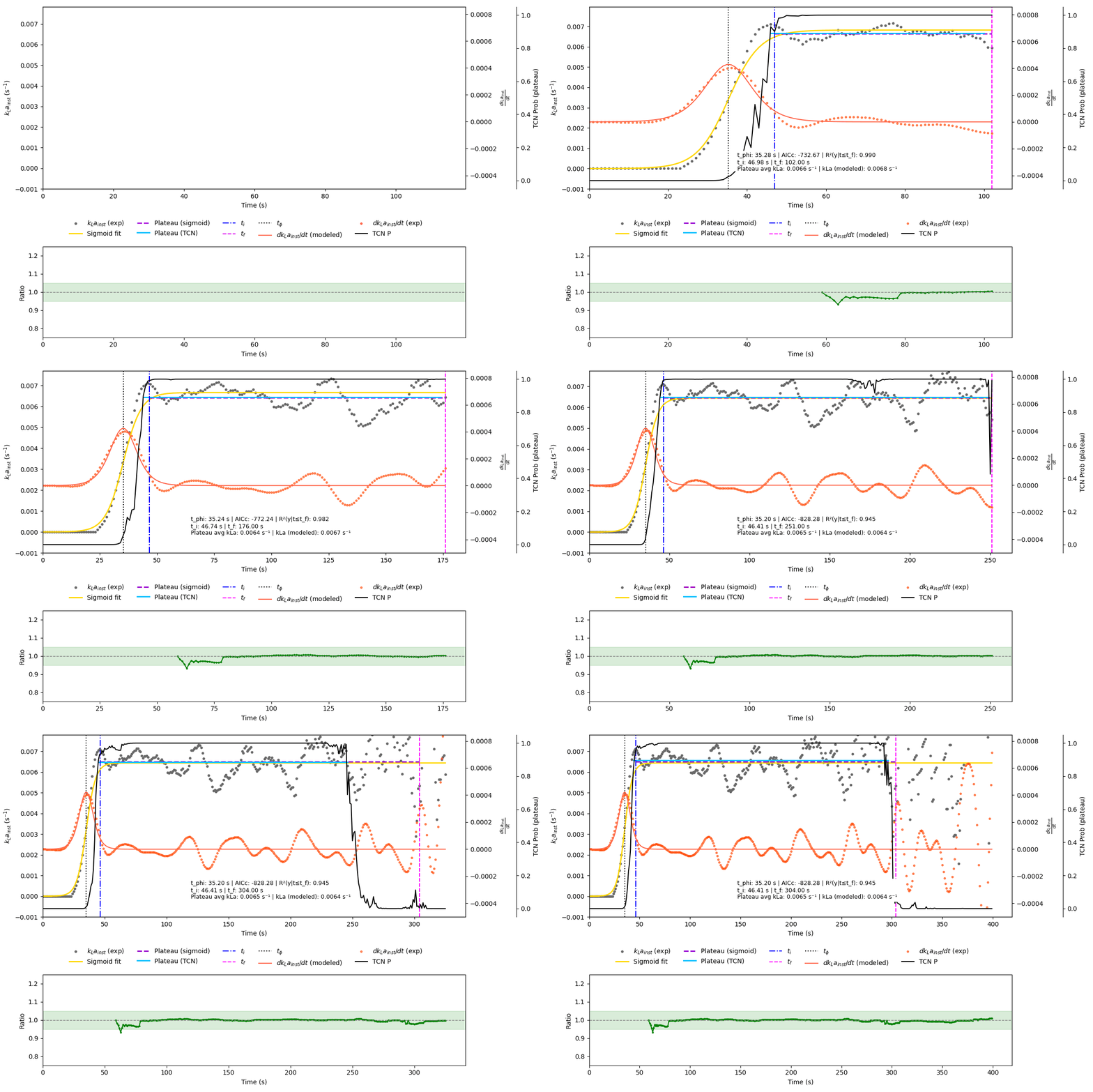
The volumetric oxygen transfer coefficient (\(\:{k}_{L}a\)) is a key parameter governing oxygen availability in bioprocesses and is critical for optimizing reactor performance. Its determination from gassing-out experiments is often hampered by subjectivity in data selection. This study presents a hybrid framework that integrates a phenomenological sigmoid model with a temporal convolutional network (TCN) for automated and reproducible \(\:{k}_{L}a\) estimation. A logistic sigmoid model was formulated to describe the temporal profile of the instantaneous transfer coefficient (\(\:{k}_{L}{a}_{inst}\)). A derivative analysis of the model established deterministic criteria for segmenting the oxygen reabsorption curve into delay, steady-state, and dispersion regions. This method produced a coefficient of determination (R²) of 0.9996 between asymptotic model predictions and experimental plateau means for 80 experimental runs. Using this model, a reference dataset of 16,415 labeled curves was constructed from experimental and augmented data. A dilated TCN trained on this dataset identified the steady-state region directly from the \(\:{k}_{L}{a}_{inst}\) time series. The model achieved a mean average precision of 0.979 ± 0.032 on a blind test set. Temporal segmentation exhibited high accuracy, with median errors of − 1 s for plateau initiation and − 2 s for termination. The inference time for the TCN remained below 3 ms per sample, in contrast to 2.3 s for iterative sigmoid model fitting. The final architecture integrates the TCN for real-time plateau detection and the sigmoid model for interpretable validation. This approach eliminates manual data selection, improves reproducibility, and enables scalable deployment for high-throughput \(\:{k}_{L}a\) estimation in bioreactor systems.