3.1 Mechanism of IO-NPs and IO-NPs + C formation using fungal isolates
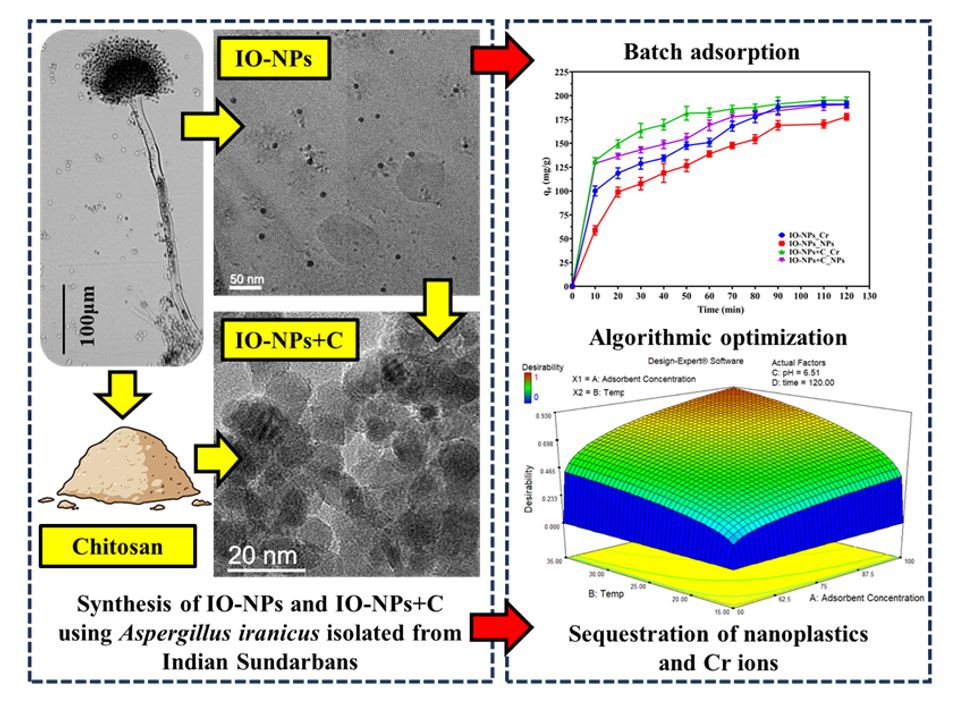
Fungal strains isolated from the rhizospheric sediment of Nypa fruticans were analyzed for colony morphology, including characteristics such as form, edge and elevation. Identification at the genus level was performed by examining the structures of conidiophores and conidia using taxonomic keys [30], as demonstrated in Fig. 1. The fungal cell-free filtrate (FCF) from 15 isolates as screened for its ability to synthesize nanoparticles using a Fe (NO3)3 solution. Among these, strain STSP9, identified as Aspergillus sp., exhibited rapid nanoparticle synthesis by reducing the iron salt solution within 5 minutes at 30°C ± 2°C. In contrast, the control experiment conducted in the absence of the fungal culture did not show any reduction, confirming the essential role of Aspergillus sp. in the nanoparticle synthesis process. Following nanoparticle formation, chitosan was extracted from STSP9 and integrated with the iron oxide nanoparticles (IO-NPs) to create a composite referred to as IO-NPs + C. The synthesis and assembly of the IO-NPs and the IO-NPs + C composite occurred in multiple stages (Fig. 1). In step I, NADH reductase initiated the reduction of the iron precursor salt, releasing Fe3+ and NO3− ions [31]. In step II, Fe3+ ions interacted with fungal extracellular proteins, leading to the formation of stable organic Fe (III) complexes [32]. In step III, hydrolysis of these Fe (III) complexes resulted in the formation of Fe(OH)3, which nucleated into Fe2O3 nanocrystals that precipitated as iron oxide nanoparticles [33]. Step IV involved the formation of the IO-NPs + C, where chitosan served as a stabilizing and matrix-forming agent. Chitosan, a natural polysaccharide derived from chitin, was dissolved in 1–2% acetic acid, forming a homogeneous, viscous solution [34, 35]. This acidic environment protonated the amine groups of chitosan, causing it to become positively charged and promoting solubility in the aqueous phase. In parallel, the synthesized iron oxide nanoparticles were suspended in distilled water and subjected to ultrasonication to ensure uniform particle distribution, preventing agglomeration. The chitosan solution and the iron oxide nanoparticle suspension were gradually combined under continuous stirring. The strong electrostatic attraction between the negatively charged iron oxide nanoparticles and the positively charged protonated chitosan allowed for efficient interaction and encapsulation of the nanoparticles within the polymer matrix [36]. This interaction facilitated the uniform dispersion of iron oxide nanoparticles throughout the chitosan matrix, forming a stable composite material [37]. To further enhance the mechanical strength and stability of the composite glutaraldehyde was introduced in minimal quantities as a cross-linking agent [38]. Glutaraldehyde forms covalent bonds between the amine groups of chitosan, leading to the formation of a three-dimensional network that reinforces the structural integrity of the composite. This cross-linking process is essential for preventing the premature release of nanoparticles from the chitosan matrix. The pH of the solution was then carefully adjusted using 0.1 M NaOH. This step was critical, as the alkaline conditions promoted the deprotonation of chitosan's amine groups, leading to the precipitation of the iron-chitosan composite [24]. In this process, the chitosan acts as a scaffold, providing a biocompatible matrix that stabilizes the iron oxide nanoparticles. For spectral analysis, the fungal cell-free filtrate (FCF) served as the positive control, while the iron precursor solution was used as the negative control, showing no significant spectral shift. Strain STSP9 was identified at the species level by sequencing the ITS region, producing a 546 bp sequence with high similarity to Aspergillus iranicus, confirmed via BLAST analysis. This sequence was deposited in the NCBI database under accession number MH824157.
3.2 Physical and chemical characterization of the nanoparticles and the nanocomposite
The characterization of IO-NPs and IO-NPs + C employs a suite of advanced analytical techniques to elucidate their structural, chemical, and magnetic properties (Figs. 2, 3 and Supplementary Fig S2). UV-Vis spectroscopy typically shows a distinct absorption peak in the range of 200–400 nm, attributed to surface plasmon resonance (SPR), indicating the formation of nanoparticles and their size-dependent optical characteristics. The IONPs + C emonstrates slight redshifts or variations in peak intensity, suggesting interactions between the chitosan matrix and the nanoparticles that may affect particle size or surface charge [39, 40, 16]. FTIR spectroscopy provides insights into functional groups (Fig. 3), with the strong Fe-O bond absorption band appearing between 580–630 cm− 1, indicative of hematite (Fe3O4) or maghemite (γ-Fe2O3). The composite reveals additional peaks related to chitosan, notably broad bands around 3200–3500 cm− 1 for hydroxyl (–OH) and amino (–NH₂) group vibrations, alongside amide I and II peaks between 1650 − 1560 cm− 1, confirming chitosan's coordination with iron oxide. Other notable peaks at 830 cm− 1, 1072–1074 cm− 1, 1394–1396 cm− 1, 1510–1512 cm− 1, and 3119–3144 cm− 1 correspond to C = O, O–H, N–O, and C–H groups, respectively [16, 18, 19, 39–42]. XRD patterns indicate (Fig. 3) the crystalline nature of IONPs, matching the rhombohedral structure of hematite (Fe2O3) as per JCPDS No. 24–0072, with characteristic peaks in the regions (012), (104), (110), (113), (024), (116), (122), (214), and (300). Peak broadening signifies the formation of nanoscale crystallites ranging from 2–20 nm, estimated using the Scherrer equation, while the presence of diffuse scattering in the composite reflects the amorphous nature of chitosan, preserving the crystalline structure of iron oxide[21, 43, 44]. Magnetic characterization via SQUID-VSM magnetometry reveals superparamagnetic behaviour of IO-NPs and IO-NPs + C at room temperature, with saturation magnetization (Ms) values between 2–8 emu/g, substantially lower than the bulk magnetite value of ~ 90 emu/g. This decrease is attributed to surface spin disorder from unsaturated surface iron coordination, finite size effects leading to a single magnetic domain structure, and the influence of the chitosan matrix, which spatially separates the nanoparticles, further attenuating their magnetic interactions [16, 20, 21, 45–47]. The M-H curves, measured within a field range of ± 6 T, demonstrate the absence of coercivity (Hc ≈ 0 Oe) and remanence (Mr ≈ 0 emu/g), affirming that the nanoparticles' magnetic moments can swiftly realign with an applied field without residual magnetization. FESEM provides high-resolution imaging of particle morphology (Supplementary Fig S2), showing pure IO-NPs as spherical or quasi-spherical particles with diameters of 10–30 nm. In the chitosan composite, nanoparticles are uniformly distributed, appearing as discrete, embedded entities within a smooth chitosan matrix. EDX mapping confirms the elemental composition, with prominent signals for Fe and O from IO-NPs and C and N from chitosan, while elemental mapping indicates a homogenous distribution of iron throughout the composite, demonstrating successful integration s[16, 20, 21, 48–50]. TEM reveals uniform particle sizes, typically 5–15 nm (Figs. 2a and 2b(i−iv)), with high-resolution images displaying lattice fringes corresponding to specific crystallographic planes, thus affirming the nanoparticles' high crystallinity. In the chitosan composite, TEM indicates encapsulation or coating of IO-NPs by the chitosan, often forming a core-shell structure with the polymer layer manifesting as a thin, amorphous coating around the nanoparticles, confirming effective surface modification and interaction [21, 51].
3.3 Batch adsorption study
The batch adsorption study of NPs and Cr ions onto IO-NPs and IO-NPs + C reveals complex adsorption kinetics and thermodynamics, which contribute to improved pollutant removal efficiencies (Fig. 4a-d). At an initial adsorbate concentration of 20 mg/L and an adsorbent dosage of 100 mg/L, the equilibrium adsorption capacities (qe) were calculated to be 191 ± 3.11 mg/g for Cr and 177.8 ± 3.6 mg/g for NPs on IO-NPs. Interestingly, the IO-NPs + C demonstrated even greater adsorption capacities, with qe values of 195.20 ± 3.33 mg/g for Cr and 190.50 ± 3.59 mg/g for NPs. Kinetic studies revealed rapid adsorption in the first 30 minutes of the 120-minute process, suggesting that the surface of the adsorbents possessed high affinity and an abundance of active sites in the early stages. As the process advanced, a slower rate of adsorption was observed as these sites became saturated, indicating a transition to a diffusion-controlled mechanism, where intraparticle diffusion becomes the dominant factor. This is particularly noticeable in IO-NPs + C, likely due to the additional binding sites provided by chitosan [51–53]. The study also examined the effect of adsorbent concentration, ranging from 20 to 120 mg/L, and found that optimal adsorption occurred at 100 mg/L (Fig. 4a, b and c). This concentration represents the ideal balance between adsorbate molecules and available active sites, preventing oversaturation and maintaining efficient surface interactions. Furthermore, the adsorption process was found to be highly pH-dependent, with maximum efficiency achieved at pH 2. Under acidic conditions, the surfaces of IO-NPs and IO-NPs + C are protonated, which enhances electrostatic attraction between the positively charged surface and the negatively charged Cr ions and NPs. As the pH increased, zeta potential analyses revealed that NPs maintained a stable negative charge (-20 to -64 mV), while the surface charge of IO-NPs and IO-NPs + C shifted from positive to neutral, slightly negative, near neutral pH levels (Fig. 4d). This behaviour aligns with the point of zero charge (PZC) of the adsorbents, confirming that the adsorption efficiency diminishes as surface charge neutrality is approached, reducing electrostatic interactions [54, 55]. Overall, both IO-NPs and IO-NPs + C are highly effective in capturing Cr ions and NPs, with IO-NPs + C exhibiting superior adsorption capacity. The enhanced performance of IO-NPs + C is attributed to the synergistic properties of chitosan, which not only increases surface area but also offers additional binding sites for adsorbates [56, 57]. This makes the composite particularly suited for applications in water purification and pollutant removal.
3.4 Effect of common ions and humic acid on adsorption of NPs and Cr on IO-NPs and IO-NPs + C
The effect of common ions and humic acid on the adsorption of NPs and Cr ions using IO-NPs and IO-NPs + C was thoroughly investigated at an adsorbent concentration of 100 mg/L, with an initial adsorbate concentration of 20 mg/L, over a contact time of 120 minutes (Fig. 5a-d). The results indicated that the presence of common ions had varying impacts on the adsorption capacity, with most anions exhibiting negligible effects. Notably, bicarbonate (HCO3−) demonstrated a pronounced influence; at a concentration of 5 mM, the removal efficiency for both NPs and Cr ions decreased by approximately 60%. This significant decline can be attributed to HCO₃⁻ acting as a buffer, which raises the pH from 5.5 to approximately 8.6, enhancing the negative charge on the adsorbent surface and resulting in electrostatic repulsion of negatively charged species like NPs. In contrast, other common ions (such as chloride, nitrate, and sulphate) induced only minor reductions in adsorption capacity, typically around 5–10%. This limited effect can be explained by the relatively weak binding affinity of these ions to the IO-NPs and IO-NPs + C, which does not substantially compete with the adsorption sites available for NPs and Cr ions. The observed minor decrease in removal efficiency suggests that these anions may possess a lower affinity for the IO-NPs and IO-NPs + C. Furthermore, the influence of humic acid concentrations on adsorption was assessed, revealing a significant decrease in removal efficiency. Even at a low concentration of 1 mg/L of humic acid, a reduction in removal percentage of 55–75% was recorded. This decline in adsorption capacity is attributed to the steric hindrances imposed by humic acid, which interferes with the effective aggregation and sedimentation of nanoparticles. The DLVO theory elucidates this phenomenon by suggesting that the presence of humic acid alters the interparticle interactions, increasing repulsive forces between the particles, thereby limiting their co-settling ratios [26]. Additionally, the stabilizing effect of humic acid on negatively charged IONPs and IO-NPs + C was confirmed by zeta potential measurements. The introduction of 1 mg/L of humic acid caused the zeta potential of IONPs and IO-NPs + C to shift from a neutral value of approximately + 2.85 mV to a significantly negative value of -20 mV. As humic acid concentration increased, the zeta potential became more negative, indicating enhanced stabilization and electrostatic repulsion between nanoparticles, which further inhibited their ability to adsorb NPs and Cr ions effectively.
3.5 Effect of NaOH on desorption of NPs and Cr ions and the reusability study on IO-NPs and IO-NPs + C
The desorption behaviour of NPs and Cr ions was investigated using varying concentrations of NaOH, ranging from 0.1 to 0.3 M (Supplementary Fig S3). The highest desorption efficiency was observed at 0.3 M NaOH, where the strong alkaline environment significantly enhanced the release of both contaminants from the adsorbent surfaces. The increased ionic strength and higher pH levels associated with 0.3 M NaOH facilitate the disruption of electrostatic interactions and hydrogen bonding between the adsorbates and the adsorbent, thus promoting effective desorption [19]. In a reusability study, both IO-NPs and IO-NPs + C demonstrated substantial stability, retaining their functionality across five adsorption-desorption cycles. However, a gradual decline in adsorption efficiency was noted, with the removal capacity decreasing to below 80% by the fifth cycle. This decrease can be attributed to potential fouling and loss of active sites on the adsorbent materials after multiple cycles, indicating a need for optimization in regeneration protocols to enhance long-term applicability in environmental remediation processes.
3.6 Thermodynamic and kinetic insights into the adsorptive removal of NPs and Cr ions
The adsorption behaviour of NPs and Cr onto IO-NPs and IO-NPs + C was systematically investigated through isotherm and kinetic studies at 288, 298, and 308 K. At 308 K, IO-NPs achieved maximum adsorption capacities qe of 526.31 mg/g for Cr ions and 270.27 mg/g for NPs, while IO-NPs + C exhibited even higher adsorption, reaching 625.12 mg/g for Cr ions and 333.31 mg/g for NPs (Fig. 6 and Supplementary Fig S4). The adsorption profiles followed the Freundlich isotherm model, indicative of a heterogeneous surface with varied energy sites and a multilayer adsorption mechanism, suggesting that the adsorption sites on both IO-NPs and IO-NPs + C have differential affinities and capacities for Cr ions and NPs.
The Freundlich isotherm (Fig. 6a and 6b) further implies that the adsorption mechanism is influenced by interactions beyond a simple monolayer saturation, accommodating multilayer adsorption on the uneven surface of the iron oxide nanoparticles and chitosan matrix. The enhanced capacity observed for IO-NPs + C at each temperature suggests that the chitosan component introduces additional active sites, potentially through amine and hydroxyl functional groups, thereby increasing surface heterogeneity and complexation potential [58, 59].
Kinetic analyses demonstrated a strong fit with the pseudo-second-order model (Fig. 6c and 6d) across all temperatures, indicating chemisorption as the primary adsorption mechanism. This is characterized by chemical bonds forming between the adsorbate and active sites on the IO-NPs and IO-NPs + C surfaces, likely through electron exchange or covalent interactions, particularly prominent due to the hydroxyl and amine groups present in chitosan. The temperature dependency observed in the pseudo-second-order kinetics also highlights the activation energy required for chemical bonding, suggesting that elevated temperatures enhance reaction rates by increasing the molecular interactions and mobility of Cr ions and NPs [60].
Thermodynamic parameters, including Gibbs free energy (ΔG), enthalpy (ΔH) and entropy (ΔS), revealed deeper insights into the adsorption mechanism (Supplementary Fig S4 and Table II). Negative values of ΔG at each temperature confirm the spontaneous nature of adsorption, while the increasingly negative ΔG with rising temperature supports an endothermic process that becomes more favourable at higher temperatures. This temperature-induced enhancement in spontaneity points to activated complex formation on the IO-NPs and IO-NPs + C surface, likely driven by stronger adsorbate-surface interactions at elevated thermal energy levels. The positive values of ΔS suggest an increase in randomness at the solid-liquid interface, which may reflect enhanced structural rearrangements within the adsorbent’s surface layers, optimizing the binding of Cr ions and NPs and thus improving adsorption efficiency[61].
7 Utilization of RSM and ANN for the validation of the batch experimental result for the IO-NPs + C for the NPs and Cr ions adsorption
In this study, the superior performance of the IO-NPs + C in batch adsorption experiments was evident when compared to IO-NPs alone. The chitosan matrix contributed additional active functional groups, such as amine and hydroxyl, enhancing surface interactions with Cr ions and NPs. This increased adsorption capacity, along with improved stability and stronger pollutant binding, positioned IO-NPs + C as the preferred adsorbent for further optimization. To explore the complex interaction of adsorption parameters, RSM and ANN were employed for multimeric analysis, providing a rigorous framework for process optimization and predictive modelling. RSM was utilized to assess the interaction effects of key variables—adsorbent dosage, temperature, pH, and contact time—on the adsorption efficiency of IO-NPs + C. The quadratic polynomial model generated by RSM allowed for the evaluation of linear, quadratic, and interaction terms in a systematic manner. Statistical significance was confirmed by the high F-values (p < 0.0001), demonstrating that the model fit the experimental data well. The predicted coefficient of determination R2 (> 0.99) was in excellent agreement with the adjusted R2, suggesting a robust fit that captured the influence of each factor accurately (Supplementary Table S3 and S4). The model's adequate precision values exceeded 4, a clear indication of its strong signal-to-noise ratio, while the coefficient of variation (% CV) was below 4%, further confirming the model's precision.
Key interactions between variables were mapped using 3D response surface plots, which revealed significant effects of IO-NPs + C dosage and temperature on adsorption efficiency, with a positive correlation between increasing dose and temperature and higher removal rates of both Cr ions and NPs. The interaction between dosage and pH was also significant, highlighting the sensitivity of the adsorption process to changes in solution acidity. Optimal conditions for Cr and NP removal were identified as 99.98 mg/L IO-NPs + C, pH 6.8, and 35°C, under which removal efficiencies of 92.68% for Cr and 97.89% for NPs were achieved (Supplementary Fig S5 and S6). The RSM model provided a detailed understanding of the influence of both linear and interaction terms, confirming the critical role of adsorbent dose and temperature in driving the adsorption process. Additionally, ANN was employed to model the non-linear relationships between variables that RSM might not fully capture. Using a multi-layer perceptron (MLP) architecture and backpropagation algorithms, the ANN model (Supplementary Fig S7 and Table S5) was trained with experimental input-output data, demonstrating high predictive accuracy. The ANN model accurately predicted adsorption efficiencies with over 98% precision, capturing the complex, non-linear interactions between variables. Error analysis showed low mean squared error (MSE) values, indicating minimal differences between predicted and experimental outcomes.
3.8 Application of the IO-NPs + C in real world scenario
The application of IO-NPs + C in real-world groundwater remediation was evaluated using a sample collected from a chromite ore processing residue (COPR)-contaminated site in Uttar Pradesh, India. The groundwater exhibited high total dissolved solids (TDS) of 684 mg/L, a pH of 7.6, and an elevated Cr concentration of 12.68 ± 1.2 mg/L with Cr(VI) concentration of 10.96 ± 1.01 mg/L (Supplementary Table S6). Additionally, to simulate a worst-case contamination scenario, the sample was spiked with 20 mg/L of NPs before treatment. The remediation process involved treating the contaminated water with 100 mg/L of IO-NPs + C under vigorous stirring at 313 K for 120 minutes, leading to an impressive removal efficiency of 95.22% for the total Cr, 93.39% Cr(VI) ions and 92.91% of NPs (Fig. 5d).
The high efficacy of IO-NPs + C can be attributed to a combination of adsorption, surface complexation, and redox transformation processes facilitated by the iron oxide (IO) core and the biopolymeric chitosan (C) coating. The iron oxide nanoparticles provide abundant active sites for Cr(VI) adsorption via electrostatic interactions and ligand exchange, while Fe²⁺/Fe³⁺ redox pairs within the IO structure promote in situ reduction of Cr(VI) to the less toxic Cr(III). Simultaneously, chitosan enhances pollutant removal through its chelating ability, forming stable complexes with Cr species, and its extensive network of hydroxyl (-OH) and amine (-NH₂) functional groups facilitates the adsorption of both metal ions and nanoplastics. The presence of chitosan also imparts additional stability, preventing nanoparticle aggregation and minimizing secondary pollution by reducing material leaching. Furthermore, nanoplastic removal is facilitated by a combination of hydrophobic interactions, electrostatic attraction, and entrapment within the chitosan matrix, preventing further dispersion in the environment. Importantly, the near-neutral pH of the treated water suggests minimal secondary changes to water chemistry, making IO-NPs + C suitable for field-scale applications. These findings underscore IO-NPs + C as a highly efficient and sustainable nanocomposite for the simultaneous removal of heavy metals and emerging contaminants like NPs from polluted water sources. However, further research is needed to evaluate its long-term stability, regeneration potential, and field-scale applicability under varying environmental conditions.