Adequate micronutrient concentrations in crops are essential for human health and agricultural productivity. However, 30% of cultivated soils worldwide are deficient in iron. Because of low micronutrient bioavailability, graminaceous plants have evolved to exude small molecules, called phytosiderophores, into their environment, which strongly complex and promote uptake of trace elements. The introduction of a synthetic phytosiderophore, proline-2’-deoxymugeneic acid (PDMA), has been shown to promote Fe uptake in rice plants; however, its binding capabilities with other metals, which may impact the ability promote the uptake of Fe and other trace nutrient metals commonly found in soils, remain unknown. We conducted spectrophotometric titrations to determine the stability constants (logβ) of PDMA complexes with Mn(II), Co(II), Cu(II), Ni(II), and Zn(II). We determined that PDMA complex stability constants correlated with: (1) the hydrolysis constants of metal ions (logβOH) in complexes; (2) the ionic potential of complexed metals; and (3) the corresponding complex stability constants of other mugineic acid type phytosiderophores, as well as the trishydroxamate microbial siderophore DFOB. These correlations demonstrate the potential, and limitations, on our ability to predict the stability of phytosiderophore complexes with metal ions with different properties and with potentially different coordination structures.
Research Article
Stability of metal ion complexes with the synthetic phytosiderophore proline-2′-deoxymugineic acid
https://doi.org/10.21203/rs.3.rs-4534950/v1
This work is licensed under a CC BY 4.0 License
Journal Publication
published 28 Aug, 2024
You are reading this latest preprint version
Soil
siderophore
stability constant
extrathermodynamic relationships
Essential trace metals, including Mn, Fe, Co, Ni, Cu, and Zn, are required by plants and humans, largely for use in metalloenzymes required for proper metabolic function (Alloway 2008, Alloway 2013). In humans, inadequate dietary micronutrient concentrations of crops grown in deficient soils can contribute to “hidden hunger”, which occurs when nutritional requirements are not properly met despite sufficient calorie consumption (Muthayya et al. 2013). Currently, about 30% of cultivated soils worldwide are deficient in iron and 50% of soils growing staple cereal crops (wheat, maize, barley, and rice) are deficient in zinc, leading to significant decreases in agricultural yield and nutritional value, while also increasing crop susceptibility to chlorosis and other developmental defects (Das 2014; Alloway 2013). Nutrient deficiencies can stem from several issues, including the insolubility of trace metal nutrients preventing their dissolution into the bioavailable pool. Recent agronomic advancements have led to increasing efforts to “biofortify” staple crops to prevent nutrient deficiencies (Khush et al. 2012).
To facilitate the uptake of low bioavailability essential nutrients, graminaceous plants, as well as many bacteria and fungi, have developed the ability to exude low molecular weight organic ligands (metallophores) when experiencing trace metal deficiency stress (Schenkeveld et al. 2014; Kraemer et al. 2015). The most widely recognized class of metallophores is siderophores (from the Greek: “iron carriers”), a structurally broad group of molecules that have large binding affinities for Fe(III), but have also been shown to bind with and impact the biogeochemical cycling of other elements (Treeby, Marschner, and Römheld 1989; Kraemer et al. 2015; Suzuki et al. 2021). Once exuded, siderophores can mobilize metal cations from low-solubility soil minerals into the bioavailable pool by forming high affinity soluble complexes (Treeby, Marschner et al. 1989, Dhungana and Crumbliss 2005).
2′- deoxymugineic acid (DMA) is a phytosiderophore, a subclass of α- hydroxycarboxylate siderophores secreted by plants (Fig. 1), that is exuded by rice plants during metal deficiency stress and has been shown to effectively bind with many trace metal nutrients (Sugiura et al. 1981; Dell'mour et al. 2010; Schenkeveld et al. 2014; Suzuki et al. 2021). Because of its binding affinities for trace metals, synthetic DMA has been tested as a soil amendment to increase nutrient availability across a wide range of agricultural settings, particularly in nutrient-poor soils like those that comprise approximately one third of Earth’s total land area (Kraemer, Crowley, and Kretzschmar 2006). However, DMA contains a highly strained 4-membered azetidine ring that contributes to the relative instability of the molecule (Suzuki et al. 2021). Recently, a more stable synthetic DMA analog, proline 2′-deoxymugineic acid (PDMA; Fig. 1), was developed which shows a comparable binding affinity with Fe3+ (Suzuki et al., 2021). By replacing the strained 4-membered azetidine ring in DMA with the 5-membered pyrrolidine ring in PDMA, the synthesis costs and susceptibility to microbial degradation were reduced (Suzuki et al. 2021).
Preliminary laboratory experiments indicate that PDMA can mobilize Fe(III) with similar efficiency as DMA, but less is known about how PDMA interacts with other trace metal nutrients (Suzuki et al. 2021). Direct observation and accurate measurements of siderophore dynamics in natural rhizosphere ecosystems are difficult to facilitate due to the inaccessibility of high-resolution in situ techniques and the complexity of natural soil substrates (Northover et al. 2022). Consequently, laboratory experiments and geochemical models are commonly used to study trace metal acquisition and transport (Di Bonito, Lofts, and Groenenberg 2018). However, these models require accurate thermodynamic parameters to reflect the behavior of siderophores in soil environments. The goals of this study are to: (1) use spectrophotometric titrations to quantify the stability constants of PDMA with Mn(II), Co(II), Ni(II), Cu(II), and Zn(II); and (2) to compare the values with known stability constants of other metal-siderophore complexes, which can provide insights into metal-phytosiderophore complex formation and fate in the environment. Our results are critical for further understanding the potential effectiveness of PDMA as a trace metal fertilizer and its impacts on trace metal biogeochemistry.
Materials. All solutions were prepared using ASTM Type 1 (> 18.2 MΩ∙cm) deionized water (DI). Unless otherwise noted, all chemicals used were of reagent grade from Fisher Scientific (Hampton, NH) or Sigma-Aldrich (St. Louis, MO). Proline-2′-deoxymugineic acid PDMA was provided as PDMA∙2HCl by Aichi Steel Corporation (Japan) (Suzuki et al, 2021).
Spectrophotometric titrations. Solutions containing 1.0 mM of metal ion (as the salts MnSO4 ·H2O, Co(NO3)2 ·6H2O, NiCl2 ·6H2O, CuCl2, or ZnSO4 ·7H2O) and 1.0 mM PDMA were prepared in a matching 0.1 M NaCl or NaNO3 background electrolyte in deionized water. These metal-PDMA solutions were shielded from light with aluminum foil and titrated within a few hours of preparation to limit potential degradation of the siderophore. Solutions were N2 purged for at least 1 hour prior to use in the titrations.
Titrations were conducted using an autotitrator (888 Titrando, Metrohm, Switzerland) equipped with a combination glass electrode and a UV-visible miniature spectrophotometer (FLAME-T-UV-VIS-ES, OceanOptics) with a equipped with a dip probe (1 cm pathlength) and a deuterium-halogen light source (DH-mini UV-Vis-NIR, OceanOptics, FL, USA). The autotitrator electrode was calibrated by measuring electromotive force (emf; mV) as a function of known [H+] concentrations using commercially standardized 0.1 M HCl and NaOH.
Solutions were pH adjusted to pH = 2.6 with 0.1 M HCl and 50 mL aliquots of the metal ion-PDMA solution were transferred into an aluminum foil covered reaction flask and titrated with 0.2 mL doses of commercially standardized 0.1 M NaOH every minute under constant stirring. During the titration, stable emf readings were collected after each dose of titrant. After each stable reading, UV-visible spectra were immediately collected between 200–800 nm. Titrations were terminated after the pH of solution reached 11.5 (Doydora et al. 2022). This process was performed in duplicate for each metal-PDMA solution.
Determination of Stability Constants. The UV-visible absorbance (200–800 nm) and pH data from each titration was fit in the chemical equilibria modeling program KEV (Gamov et al., 2019, Meshkov and Gamov, 2019) to determine stability constants of MIIHPDMA3 complexes with individual trace metals. For Mn(II), which did not have a measurable shift in spectrophotometric data, only pH data was used in stability constant determination. It has been previously shown that divalent metal ions form pentadentate complexes with DMA at alkaline pH (Sugiura, Tanaka et al. 1981), and we this assume our final species to be MIIHPDMA3−. By calculating the amount of protons consumed in excess of those required to change the pH of water (3 ± 0.5 for all titrations), the species at the beginning of the titration was inferred to be MIIH4PDMA0. The molar absorptivity constants for MIIH4PDMA0 and MIIHPDMA3− were thus determined from the first and last spectra of each titration. KEV was further parametrized with all species present in the titration, including metal hydrolysis species and metal ligand species, by using known thermodynamic data (Schecher 2001).
Binding of metal ions by phytosiderophores. The pKa values for different functional groups in PDMA (Figure 1) are: pKa1 = 2.01, pKa2 = 2.47, pKa3 = 3.12, pKa4 = 7.63, and pKa5 = 9.23 (Suzuki et al., 2021). It is worth noting that PDMA has very basic pKa6 (i.e., pKa > 14) associated with the terminal α-hydroxyl group. For DMA, the dissociation constant for the α-hydroxyl group has been estimated to be 10‑17.1 by using the Taft equation (Perrin 1981); based on the similarity of the molecules, we assume the pKa6 to be the same for PDMA.
Siderophore complexes with metal ions have been shown to change with the pH-dependent protonation state of the siderophore (Kim, Duckworth, and Strathmann 2009). We modelled metal-PDMA to undergo deprotonation reactions as the pH increased during the titration from an initially acidic solution (pH = 2.6):

where successive deprotonation reactions free up electron pairs and create a more negative charge in PDMA to produce stronger PDMA metal interactions.
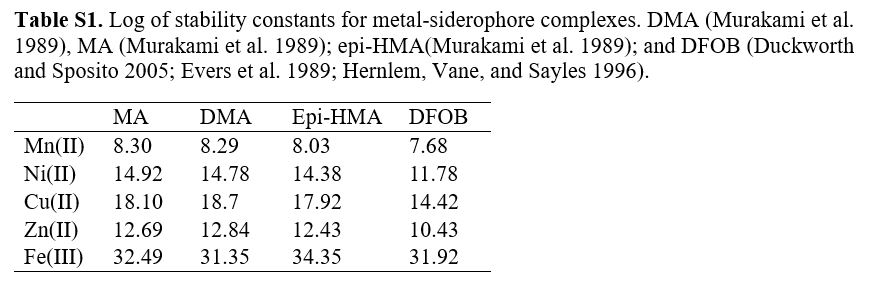
The terminal α-hydroxyl group is not thought to bind with divalent metal ions at pH values in the range of our titrations, resulting in a pentadentate complex at the high pH end (Murakami et al. 1989). However, it is worth noting that strongly Lewis acidic trivalent cations are thought to form hexadendate complexes (e.g., Fe(III)DMA3-) where the final α-hydroxyl group deprotonates and bonds to the ligand (Murakami et al. 1989). This has led to some inconsistences in the reporting of stability constants. For example, the Fe(III)DMA complex stability constant has been reported as 15.7-31.35, dependent on whether MIIHDMA3- (logβ111) or MIIDMA4- (logβ110) was used as the reference state, where logβMLH represents metal ion, ligand, and protons present, respectively. (Shenker, Fan et al. 2001, Dell'mour, Koellensperger et al. 2010) It is worth noting that, when the stability constant is corrected for the deprotonation of the α-hydroxyl group, the logβ110 shows a difference between Fe(III) and divalent cations that more is typical of other siderophores and ligands with hard base binding moieties (Supplementary Information Table S1).
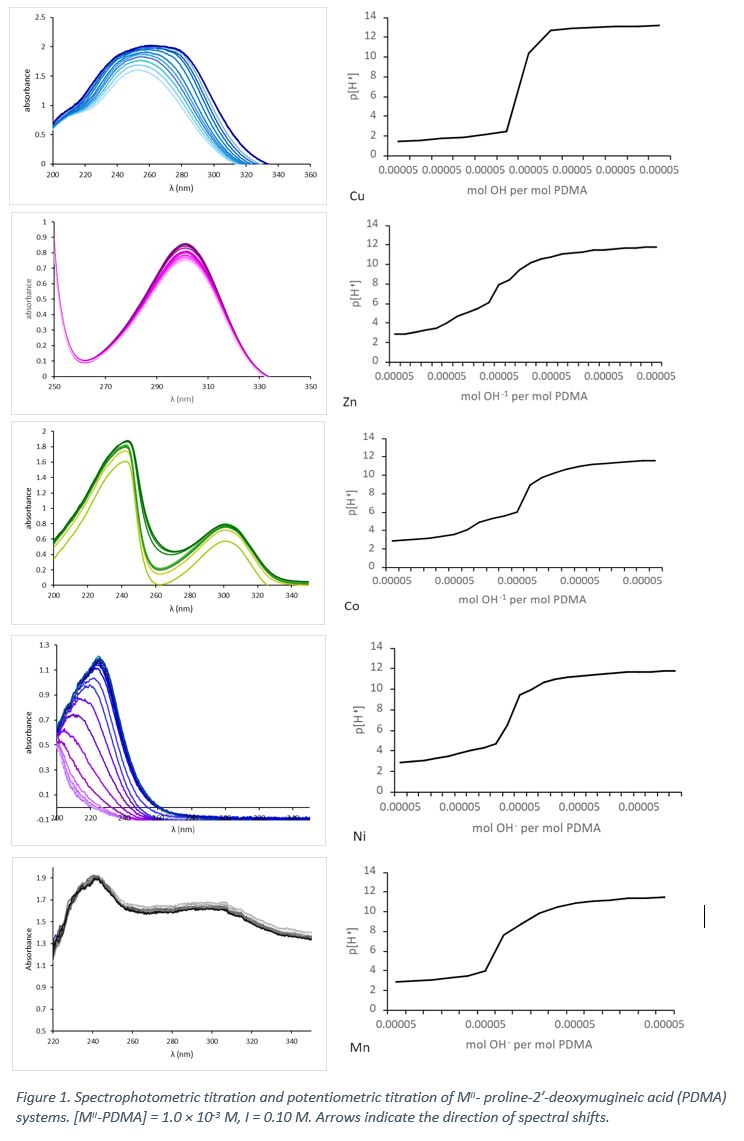
Spectrophotometric titrations of metal-PDMA solutions. The UV-visible spectra of metal-PDMA complexes during titrations are shown in Figure 2. For PDMA complexes with Co(II), Zn(II), Cu(II), and Ni(II), spectral shifts were observed as the solution changed from low to high pH, reflecting changes in light absorption among the intermediate species in equation 1. For example, solutions with Co(II) and PDMA, a shift of Amax was observed from 262 to 272 nm, with a 0.2 unit absorbance increase (Figure 1). In contrast, Mn(II) does not show a spectral shift in the UV-visible range.
Determination of Stability Constants. Using the spectrophotometric titration data, we calculated the stability constants for MIIHPDMA3- (Logβ111), with Mn(II), Ni(II), Cu(II), Co(II), and Zn(II), in KEV (Table 1). The resulting stability constants are similar to those previously obtained stability constants for other phytosiderophores, such as mugineic acid (MA), 2’- deoxymugineic acid (DMA), 3-hydroxymugineic acid (HMA) and 3-epi-hydroxymugineic acid (epi-HMA) (supplementary material Table S1). The Fe(III)PDMA3- stability constant was previously determined by Suzuki et al. (2021), and adjusted to logβ011 = 34.2, considering the deprotonation of the α-hydroxyl group.
Lewis acidity and binding. The affinity of ligands for metal ions has previously been correlated to several parameters, including ionic potential, and hydrolysis constant (KOH) of cations (Hernlem, Vane, and Sayles 1999; Hancock and Martell 1989). These correlations not only provide insights into the interactions between binding ligands and metal ions, they can facilitate the estimation of affinity constants for metals for which there is no experimental data (Duckworth, Akafia et al. 2014).
Because ligand complexation is fundamentally a Lewis acid-base interaction, some aspects of siderophore stability constants can be attributed to the hard-soft acid/base theory. Figure 3a presents a linear correlation of logβPDMA with the ionic potential (z/r) of the corresponding metal ion (R2 = 0.87). This phenomenon can be rationalized by noting that the Pearson's hardness of the metal ion is related to the strength of interaction with the Lewis bases in the siderophore binding moieties. Similarly, Figure 3b presents a correlation of logβPDMA versus the logarithm of the hydrolysis constant (logβOH) (R2 = 0.96). Because siderophores feature negatively charged oxygen donor groups (in the case of PDMA, carboxylate groups and a hydroxyl group), it is assumed that the ability of the metal ion to attract the binding groups on the ligand trends with the affinity of the metal ion for hydroxide ions (Hernlem, Vane, and Sayles 1999).
Despite its utility in explaining fundamental chemistry, Hernlem et al. (1999) noted that using z/r as a predictor of unknown ligand-metal stability constants may be superfluous because the relationship with logβOH yields a stronger correlation (Figure 3). The resulting equation, which may be used to estimate stability constants from tabulated hydrolysis constants, is:

where logβ is the β110 or the β111 depending on the metal in question. Estimates of PDMA stability constants determined by equation 2 are presented in the supporting information (supplementary material Table S2).
Estimation of phytosiderophore stability. Unlike structurally diverse microbial siderophores, phytosiderophores are closely structurally related{Hider, 2010 #39}. As seen in the Figure 1, the main difference between phytosiderophores is the presence and position of hydroxyl groups not associated in metal binding. Synthetic PDMA has the added change of having a five membered ring instead of a four membered ring, making it more resistant to microbial degradation in the rhizosphere environment than natural phytosiderophores (Suzuki et al. 2021). The homology of these ligands suggest commonalities in the binding affinities of these ligands.
To that end, we constructed log-log plots of the stability constants for PDMA that we determined against known literature stability constants for the other phytosiderophores, as well as the commonly used trishydroxamate siderophore DFOB. Regressions for all the siderophores with PDMA show strong linear trends, with R2 = 0.90–0.94 (Table 2). Because PDMA is easier to obtain, more stable and more inexpensive than a lot of other phytosiderophores such as mugineic acid (MA), 2’-deoxymugineic acid (DMA), 3-hydroxymugineic acid (HMA) and 3-epi-hydroxymugineic acid (epi-HMA), it could be used as an alternative to these siderophores, and as a predictor of metal stability constants with MA, DMA, HMA and epi-HMA.
When regressing the stability constants for PDMA with those of the trishydroxamate DFOB, an R2 = 0.97 was observed from the relationship:

This correlation was previously discounted because of the aforementioned inconsistencies in reporting of the hexadentate Fe(III) binding constants (with phytosiderophore constants being orders of magnitude smaller than DFOB) and the structural differences between the ligands (viz. amine groups associated with complexation by PDMA). Because DFOB has a large thermodynamic database of siderophore-metal ion interactions, using DFOB as a predictor for PMDA, and potentially other phytosiderophores, could allow for estimation of a large number of ions that may be used in models of siderophores in the environment.
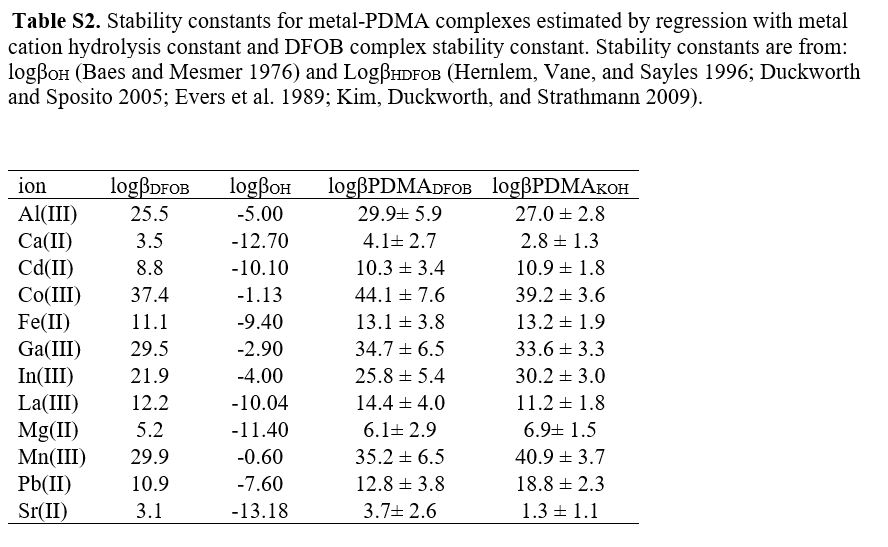
Table S2 shows estimated binding affinities for PDMA as calculated by equations 2 and 3 (e.g., estimation from hydrolysis and DFOB binding constants). In general, estimated errors are lesser for logβ estimated constants than from hydrolysis constants. In general, there is reasonable agreement (difference been Logβ values less than 2) for divalent cations as well as Al(III) and Ga(III). Greater discrepancies appear for large cations that have non-octahedral or pentadentate coordination (e.g., La(III) or Pb(II) and hard cations with high affinities (e.g., In(III), Co(III), and Mn(III)). Previous studies have noted that for hard ions, steric effects may have significant impacts on the relative affinity for specific metal ions (Harrington et al. 2012). This suggest that caution may be needed when estimating the binding constants of ligands that have differing coordination chemistries (e.g., steric contracts, moiety preorganization, or complex architectures). The values in Table S2 provide potential end member estimates for phytosiderophores with metal ions that lack values, as well as illustrate the limits of this approach, and may help to guide future measurements to improve our ability to estimate logβ values.
Results of this study determined the stability constants of synthetic mugineic acid derivative siderophore – PDMA – with the metals ions Mn(II), Co(II), Ni(II), Cu(II), and Zn(II) via potentiometric and spectrophotometric titrations. Spectrophotometric shifts were observed, acting as an indication that the ligand was deprotonating and binding with the metal complex as pH increased. The hydrolysis constant and the ionic potential of the metal ion may be used as predictors of stability constants with PDMA. Stability constants were also regressed against the stability constants of other mugineic acid type phytosiderophores, as well as the trishydroxamate microbial DFOB, showing that known constants for these siderophores could also act as predictors, with specific caveats and limitations related to different coordination chemistries with different metals. Being able to estimate the stability of PDMA with different micronutrients can help predict PDMA’s possibility as a fertilizer, while estimates with several metal cations could predict the plausibility in contaminant remediation scenarios.
The authors declare no conflict of interest.
Acknowledgements. We are grateful for our funding provided by NSF Award 1757699. We thank United States Department of Agriculture—National Institute of Food and Agriculture (USDA-NIFA) Project 2019-06522 for support. This work was supported by the USDA National Institute of Food and Agriculture, Hatch projects NC02713 and NC02951. We also appreciate useful discussion with Dr. Georgiy Gamov.
Author Contribution
A.E. provided development of methodology. A.E. and J.K. did the formal analysis and investigation. A.E, J.K. and O.W. contributed to writing the original draft. A.E, O.W., O.B, and J.H. aided in critical review and editing of the manuscript. O.W and O.B. provided funding acquisition, as well as conceptualization and visualization. K.N. provided recourses for experimentation.
- Alloway, B. J. (2008). Micronutrients and Crop Production: An Introduction. Micronutrient Deficiencies in Global Crop Production. B. J. Alloway. Dordrecht, Springer Netherlands: 1–39.
- Alloway, B. J. (2013). Bioavailability of Elements in Soil. Essentials of Medical Geology: Revised Edition. O. Selinus. Dordrecht, Springer Netherlands: 351–373.
- Baes, C. F. and R. E. Mesmer (1976). The hydrolysis of cations. New York, Wiley New York.
- Das, S. (2014). Role of Micronutrient in Rice Cultivation and Management Strategy in Organic Agriculture—A Reappraisal. Agricultural Sciences 5: 765–769. https://doi.org/10.4236/as.2014.59080.
- Dell'mour, M., G. Koellensperger, J. P. Quirino, P. R. Haddad, C. Stanetty, E. Oburger, M. Puschenreiter and S. Hann (2010). Complexation of metals by phytosiderophores revealed by CE-ESI-MS and CE-ICP-MS. ELECTROPHORESIS 31(7): 1201–1207. https://doi.org/https://doi.org/10.1002/elps.200900635
- Dhungana, S. and A. L. Crumbliss (2005). Coordination Chemistry and Redox Processes in Siderophore-Mediated Iron Transport. Geomicrobiology Journal 22(3–4): 87–98. https://doi.org/10.1080/01490450590945870
- Di Bonito, M., S. Lofts and J. E. Groenenberg (2018). Chapter 11 - Models of Geochemical Speciation: Structure and Applications. Environmental Geochemistry (Second Edition). B. De Vivo, H. E. Belkin and A. Lima, Elsevier: 237–305.
- Doydora, S. A., O. Baars, J. M. Harrington and O. W. Duckworth (2022). Salicylate coordination in metal-protochelin complexes. Biometals 35(1): 87–98. https://doi.org/10.1007/s10534-021-00352-7
- Duckworth, O. W., M. M. Akafia, M. Y. Andrews and J. R. Bargar (2014). Siderophore-promoted dissolution of chromium from hydroxide minerals. Environmental Science: Processes & Impacts 16(6): 1348–1359. https://doi.org/10.1039/C3EM00717K
- Duckworth, O. W. and G. Sposito (2005). Siderophore – Manganese(III) Interactions. I. Air-Oxidation of Manganese(II) Promoted by Desferrioxamine B. Environmental Science & Technology 39(16): 6037–6044. https://doi.org/10.1021/es050275k
- Evers, A., R. D. Hancock, A. E. Martell and R. J. Motekaitis (1989). Metal ion recognition in ligands with negatively charged oxygen donor groups. Complexation of iron(III), gallium(III), indium(III), aluminum(III), and other highly charged metal ions. Inorganic Chemistry 28(11): 2189–2195. https://doi.org/10.1021/ic00310a035
- Hancock, R. D. and A. E. Martell (1989). Ligand design for selective complexation of metal ions in aqueous solution. Chemical Reviews 89(8): 1875–1914. https://doi.org/10.1021/cr00098a011
- Harrington, J. M., D. L. Parker, J. R. Bargar, A. A. Jarzecki, B. M. Tebo, G. Sposito and O. W. Duckworth (2012). Structural dependence of Mn complexation by siderophores: Donor group dependence on complex stability and reactivity. Geochimica et Cosmochimica Acta 88: 106–119. https://doi.org/https://doi.org/10.1016/j.gca.2012.04.006
- Hernlem, B. J., L. M. Vane and G. D. Sayles (1996). Stability constants for complexes of the siderophore desferrioxamine B with selected heavy metal cations. Inorganica Chimica Acta 244(2): 179–184. https://doi.org/https://doi.org/10.1016/0020-1693(95)04780-8
- Khush, G. S., S. Lee, J.-I. Cho and J.-S. Jeon (2012). Biofortification of crops for reducing malnutrition. Plant Biotechnology Reports 6(3): 195–202. https://doi.org/10.1007/s11816-012-0216-5
- Kim, D., O. W. Duckworth and T. J. Strathmann (2009). Hydroxamate siderophore-promoted reactions between iron(II) and nitroaromatic groundwater contaminants. Geochimica et Cosmochimica Acta 73(5): 1297–1311. https://doi.org/https://doi.org/10.1016/j.gca.2008.11.039
- Kraemer, S. M., D. E. Crowley and R. Kretzschmar (2006). Geochemical Aspects of Phytosiderophore-Promoted Iron Acquisition by Plants. Advances in Agronomy, Academic Press. 91: 1–46.
- Kraemer, S. M., O. W. Duckworth, J. M. Harrington and W. D. C. Schenkeveld (2015). Metallophores and Trace Metal Biogeochemistry. Aquatic Geochemistry 21(2): 159–195. https://doi.org/10.1007/s10498-014-9246-7
- Murakami, T., I. Kunio, H. Minato, K. Shigeru and T. Sei-ichi (1989). Stabilities of Metal Complexes of Mugineic Acids and Their Specific Affinities for Iron(III). Chemistry Letters 18(12): 2137–2140. https://doi.org/10.1246/cl.1989.2137
- Muthayya, S., J. H. Rah, J. D. Sugimoto, F. F. Roos, K. Kraemer and R. E. Black (2013). The global hidden hunger indices and maps: an advocacy tool for action. PLoS One 8(6): e67860. https://doi.org/10.1371/journal.pone.0067860
- Northover, G. H. R., Y. Mao, S. Blasco, R. Vilar, E. Garcia-España, C. Rocco, M. Hanif and D. J. Weiss (2022). Synergistic use of siderophores and weak organic ligands during zinc transport in the rhizosphere controlled by pH and ion strength gradients. Scientific Reports 12(1): 6774. https://doi.org/10.1038/s41598-022-10493-5
- Schecher, W. (2001). Thermochemical data used in MINEQL + version 4.5 with comparisons to versions 4.07 and earlier. Environmental Research Software.
- Schenkeveld, W. D. C., Y. Schindlegger, E. Oburger, M. Puschenreiter, S. Hann and S. M. Kraemer (2014). Geochemical Processes Constraining Iron Uptake in Strategy II Fe Acquisition. Environmental Science & Technology 48(21): 12662–12670. https://doi.org/10.1021/es5031728
- Shenker, M., T. W. Fan and D. E. Crowley (2001). Phytosiderophores influence on cadmium mobilization and uptake by wheat and barley plants. J Environ Qual 30(6): 2091–2098. https://doi.org/10.2134/jeq2001.2091
- Sugiura, Y., H. Tanaka, Y. Mino, T. Ishida, N. Ota, M. Inoue, K. Nomoto, H. Yoshioka and T. Takemoto (1981). Structure, properties, and transport mechanism of iron(III) complex of mugineic acid, a possible phytosiderophore. Journal of the American Chemical Society 103(23): 6979–6982. https://doi.org/10.1021/ja00413a043
- Suzuki, M., A. Urabe, S. Sasaki, R. Tsugawa, S. Nishio, H. Mukaiyama, Y. Murata, H. Masuda, M. S. Aung, A. Mera, M. Takeuchi, K. Fukushima, M. Kanaki, K. Kobayashi, Y. Chiba, B. B. Shrestha, H. Nakanishi, T. Watanabe, A. Nakayama, H. Fujino, T. Kobayashi, K. Tanino, N. K. Nishizawa and K. Namba (2021). Development of a mugineic acid family phytosiderophore analog as an iron fertilizer. Nature Communications 12(1): 1558. https://doi.org/10.1038/s41467-021-21837-6
- Treeby, M., H. Marschner and V. Römheld (1989). Mobilization of iron and other micronutrient cations from a calcareous soil by plant-borne, microbial, and synthetic metal chelators. Plant and Soil 114(2): 217–226. https://doi.org/10.1007/BF02220801
Table 1. Stability constants, standard deviations, R2 values for divalent metal-PDMA complexes calculated by KEV from spectrophotometric titration data (in duplicate).
|
M(II)HPDMA3- complex |
Logβ111 |
R2 |
Logβ111 |
R2 |
|
Mn(II) |
7.6 ± 0.2 |
0.99 |
7.6 ± 0.3 |
0.98 |
|
Co(II) |
13.9 ± 0.6 |
0.97 |
13.7 ± 0.5 |
0.96 |
|
Ni(II) |
12.3 ± 0.5 |
0.99 |
11.3 ± 0.5 |
0.92 |
|
Cu(II) |
18 ± 1 |
0.99 |
21 ± 1 |
0.96 |
|
Zn(II) |
14.0 ± 0.1 |
1.00 |
15.7 ± 0.2 |
0.92 |
Table 2. Regression statistics for the regression of PDMA with HMA, DMA, MA, epi-HMA, and DFOB. Stability constants are from: HMA (Murakami et al. 1989); DMA (Murakami et al. 1989); MA (Murakami et al. 1989); epi-HMA(Murakami et al. 1989); and DFOB (Hernlem, Vane, and Sayles 1996)
|
siderophore |
slope |
intercept |
R2 |
|
DMA |
0.82 ± 0.07 |
1 ± 1 |
0.93 |
|
MA |
0.85 ± 0.08 |
1 ± 1 |
0.93 |
|
epiHMA |
0.92 ± 0.07 |
1 ± 1 |
0.94 |
|
DFOB |
0.85 ± 0.07 |
2 ± 1 |
0.90 |
No competing interests reported.
- FigureS1.jpg
- TableS1.jpg
Table S1.Log of stability constants for metal-siderophore complexes. DMA (Murakami et al. 1989), MA (Murakami et al. 1989); epi-HMA(Murakami et al. 1989); and DFOB (Duckworth and Sposito 2005; Evers et al. 1989; Hernlem, Vane, and Sayles 1996).
- TableS2.jpg
Table S2. Stability constants for metal-PDMA complexes estimated by regression with metal cation hydrolysis constant and DFOB complex stability constant. Stability constants are from: logβOH (Baes and Mesmer 1976) and LogβHDFOB (Hernlem, Vane, and Sayles 1996; Duckworth and Sposito 2005; Evers et al. 1989; Kim, Duckworth, and Strathmann 2009).