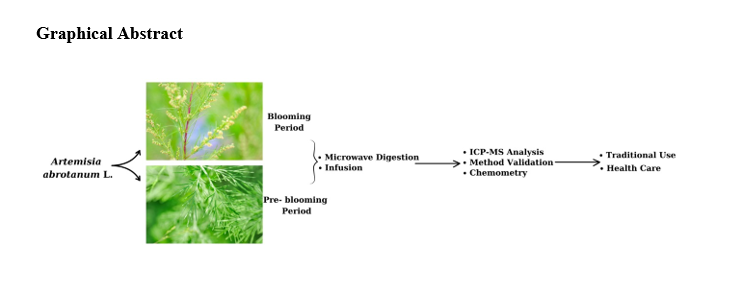
Elemental analysis in medicinal plants is of great importance for human health. In the analysis of trace elements, sample preparation steps affect the results. The microwave digestion technique is the most sensitive method for the extraction of the plant. However, Artemisia abrotanum L is consumed by infusing among the public. For this purpose, two methods were used in the sample preparation stage: microwave digestion in an acidic environment and infusion.
Na, Mg, Al, P, S, K, Ca, Al, Sr, Ni, Cu, Mn, Zn, Co, As, Se, V, Cr, Mo, Cd, Ba, T, Pb, U were analyzed in Artemisia abrotanum L. A multi-element analysis by its optimum range, standards were given to ICP-MS for the determining linearity, sensitivity, LOD, and LOQ of the method. Correlation coefficients, which are indicators of the linearity and sensitivity of the method, are given for all elements (Table 2).
The CRM sample results were derived from averaging six parallel runs. Thallium (Tl) and uranium (U) were absent from the certificate. Sodium (Na), copper (Cu), vanadium (V), and selenium (Se) values were listed in the certificate as indicative. These indicator values were also included in Table 3, and their recovery was calculated accordingly.
Table 2
The calibration data of ICP-MS analysis provides linearity and precision information
| Parameters | Calibration Equation | R |
|---|
| Na | Y = 13.412 + 0.855X | 0,99998 |
| Mg | Y = 6.028 + 0.007X | 1,00000 |
| Fe | Y = 105.18 + 0.157X | 0,99999 |
| P | Y = 0.075 + 0.002X | 0,99999 |
| S | Y = 0.018 + 0.004X | 0,99994 |
| K | Y = 2.315 + 0.156X | 1,00000 |
| Ca | Y = 0.024 + 0.0003X | 0,99999 |
| Al | Y = 0.001 + 0. 001X | 0,99993 |
| V | Y = 689.5 + 1.33X | 0,99998 |
| Cr | Y = 0.118 + 0.007X | 0,99998 |
| Mn | Y = 0.0365 + 0.004X | 0,99999 |
| Co | Y = 2175 + 16.67X | 0,99990 |
| Ni | Y = 0.076 + 0.019X | 0,99995 |
| Cu | Y = 0.226 + 0.047X | 0,99997 |
| Zn | Y = 0.227 + 0.228X | 0,99996 |
| As | Y = 0.014 + 0.0005X | 0,99999 |
| Se | Y = 0.002 + 3.5x10− 5X | 0,99997 |
| Sr | Y = 0.04 + 0.004X | 1,00000 |
| Mo | Y = 0.002 + 0.0002X | 0,99999 |
| Cd | Y = 0.0007 + 2.4x10− 6X | 0,99998 |
| Ba | Y = 0.0004 + 9.6x10− 6X | 0,99999 |
| Tl | Y = 0.023 + 0.0005X | 0,99999 |
| Pb | Y = 0.015 + 0.002X | 1,00000 |
| U | Y = 0.033 + 9.8x10− 6X | 1,00000 |
Table 3
Method validation results for the analysis of Artemisia abrotanum L. by ICP-MS.
| Parameters | LOD (mgkg− 1) | LOQ (mgkg− 1) | Recovery (%) | Accuracy (CV) | Precision (RSD) | Repeatability (RSD) |
|---|
| Na | 1.1x10− 2 | 3.8x10− 2 | 87.4 | 3.4 | 1.90 | 2.38 |
| Mg | 1.3x10− 3 | 4.3x10− 2 | 93.5 | 1.9 | 2.47 | 2.73 |
| Fe | 5.8x10− 4 | 1.9x10− 3 | 77.2 | 1.8 | 1.76 | 2.49 |
| P | 1.4x10− 2 | 4.7x10− 2 | 93.6 | 2.0 | 1.37 | 6.13 |
| S | 3.4x10− 2 | 1.1x10− 1 | 93.6 | 2.1 | 0.05 | 1.02 |
| K | 2.0x10− 2 | 6.5x10− 2 | 92.9 | 1.7 | 1.40 | 4.40 |
| Ca | 2.7x10− 3 | 9.2x10− 3 | 98.0 | 1.1 | 0.97 | 1.09 |
| Al | 1.2x10− 3 | 3.9x10− 3 | 91.2 | 8.1 | 5.19 | 6.63 |
| V | 8.0x10− 6 | 2.6x10− 5 | 73.5 | 1.7 | 0.98 | 1.75 |
| Cr | 3.4x10− 5 | 1.1x10− 4 | 82.8 | 4.9 | 2.6 | 4.28 |
| Mn | 1.7x10− 4 | 5.5x10− 4 | 90.5 | 1.4 | 2.92 | 4.75 |
| Co | 1.1x10− 5 | 3.8x10− 5 | 92.1 | 5.4 | 0.75 | 1.11 |
| Ni | 5.8x10− 5 | 1.9x10− 4 | 94.8 | 1.9 | 1.80 | 4.15 |
| Cu | 8.3x10− 5 | 2.8x10− 4 | 106.1 | 4.8 | 2.54 | 3.74 |
| Zn | 4.0x10− 3 | 1.3x10− 2 | 90.5 | 8.6 | 5.23 | 7.18 |
| As | 2.4x10− 5 | 7.9x10− 5 | 92.1 | 3.1 | 1.93 | 3.27 |
| Se | 3.3x10− 5 | 1.1x10− 4 | 85.0 | 3.9 | 0.68 | 0.91 |
| Sr | 1.7x10− 4 | 5.8x10− 4 | 90.0 | 1.3 | 2.15 | 5.16 |
| Mo | 4.9x10− 4 | 1.6x10− 3 | 89.9 | 3.0 | 0.72 | 2.77 |
| Cd | 6.0x10− 6 | 2.2x10− 5 | 87.0 | 4.5 | 0.91 | 1.27 |
| Ba | 7.8x10− 5 | 2.6x10− 4 | 89.6 | 2.0 | 3.22 | 3.59 |
| Tl | 5.0x10− 6 | 1.7x10− 5 | N.A. | 5.9 | 0.66 | 0.90 |
| Pb | 2.2x10− 5 | 7.4x10− 5 | 90.8 | 8.2 | 0.52 | 0.71 |
| U | 1.0x10− 6 | 2.0x10− 6 | N.A. | 6.8 | 0.82 | 0.66 |
| NA: Not Available |
The validated method was used to compare the element contents of Artemisia abrotanum L. before and during flowering. The results of samples obtained after both microwave digestion and infusion were evaluated. As expected, the results obtained with microwave digestion were higher than the results obtained with infusion. The purpose of preparing samples by infusion is to determine how much of the elements present in the plant are released into the water. The aim here is to compare the pre-blooming and blooming period element contents of Artemisia abrotanum L. rather than comparing sample preparation techniques. The results summarized in Table 4.
Table 4
Elemental content of A. abrotanum L. in pre-blooming and blooming periods
| Element | Mod | Unit | PBP-MW ± SD | BP-MW ± SD | PBP-INF ± SD | BP-INF ± SD |
|---|
| Na | He | mg/kg | 670.1 ± 13.2 | 1137.7 ± 50.8 | 175.55 ± 7.80 | 257.66 ± 13.62 |
| K | He | mg/kg | 38332 ± 560 | 29387 ± 490 | 11445 ± 528 | 9922 ± 319 |
| Mg | He | mg/kg | 1701.8 ± 26.1 | 1676.6 ± 33.1 | 1205.6 ± 52.8 | 1017.8 ± 51.9 |
| P | He | mg/kg | 3653.1 ± 134.3 | 2109 ± 98.8 | 1847 ± 166.9 | 1974.8 ± 13.5 |
| S | H2 | mg/kg | 3588.7 ± 92.9 | 3862.1 ± 70.8 | 2796 ± 102.6 | 2783 ± 102.1 |
| Fe | He | mg/kg | 253.32 ± 17.15 | 385.80 ± 15.52 | 4.02 ± 0.21 | 2.96 ± 0.18 |
| Ca | H2 | mg/kg | 8793.2 ± 257.3 | 8103.6 ± 119.2 | 2669.8 ± 71.1 | 2581.2 ± 49.5 |
| Mn | He | mg/kg | 161.05 ± 11.87 | 182.21 ± 3.75 | 49.33 ± 2.11 | 51.44 ± 1.81 |
| Cu | He | mg/kg | 14.31 ± 1.07 | 14.98 ± 0.47 | 5.91 ± 0.29 | 5.90 ± 0.18 |
| Zn | He | mg/kg | 45.72 ± 1.77 | 19.32 ± 0.26 | 12.43 ± 0.53 | 5.94 ± 0.16 |
| Ni | He | mg/kg | 6.33 ± 0.46 | 11.25 ± 0.21 | 5.42 ± 0.26 | 9.08 ± 0.25 |
| Al | He | mg/kg | 306.88 ± 12.23 | 348.81 ± 11.77 | 4.80 ± 0.30 | 3.04 ± 0.19 |
| V | He | µg/kg | 595.50 ± 13.99 | 952.29 ± 39.42 | 58.60 ± 2.48 | 48.27 ± 2.98 |
| Cr | He | µg/kg | 1140.58 ± 36.46 | 2001.81 ± 188.23 | 70.66 ± 6.87 | 58.61 ± 3.74 |
| Co | He | µg/kg | 422.31 ± 14.28 | 590.87 ± 25.52 | 246.41 ± 3.88 | 306.01 ± 15.64 |
| As | He | µg/kg | 131.33 ± 8.14 | 233.35 ± 18.95 | 31.93 ± 2.64 | 72.19 ± 3.19 |
| Se | H2 | µg/kg | 17.94 ± 1.71 | 35.14 ± 1.72 | 17.06 ± 0.92 | 22.70 ± 1.82 |
| Sr | He | mg/kg | 6.76 ± 0.30 | 19.39 ± 0.69 | 1.41 ± 54.58 | 3.51 ± 0.13 |
| Mo | He | µg/kg | 466.32 ± 40.90 | 357.44 ± 21.09 | 110.81 ± 4.21 | 65.51 ± 3.80 |
| Cd | He | µg/kg | 157.66 ± 11.25 | 89.79 ± 7.10 | 39.53 ± 2.64 | 27.30 ± 1.37 |
| Ba | He | µg/kg | 4272.5 ± 391 | 4546.6 ± 214.9 | 536.28 ± 23.94 | 718.71 ± 15.49 |
| Tl | He | µg/kg | 5.74 ± 0.49 | 5.65 ± 0.35 | 0.81 ± 0.05 | 1.03 ± 0.05 |
| Pb | He | µg/kg | 391.40 ± 37.89 | 176.21 ± 3.97 | 240.38 ± 9.10 | 126.77 ± 4.41 |
| n = 6, SD: Standard deviation, MW: Microwave digestion, INF: Infusion |
It is observed that element concentrations change according to the harvest time of the plant. In both extraction methods, Na, Mn, Ni, Co, As, Se, Sr, and Ba concentrations were higher in BP (Blooming Period) and K, Mg, Ca, Zn, Mo, Cd, and Pb concentrations were higher in PBP (pre-Blooming Period) of Artemisia abratonum L. The amounts of P, Fe, Al, V, Cr, and Tl concentrations differed according to the extraction method. Cu and S concentrations were determined to be similar in both extraction methods and at both harvest times (Fig. 1–3).
There are a few studies on Artemisia abrotanum L. Therefore, the elemental content of the plants was compared with those of other Artemisia species. There is a review article in which the elemental contents of some Artemisia species are summarized, but Artemisia abrotanum is not included in this article [8].
Generally, our study revealed higher elemental values compared to plants grown in Pakistan, as indicated by this review. Likewise, there were significant differences between the elemental analysis results of the infusion samples of the Artemisia absinthium L. conducted by Szparaga et al. and the analysis results of the infusion samples in our study, and the data obtained in our study were found to be higher [9].
There are some studies on Artemisia absinthium L. In this study, the amounts of K, Ca, Mg, and Na were determined in Artemisia absinthe L. as 417.903, 116.0225, 26.2250, and 15.9825 µgL− 1, respectively. These values were also lower than our results [10]. In another study, the concentrations of Ba, Cr, Zn, Mn, Cu Ni, and Pb in Artemisia absinthium L. were found to be 185, 0.72, 15.6, 13.6, 15.5, 3.1, and 1.1 mgkg− 1, respectively. According to the results of this study, these values are higher for elements other than Pb and Ba element concentrations [11]. When evaluated in general, it is normal for trace amounts to vary. However, the lack of elemental analysis data for the species used in this study made the discussion difficult.
The multivariate analysis design for classification of the plant was used as the most basic analysis design. When the data in Fig. 4 is evaluated, it can be seen that 74.9% of the data variance can be explained using two main factors. PCA based on the correlation matrix of the data provides the results in different procedure and in different harvest time of Artemisia abrotanum L. samples were given in Fig. 4 in the scores and loadings. It was found that it was possible to group the obtained score according to collection times and sample preparation method. The loading graph shows us the similarities between the elements, for example, we can state that there is a high correlation between Mo and K, which are on the same line. A similar situation can be said for other elements.
Hierarchical Cluster analysis gives more information about element correlation. The dendrogram obtained by cluster analysis using Ward’s software was used to separate the raw ICP-MS data into groups. When Fig. 5 is evaluated, it can be concluded that there are two main element groups in the data.
Hierarchical Clustering
Method = Ward, Standardized by Column Robust
-+Dendrogram
Principal Component Analysis (PCA) of elements is crucial for understanding their impact on human health. The classification of elements based on their effects includes; essential elements (Na, Mg, K, Ca, P, S, Mo, Mn, Fe, Co, Cu, Zn) beneficial elements (V, Cr, Se, Ba, Sr), polluting elements (Ni, Al, As, Cd, Hg, Pb).
In the PCA of Artemisia abrotanum L., eigenvectors, eigenvalue scores, and loading plots are utilized to analyze and understand the distribution and relationships of these elements. This method helps in identifying which elements contribute positively or negatively to overall health outcomes.
When evaluating the amounts of essential, beneficial, and harmful elements present in Artemisia abrotanum L., which is consumed as an infusion by the public, independent of harvest time, we found that the detected levels of these elements exceeded the required or harmful thresholds for human health (Table 5).
Table 5
Effects of some toxic elements on health and comparison of toxic doses of these elements with samples prepared by infusion of Artemisia abrotanum L. according to the harvest time
| Element | Daily intake (mg) | Some Biologic effects | Artemisia abrotanum L. inf. PBP/BP (mg) | References |
|---|
| Fe | 8 | In many enzymes and respiratory proteins | 4 / 3 | [12] |
| Zn | 10 | In hydrolytic enzymes, nucleic acid synthesis | 12 / 6 | [12] |
| Cu | 0.9 | In enzymes and oxygen transport | 6 / 6 | [12] |
| Mn | 2 | In photosynthesis, enzyme activation | 49 / 51 | [12] |
| Mo | 0.045 | In redox enzymes, nitrogenase | 0.111 / 0.066 | [12] |
| Co | 0.007 | In colabamine | 0.246 / 0.306 | [13] |
| V | 0.1 | In bromperoxidase | 0.059 /0.0 48 µg | [14] |
| Ni | 0.07 | In hydrogenase | 5 / 9 | [15] |
| Ca | 1000 | In bone, teeth, muscle activationrogenase | 2670 / 2581mg | [12] |
| Mg | 350 | In photosynthesis, nucleic acid processes | 1206 / 1018 | [12] |
| Na | 2000 | In control body fluid balance, nervous system | 176 / 258 | [12] |
| K | 2600 | In nervous sytem | 11445 / 9922 | [12] |
| Cr | 0.02 | In cholesterol, fat and protein synthesis | 0.071 / 0.059 | [12] |
| Se | 0.055 | In glutathione peroxidase enzyme | 0.017 / 0.023 | [12] |
| S | 50 | In skin, bone, muscle, enzymes | 2796 / 2783 | [16] |
| P | 700 | Bones, cell membrane, nucleic acid | 1847 / 1975 | [12] |
Table 6
The impact of toxic elements on human health and a comparison of the concentrations of these elements in samples prepared by infusing the plant Artemisia abrotanum L. with levels deemed toxic to human health.
| Element | Toxic doses | Side effects | Artemisia abrotanum L. inf. PBP/BP | References |
|---|
| Al | 1 mg/kg/week | In nervous system, bone and blood system | 4.8 / 3 mg | [17] |
| As | 2-20mg/kg | In DNA, protein | 32 / 72 µg | [18] |
| Cd | * | Cytotoxic, cancer | 40 / 27 µg | [19] |
| Pb | 0.03-0.07mg/day | In nervous system, blood cell | 240 / 127 µg | [20] |
| Ba | * | In nervous system, brain, metabolic disorder | 0.536 / 0.718 | [21] |