Cellular therapies have the potential to advance treatment for a broad array of diseases and are composed of living cells that have been genetically engineered as the drug administered to patients. For instance, chimeric antigen receptor (CAR)-T cell therapies have shown remarkable efficiency in certain hematological cancers [1]–[5]. Currently approved CAR-T cell therapies consist of autologous T cells genetically reprogrammed to express a CAR, which fuses an extracellular antigen-binding domain with intracellular signaling modules [6]. By selecting the target antigen, CAR-T cells can be engineered to specifically target and destroy cancer cells. Since the first FDA approved treatment in 2017 for acute lymphoblastic leukemia, the number of studies focused on CAR-T cell therapies has grown exponentially with an estimated 2,129 CAR-T cell therapies being developed as of January 2023 [7]. Currently approved CAR-T cell therapies utilize lentivirus or adeno-associated virus (AAV) for genetic engineering, but viruses have several drawbacks related to their relatively lengthy manufacturing processes, immunogenicity, and potential for insertional mutagenesis [8]–[10]. In particular, the time and expense required to manufacture viral products, coupled with the explosive growth in the cell therapy field, has created a bottleneck in which demand far outstrips supply.
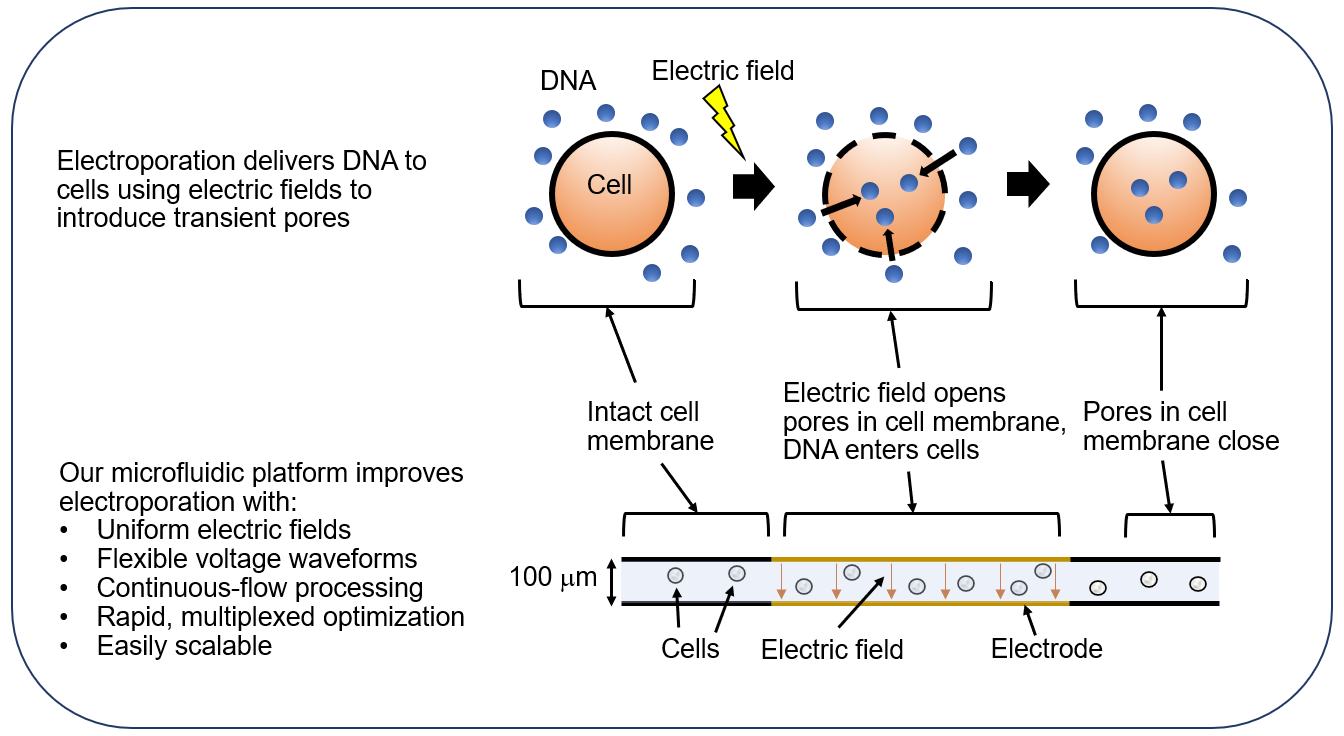
The viral bottleneck has led to intense efforts to develop non-viral methods for genetic engineering [11]. Electroporation is a well-known method for delivery of DNA, RNA, and proteins into cells, that is recognized as a leading replacement for viral delivery [11]–[13]. During electroporation, a time-varying electric field creates transient pores in the cell membrane to allow molecules to diffuse into cells [14]–[16]. Electroporation can engineer target cells with specialized cargo such as plasmid DNA or CRISPR-Cas9 ribonucleoproteins (RNPs) to manufacture cells for cell therapies. These cargos are simpler and cheaper to manufacture relative to viruses, and they can be adapted more quickly during research and development to screen potential drug candidates. Thus, electroporation has the potential to bypass viral bottlenecks in cell therapy.
Despite the known potential, electroporation has not been widely adopted because current equipment has technical limitations that make essential process development difficult. Most commercial electroporation systems are “batch-at-a-time” systems in which a fixed “batch” of cells and cargo are electroporated in a container, such as a cuvette, with an electric pulse. For example, cells mixed with a given concentration of plasmid DNA could be electroporated with a simple square wave pulse defined by a pulse voltage, pulse duration, and number of pulses. These parameters (voltage, duration, pulse number, and plasmid DNA concentration) are empirically varied to balance transfection efficiency against cell viability [17], [18]. However, this optimization can be time-consuming because of the large number of parameters to vary. Also, transferring cell solutions between a large number of cuvettes is labor intensive. These systems also offer limited flexibility in the cell processing volume which must be matched to the cuvette size. Importantly, as the cuvette size is altered to accommodate larger volumes of cells, the gap between the electrodes and the electric field experienced by the cell is also altered. As such, cuvette-based systems are unsuitable to scale for the high number of cells required for therapies, such as a typical CAR-T cell therapy which requires greater than 1 billion cells per dose [11], [19], [20]. The comparatively few commercial electroporation devices available for large-volume cell manufacturing also rely on cuvettes for low-volume optimization, limiting their ability to efficiently screen transfection parameters and scale these parameters for high-volume manufacturing. Overall, there is a need for a flexible electroporation platform that can easily optimize transfection parameters using low volumes of cells and reagents, and once identified, apply these parameters for large-volume cell manufacturing without re-optimization.
Here, we describe a microfluidic electroporation platform that provides flexible, multiplexed, and efficient optimization capabilities with ease of scaling from low-volume optimization to high-volume cell manufacturing. Flexibility and scaling capabilities are afforded by the microfluidic electroporation chip, which we have previously shown can be scaled for any desired range of cell volume without changing the electric field experienced by the cells [21]. Here, we take advantage of this capability by optimizing transfection efficiency using small volumes of cells using flow chips with 2 mm channel widths. We demonstrate multiplexed optimization by simultaneously screening 8 different plasmid concentrations and 9 different electrical waveforms in a 96-well plate. After selecting one plasmid concentration, we rapidly screened hundreds of different voltage waveforms of varying shapes, durations, and amplitudes using ~ 3 s and ~ 20 µL of cells per waveform. Finally, we selected one set of optimized transfection parameters and scaled our processing throughput from 1.6 million cells/minute to 8 million cells/minute by scaling our flow chip’s channel width from 2 mm to 10 mm without impacting the electric field experienced by the cells, producing similar transfection performance at both rates. We believe these data demonstrate how our platform could enable electroporation to be more broadly adopted by researchers and manufacturers seeking a non-viral method to engineer cells for cellular therapies.