3.1. Optical measurement validation
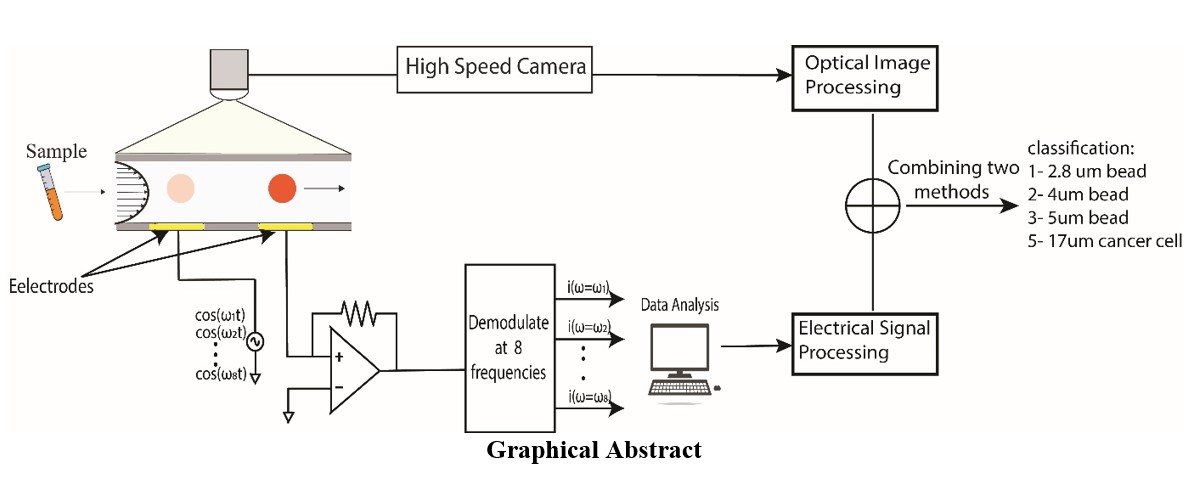
In this study, each group of beads and cancer cells was appropriately labeled (as shown in Table 1) to distinguish between different categories. Class 1, 2, and 3 corresponded to average bead sizes of 2 µm, 4 µm, and 5 µm, respectively. Class 4 represented the group of cancer cells. In each individual experiment, only one type of beads or cells passed through a PDMS microfluidic channel. Impedance cytometry techniques were then employed to detect impedance differences between beads of different sizes and cells. The impedance response was measured at 8 different frequencies using a multi-frequency lock-in amplifier (Zurich Instruments HF2A, Zurich, Switzerland). Concurrently, optical images were captured using a high-speed camera.
Fig. 5a demonstrates the average impedance across all 8 frequencies for each individual particle category in both the training and test datasets. As depicted, there is a noticeable increase in impedance with larger particle sizes. Figure 5b illustrates the average volume for each particle category. In situations involving the aggregation of beads or cancer cells, the volume of each individual particle is calculated, and the final volume is determined by summing the volumes of all the individual particles.
To validate the accuracy of the optical measurements obtained from the high-speed camera, a linear regression model was employed for data analysis. Figure 6 illustrates the linear relationship between the particle volume derived from the high-speed camera images and the impedance measurements obtained from the Zurich instrument, for each of the 8 frequencies. For better visualization of the linear regression, both impedance and volume are depicted in a logarithmic scale. As depicted in Fig. 6, a positive correlation exists between the particle volume and its impedance. This relationship indicates that as particle volume increases, impedance also increases.
Several factors contribute to the impedance of a material, including the size and shape of its constituent particles. With an increase in particle size, impedance tends to rise. This phenomenon arises due to the larger surface area and modified surface-to-volume ratio of larger particles. These alterations influence the interaction of the material with the AC signal traversing through it, leading to variations in impedance.
Figure 6 provides visual evidence of the linear regression relationship between the particle volume and the peak intensity (impedance), with an average R-squared value of 86%. This high R-squared value indicates a relatively strong correlation between the two variables. The linear regression analysis confirms the reliability and consistency of the optical measurements in capturing information about the particle volume, which correlates with the impedance response. Table 2 represents the R-squared values of Volume vs Peak Intensity for different frequencies. It also shows the R-squared values of Volume, Peak Intensity, and Velocity for various frequencies. The data indicates that particle velocity is not considered as a potentially informative parameter, as the R-squared value remains unchanged. The reason for this is that the flow of particles in the channel is not dependent on particle size in our case, due to potential variations in channel clogging. In the multimodal classification, we only applied volume and impedance measurements as the two potential informative features for classification.
Table 2
Rsquared values of Volume (VOL) vs Peak Intensity (PI), as well as VOL and PI vs Velocity (VEL), for both the train and test datasets.
| |
Rsquared VOL vs PI
|
Rsquared VOL and PI vs VEL
|
|
Frequency
|
Train
|
Test
|
Train
|
Test
|
|
100 KHz
|
0.86
|
0.89
|
0.86
|
0.89
|
|
250 KHz
|
0.87
|
0.88
|
0.87
|
0.88
|
|
500 KHz
|
0.87
|
0.87
|
0.87
|
0.87
|
|
750 KHz
|
0.87
|
0.86
|
0.87
|
0.86
|
|
1 MHz
|
0.86
|
0.86
|
0.86
|
0.86
|
|
1.25 MHz
|
0.86
|
0.91
|
0.86
|
0.91
|
|
1.5 MHz
|
0.87
|
0.92
|
0.87
|
0.92
|
|
1.75 MHz
|
0.87
|
0.92
|
0.87
|
0.92
|
Figure 7 illustrates box plots depicting different representative volumes. Notably, each representative volume is associated with multiple peak intensity values. This occurrence is attributed to the low resolution of the high-speed camera utilized. Specifically, each pixel within the captured image corresponds to approximately 0.2 µm due to constraints inherent to the high-speed camera's capabilities. Given these circumstances, the combination of volume and peak intensity as classification features becomes a compelling strategy. By leveraging the complementary information provided by these two features, the classification model can potentially overcome the limitations of individual measurements and enhance the accuracy of particle categorization.
3.2. Multi-modal classifier
In this section, we will be providing machine learning algorithms with both electrical and optical features to examine their respective effects. By incorporating both types of features into the analysis, we aim to gain a comprehensive understanding of their individual impacts and potential synergies. Through this approach, we can assess how electrical and optical characteristics influence the performance and outcomes of the machine learning algorithms employed. This perspective will enable us to identify key insights and determine the optimal combination of features for our purposes. To evaluate the performance of a machine learning model, the following metrics are commonly used: accuracy (ACC), true positive rate (TPR), true negative rate (TNR), false negative rate (FNR), and false positive rate (FPR). These measures are computed using the following forms:
|
\(\text{A}\text{c}\text{c}\text{u}\text{r}\text{a}\text{c}\text{y} \left(\text{A}\text{C}\text{C}\right)=\frac{\text{T}\text{P}+\text{T}\text{N}}{\text{T}\text{N}+\text{T}\text{P}+\text{F}\text{N}+\text{F}\text{P}}\)
|
(1)
|
|
\(\text{S}\text{e}\text{n}\text{s}\text{i}\text{t}\text{i}\text{v}\text{i}\text{t}\text{y} \left(\text{T}\text{R}\text{P}\right)=\frac{\text{T}\text{P}}{\text{T}\text{P}+\text{F}\text{N}}\)
|
(2)
|
|
\(\text{S}\text{p}\text{e}\text{c}\text{i}\text{f}\text{i}\text{c}\text{i}\text{t}\text{y} \left(\text{T}\text{N}\text{R}\right)=\frac{\text{T}\text{N}}{\text{T}\text{N}+\text{F}\text{P}}\)
|
(3)
|
|
\(\text{F}\text{a}\text{l}\text{l}\text{o}\text{u}\text{t} \left(\text{F}\text{P}\text{R}\right)=\frac{\text{F}\text{P}}{\text{T}\text{N}+\text{F}\text{P}}\)
|
(4)
|
|
\(\text{F}\text{a}\text{l}\text{s}\text{e} \text{N}\text{e}\text{g}\text{a}\text{t}\text{i}\text{v}\text{e} \text{R}\text{a}\text{t}\text{e} \left(\text{F}\text{N}\text{R}\right)=\frac{\text{F}\text{N}}{\text{T}\text{P}+\text{F}\text{N}}\)
|
(5)
|
Where, TPs [FPs] refer to the number of correct [incorrect] predictions of outcomes to be in considered output class, whereas TNs [FNs] refer to the number of correct [incorrect] predictions of outcomes to be in any other output classes (Kokabi et al. 2020). In the preceding section, we conducted an evaluation of 25 available algorithms using the MATLAB Classification Learner application. Among these algorithms, the fine tree machine learning algorithm exhibited the highest accuracy values and was selected for this study. Our objective was to assess the algorithm's performance in classifying different particle classes. Specifically, we employed the fine tree algorithm to classify each particle class based on electrical, optical, and a combination of electrical and optical features.
In Fig. 8a, the classification accuracy is represented at a single representative frequency (500 kHz). With the chosen frequency of 500 kHz, three different categories of features are fed to the machine learning model, including peak intensity (PI), volume (VOL), and a combination of PI and VOL. Notably, a noteworthy improvement of approximately 17% is observed when employing the optical feature instead of the electrical feature. This emphasizes the effectiveness of the optical feature in accurately categorizing particles. To showcase the capabilities of both optical and electrical features, a machine learning algorithm was applied to classify particles using both sets of features. Remarkably, this approach yielded an additional improvement of approximately 8\% in accurately classifying particles on the test dataset. The findings underscore the advantage of integrating optical features in particle classification, leading to enhanced accuracy compared to relying solely on electrical or optical features.
In order to enhance data classification and improve accuracy, electrical measurements from all 8 frequencies are combined and inputted into the machine learning algorithm. As evident from Fig. 8b, when compared to Fig. 8a, by integrating data from all 8 frequencies, there's an approximate 8% improvement in categorization using solely electrical features. For test data based on optical features, there's an improvement of around 15%. When both electrical and optical features are combined, there's an approximately 11% enhancement compared to the test data from a single representative frequency.
Table 3 presents the True Positive Rates (TPR) obtained for identifying and categorizing each particle class at representative frequency of 500KHz. The integration of electrical and optical features yielded improvements in classification accuracy. In addition to accuracy and TPR, confusion matrices provide a valuable metric for evaluating the performance of machine learning algorithms (Beauxis et al. 2014; Marom et al. 2010).
Table 3. True Positive Rates for Electrical, Optical, and Multimodal Features in the Test and Train Datasets at 500KHz Frequency.
| |
TPR
|
Electrical
|
Optical
|
Multimodal
|
|
Class 1
|
Train%
|
82.6
|
97.7
|
98.5
|
|
Test%
|
59.6
|
97.9
|
100
|
|
Class 2
|
Train%
|
31
|
83.1
|
77.5
|
|
Test%
|
36.3
|
42.5
|
67.1
|
|
Class 3
|
Train%
|
93.7
|
96.2
|
96.2
|
|
Test%
|
84
|
100
|
88
|
|
Class 4
|
Train%
|
81.1
|
97.3
|
97.3
|
|
Test%
|
100
|
100
|
100
|
Table 3. True Positive Rates for Electrical, Optical, and Multimodal Features in the Test and Train Datasets at 500KHz Frequency.
Figure 9 presents the confusion matrices obtained from the electrical, optical, and combined electrical and optical features on both the train and test datasets at frequency of 500KHz. For instance, let us consider the classification of class 2, which corresponds to 4 µm beads. The confusion matrix reveals that when using electrical features on the test dataset, there were 51 particles erroneously classified as class 1 (2.8 µm bead size) and 42 particles misclassified as class 3 (5 µm bead size). However, upon incorporating the optical feature (volume feature), the classification improved significantly, eliminating misclassifications in class 1. Nonetheless, there were still 84 particles from class 2 that were misclassified as class 3. By incorporating both electrical and optical features, the classification accuracy is further enhanced, resulting in a reduction of misclassified particles from 84 to 48. This demonstrates the effectiveness of utilizing a combination of features in improving the precision of particle classification.
The utilization of confusion matrices allows for a more comprehensive evaluation of the machine learning algorithm's performance, providing insights into the specific misclassifications made for each particle class. These findings highlight the effectiveness of integrating optical features, alongside electrical features, to enhance the classification accuracy, particularly when dealing with closely related particle sizes.
Table 4 provides a visual representation of the True Positive Rate (TPR) values obtained from both the training and test datasets, employing a comprehensive approach that involves combining data from all available frequencies. This strategic integration of data from all available frequencies has a significant impact on the accuracy of the classification model. By incorporating information from various frequencies, the model becomes capable of capturing a wider range of features and nuances present within the data. When using data from just one frequency, the model's capacity to distinguish between various categories can be limited. Some patterns may be clearer at particular frequencies, while others might be less evident. By including data from all frequencies, the model gains a comprehensive view of the information, resulting in more accurate and dependable predictions. The increase in the TPR values underscores the advantages of this method.
Table 4
True Positive Rates for Electrical, Optical, and Multimodal Features in the Test and Train Datasets at 500KHz Frequency.
| |
TPR
|
Electrical
|
Optical
|
Multimodal
|
|
Class 1
|
Train%
|
71
|
100
|
99.2
|
|
Test%
|
51.8
|
97.9
|
98.5
|
|
Class 2
|
Train%
|
49.8
|
96.8
|
97.6
|
|
Test%
|
55.6
|
97.5
|
83.8
|
|
Class 3
|
Train%
|
96.5
|
97.3
|
98.4
|
|
Test%
|
82.1
|
81.6
|
96.5
|
|
Class 4
|
Train%
|
87.5
|
100
|
99.7
|
|
Test%
|
93.1
|
87.5
|
87.5
|
3.3. Performance comparison
To compare our methodology with prior research that employed electrical, optical, and combined features for particle classification, we conducted a comparison with the work of D'Orazio et al. 2020. In their study, they proposed a novel multimodal approach that integrates electrical sensing and optical imaging to classify pollen grains flowing in a microfluidic chip, achieving a throughput of 150 grains per second. They reported accuracy values of 82.8% for the electrical classifier, 84.1% for the optical classifier, and 88.3% for the multimodal classifier on their training dataset. It is important to acknowledge that they also observed improvements when employing a multimodal approach. Their research reported an accuracy of 88.3% for the multimodal classifier on the training dataset, indicating the potential benefits of combining electrical and optical features in particle classification. Our study builds upon this valuable insight and further advances the multimodal approach. By integrating electrical and optical features, our methodology achieves a notably higher accuracy of 98.4% on training dataset. These results reinforce the notion that multimodal approaches have the potential to improve particle classification accuracy. Our study humbly contributes to this understanding by showcasing the effectiveness of our methodology in achieving higher accuracy through the combination of electrical and optical features.