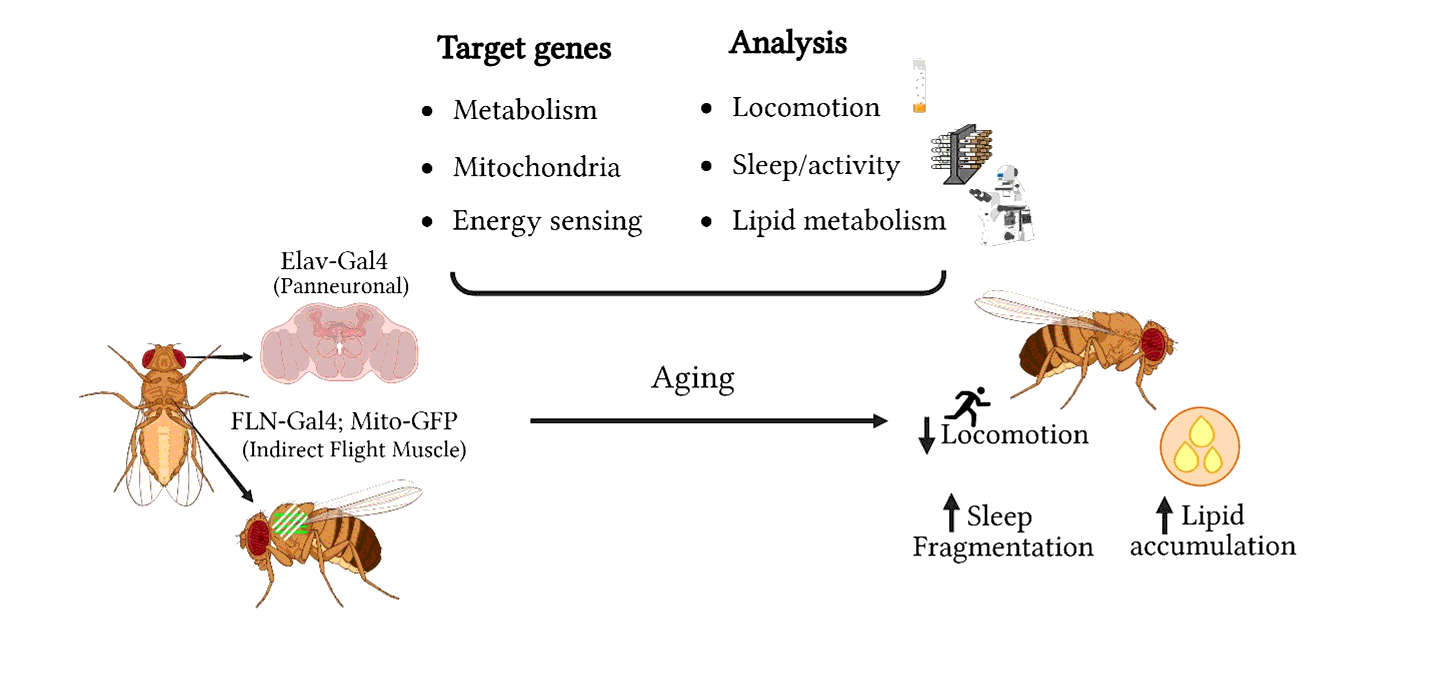
- Panneuronal knockdown of metabolic and mitochondrial genes altered sleep duration and enhanced sleep fragmentation:
To understand the impact of these genes on physiological and behavioral functions, we have tested knockdown of various genes that are involved in glycogen metabolism, TCA cycle, fatty acid metabolism, mitochondrial function, and energy production. We have used Adsl, Gnmt, GlyP, Sardh, Ampkα, ALD, LSD-2, mAcon1, Nmdmc, SdhD, Marf gene RNAi fly lines to understand their impact on physiological and behavioral functions individually, during aging under panneuronal (Elav-Gal4) driver (Figure 1). At mid (3-week-old) age, we observed increased total sleep in mAcon1, Gnmt, compared to controls, and Ald, GlyP, Ogdh showed increased total sleep compared to 3-week Drosophila and with control (Figure 1a). Decreased day sleep at 3-week-old in Ogdh, increased day sleep in Ald at 6-week-old compared to their control. Whereas Ald, GlyP, and Ogdh increased day sleep at 6-week-old compared to 3-week-old Drosophila (Figure 1b). Night sleep increased in Nmdmc, Marf at 3-week-old, Ald, mAcon1, Gnmt, GlyP, Ogdh at 6-week-old compared to the control. Whereas Adsl, mAcon1 showed increased night sleep compared to 3-week-old Drosophila (Figure 1c). Total sleep fragmentation (Figure 1d) increased in Adsl, and Ogdh at 3-week-old and decreased in Ald, Glyp, and Ampkα at 6-week-old compared to controls. Whereas Nmdmc showed increased and Ogdh showed decreased total sleep fragmentation compared to 3-week-old Drosophila. Day sleep fragmentation increased in SdhD and Ogdh (Figure 1e) at 3-week-old compared to control and decreased in Ogdh at 6-week-old compared to 3-week-old Drosophila. Night sleep fragmentation increased in Ald and decreased in mAcon1, Nmdmc, SdhD, Ampkα compared to control at 3-week-old. At 6 weeks old, Ald showed a decrease and an increase in Nmdmc statistically significantly compared to 3-week-old Drosophila (Figure f). Total activity statistically significantly decreased in Nmdmc compared to control in 3-week-old and decreased in Ald, mAcon1, Gnmt, GlyP compared to 6-week-old control, also Ald, Gnmt, GlyP compared to 3-week-old Drosophila (Figure 1g). At old (6-week-old) age, Day activity (Figure 1h) decreased in Gnmt compared to control and Ald, Gnmt, GlyP, and Ogdh compared to 3-week-old Drosophila. Panneuronal knockdown of metabolic and mitochondrial genes caused apparent and vigorous changes in sleep architecture and activity during aging. Genes such as Ald, mAcon1, Gnmt, and GlyP showed increased sleep and reduced activity, indicating a compensatory energy-conservation response. In contrast, Ogdh, Adsl, and Nmdmc were associated with increased sleep fragmentation and reduced daytime activity, suggesting interrupted neuronal energy regulation. These findings highlight the critical role of neuronal metabolism in maintaining sleep-wake stability with age.
- Locomotor ability was compromised upon IFM-specific knockdown of metabolic and mitochondrial genes compared to panneuronal knockdown:
Panneuronal expression of SdhD at 3-week-old and 6-week-old Gnmt, Marf knockdown Drosophila showed decreased flight performance in males compared to control Drosophila. Also, at 6 weeks old, Gnmt and Ogdh knockdown Drosophila have reduced flight index compared to 3-week-old male Drosophila (Figure 2a). Whereas female Drosophila have no statistically significant difference at 3-week-old as well as 6-week-old age, unlike males (Figure 2b). IFM specific expression of mAcon1, SdhD, LSD-2, and Ogdh has shown statistically significant reduction at 3 weeks and Ald, Adsl, mAcon1, Ampkα, Ogdh at 6 weeks of age compared to controls. In addition, at 6-week-old Ald, Adsl, Gnmt, and Ampkα knockdown Drosophila showed statistically significantly low flight performance compared to 3-week-old knockdown male Drosophila (Figure 2c). In female Drosophila SdhD, and Ogdh Drosophila at 3-week-old and Ampkα, Ogdh knockdown at 6-week-old showed statistically significant reduction compared to controls. Whereas Adsl, Gnmt knockdown Drosophila showed reduced flight performance compared to 3-week-old female knockdown Drosophila (Figure 2d). We then analyzed the geotaxis performance using panneuronal driver to understand the non-cell-autonomous Elav males (Figure 2e) and Elav females (Figure 2f) relationship. In our study, we have noticed a close trend in some of the knockdown genes, but the significance of the difference is hindered due to the limited number of replicates. Our study showed that IFM and panneuronal-specific knockdown of metabolic and mitochondrial genes such as SdhD, Marf, and Gnmt (Fernandez-Tussy et al., 2019) lead to the statistically significant decline in locomotor ability, showed neuromuscular interaction specifically in aging male Drosophila. Key genes like Ampkα, Ogdh, Adsl, and mAcon1 were extensively impaired in-flight performance in a sex- and age-dependent manner. Overall, female Drosophila were least affected but still showed genotype-specific vulnerabilities.
- Panneuronal modulation of Ampkα and SNF1A reveals kinase-dependent roles in regulating sleep and activity rhythms.
In this study, we employed panneuronal modulation of AMPKα signaling using Elav-Gal4 to investigate its role in neuronal metabolism and function. We used two independent Elav-Gal4 drivers inserted on different chromosomes, Elav-Gal4 (X) and Elav-Gal4 (II). Both drive expressions in post-mitotic neurons, but differ in chromosomal location, which helps control for position effect variegation and background genotype effects. We overexpressed AMPKα to enhance energy-sensing activity and promote neuroprotection, while Ampkα knockdown allowed us to assess its necessity in maintaining neuronal homeostasis. To explore the evolutionary conservation of function, we overexpressed the yeast homolog SNF1A, and to further dissect kinase-dependent versus independent roles, we expressed a kinase-dead SNF1A mutant (DeadSNF1A). This approach enables us to evaluate both the functional significance and mechanistic specificity of AMPKα and SNF1A signaling in the nervous system. With the Elav(II) driver, we have observed a statistically significant reduction in total sleep (Figure 3a) at 3-week-olds in Ampkα overexpression compared to control, and at 6-week-olds, total sleep was increased compared to 3-week-old Ampkα overexpression Drosophila. Day sleep in statistically significantly reduced in Ampkα overexpression at 3- 6-week-old age (Figure 3b) compared to the respective control Drosophila. Night sleep was statistically significantly increased in SNF1A overexpression at 3-week-olds and 6-week-olds in AMPKα knockdown, SNF1A overexpression Drosophila compared to wild-type control (w1118) Drosophila (Figure 3c). Total sleep fragmentation statistically significantly increased in 3-week Ampkα overexpression Drosophila compared to wild-type control (w1118) Drosophila (Figure 3d). Day sleep fragmentation (Figure 3e) and night sleep fragmentation (Figure 3f) did not show any statistically significant difference compared to controls. Total activity was reduced in Ampkα knockdown, and SNF1A overexpression at 3-week-old and at 6-week-old age compared to controls, and Ampkα overexpression showed statistically significant reduction compared to 3-week-old Drosophila (Figure 3g). Day activity was statistically significantly increased in Ampkα overexpression compared to wild-type control (w1118) at 3-week-olds and at 6-week-olds, Ampkα overexpression Drosophila showed reduced day activity compared to 3-week-old Ampkα overexpression Drosophila (Figure 3h). The night activity was statistically significantly reduced in Ampkα knockdown and SNF1A overexpression Drosophila at 3-week-olds, compared to control and at 6-week-old Ampkα knockdown, Dead SNF1A overexpression and SNF1A overexpression Drosophila showed reduced night activity compared to control Drosophila (Figure 3i). With the Elav(X) driver at 3-week-olds, Ampkα overexpression showed reduced total sleep and at 3-week-olds compared to controls, and at 6-week-olds increased total sleep compared to 3-week-old Ampkα overexpression Drosophila (Figure 3aI). Day sleep (Figure 3bI) decreased only in Ampkα overexpression Drosophila at 3,6-week-old compared to age-matched wild-type control (w1118). Night sleep increased in Ampkα overexpression at 3-week-old compared to controls, with no observed change in other genotypes (Figure 3cI). Total sleep fragmentation (Figure 3dI) increased only in Ampkα overexpression Drosophila at 3,6-week-old compared to age-matched wild-type control (w1118). We found a statistically significant rise in day sleep fragmentation at 6-week-olds and night sleep fragmentation at 3-week-olds in Ampkα overexpression Drosophila (Figure 3eI, fI) compared to age-matched wild-type control (w1118) Drosophila. Total activity was statistically significantly decreased in Ampkα knockdown and SNF1A overexpression at 3-week-old age compared to age-matched Drosophila wild-type control (w1118), at 6-week-olds, Ampkα overexpression showed reduced total activity than 3-week-old Drosophila and SNF1A overexpression Drosophila compared to control (Figure 3gI). Day activity showed a statistically significant increase in Ampkα overexpression, compared to control Drosophila at 3-week-olds, but 6-week-old Drosophila showed a statistically significant reduction than 3-week-old Drosophila (Figure 3hI). Whereas night activity statistically significantly decreased in SNF1A overexpression at 3-week-old and Ampkα knockdown at 6-week-old compared to age-matched wild-type control (w1118) Drosophila (Figure 3iI). Our results indicate that panneuronal modulation of Ampkα and SNF1A distinctly affects sleep architecture and activity rhythms in an age-dependent manner in two different drivers. Ampkα overexpression initially reduces total sleep and increases fragmentation, but reverses at older ages, proposing adaptive or compensatory mechanisms. SNF1A and Dead SNF1A variants demonstrate selective effects on night activity and sleep, highlighting both kinase-dependent and independent roles in behavioral aging. The differential patterns observed between Elav(X) and Elav(II) further highlight the significance of a genomic perspective in functional studies.
- Behavioral impacts of Ampk/SNF1A manipulation using panneuronal and muscle-specific drivers in Drosophila:
Using neuronal and mitochondrial drivers, we explore their role in energy regulation and neural function using Ampkα overexpression, Ampkα knockdown, Dead SNF1A overexpression, and SNF1A overexpression genes. This helps us understand how energy imbalance impacts movement and coordination. In our study, we did not observe any statistically significant difference in male (Figure 4a), female (Figure 4aI) Drosophila flight index at 3 and 6 weeks of age, individually with Elav (II) driver. With the Elav(X) driver, we have observed a statistically significant decrease in flight index of Ampkα knockdown Drosophila at 6-week-old compared to 3-week-old Drosophila in males (Figure 4b), and 6-week-old Ampkα overexpression, Dead SNF1A overexpression female Drosophila compared to 3-week-old Drosophila (Figure 4bI). While using Fln-Gal4;Mito-GFP, we observed wild-type control (w1118) and Ampkα knockdown Drosophila at 6-week-old-old showed reduced flight index compared to 3-week-old male Drosophila (Figure 4c). Whereas female Drosophila showed statistically significant reduction in wild-type control (w1118), Ampkα knockdown, and Dead SNF1A overexpression Drosophila of 6-week-old age compared to 3-week-old Drosophila, and Ampkα knockdown showed statistically significant reduction compared to 6-week-old control Drosophila (Figure 4cI). We then studied the geotaxis (climbing) behavior of these Drosophila with Elav(II) and Elav(X) drivers. In our study with Elav(II), we found no statistically significant difference in male (Figure 4d) and female (Figure 4dI) Drosophila at both 3- and 6-week-old age. Whereas with the Elav(X) driver, we observed that Dead SNF1A overexpression in 6-week-old females statistically significantly reduced compared to 3-week-old Drosophila (Figure 4eI), but no significance was observed in males (Figure 4e). Our results underline that Ampkα and SNF1A signaling influence age-related motor behaviors in a driver-, sex-, and tissue-specific manner. While the Elav(II) driver showed the least impact, Elav(X) and Fln-Gal4, Mito-GFP revealed statistically significant age-associated declines in flight and geotaxis in Drosophila. This implies that mitochondrial and neuronal energy imbalance compromises neuromuscular coordination during aging.
- Panneuronal Ampkα regulation differentially impacts the lipid metabolism:
Since the behavioral responses are statistically significantly controlled by metabolic status and Ampkα expression along with age in Drosophila, we further tested the impact of panneuronal expression of Ampkα and its variants on lipid accumulation in the brain and head regions of the fly. Object count represents the number of lipid spots detected and the area represents the mean area of lipid spots in each brain section. Lipid objects count in head region data showed an increased lipid accumulation in 6-week-old Ampkα overexpression Drosophila, compared to age-matched wild-type control (w1118) and 3-week-old Ampkα overexpression Drosophila (Figure 5f). Whereas lipid object area increased in Ampkα overexpression at 3 weeks compared to wild-type control (w1118) Drosophila. At 6 weeks old, lipid object area was significantly reduced in Ampkα overexpression, Ampkα knockdown, Dead SNF1A overexpression, and SNF1A overexpression Drosophila compared to 6-week-old control Drosophila. We found a statistically significant increase in lipid object area in Ampkα overexpression compared to 3-week-old (Figure 5g). In the brain region at 3 weeks of age, we did not observe a statistically significant difference in lipid object count (accumulation) (Figure 5h), but lipid object area was higher than control Drosophila. At 6 weeks of age, statistically significantly less in Ampkα overexpression, Ampkα knockdown, Dead SNF1A overexpression, and SNF1A overexpression Drosophila compared to 6-week-old control and compared to 3-week-old Ampkα overexpression and Dead SNF1A overexpression Drosophila. We also found an increased lipid object area in wild-type control (w1118) at 6-week-old age compared to 3-week-old wild-type control (w1118) Drosophila. Our findings show that lipid metabolism is considerably changed by panneuronal regulation of Ampkα in an age-dependent way. Ampkα overexpression causes dynamic changes in lipid droplet size across the head and brain regions, as well as increased lipid accumulation in the head at older ages. The decreased lipid object area seen in several genotypes at 6-week-old implies that lipid homeostasis is disrupted by long-term disruption of Ampkα signaling, whether by overexpression or knockdown, which may reflect changed metabolic needs or poor energy mobilization in the aged brain. At the same time, our results support the idea that age-related changes in brain lipid storage can be caused by metabolic imbalance in neurons and identify Ampkα as a major regulator of lipid remodeling throughout aging.