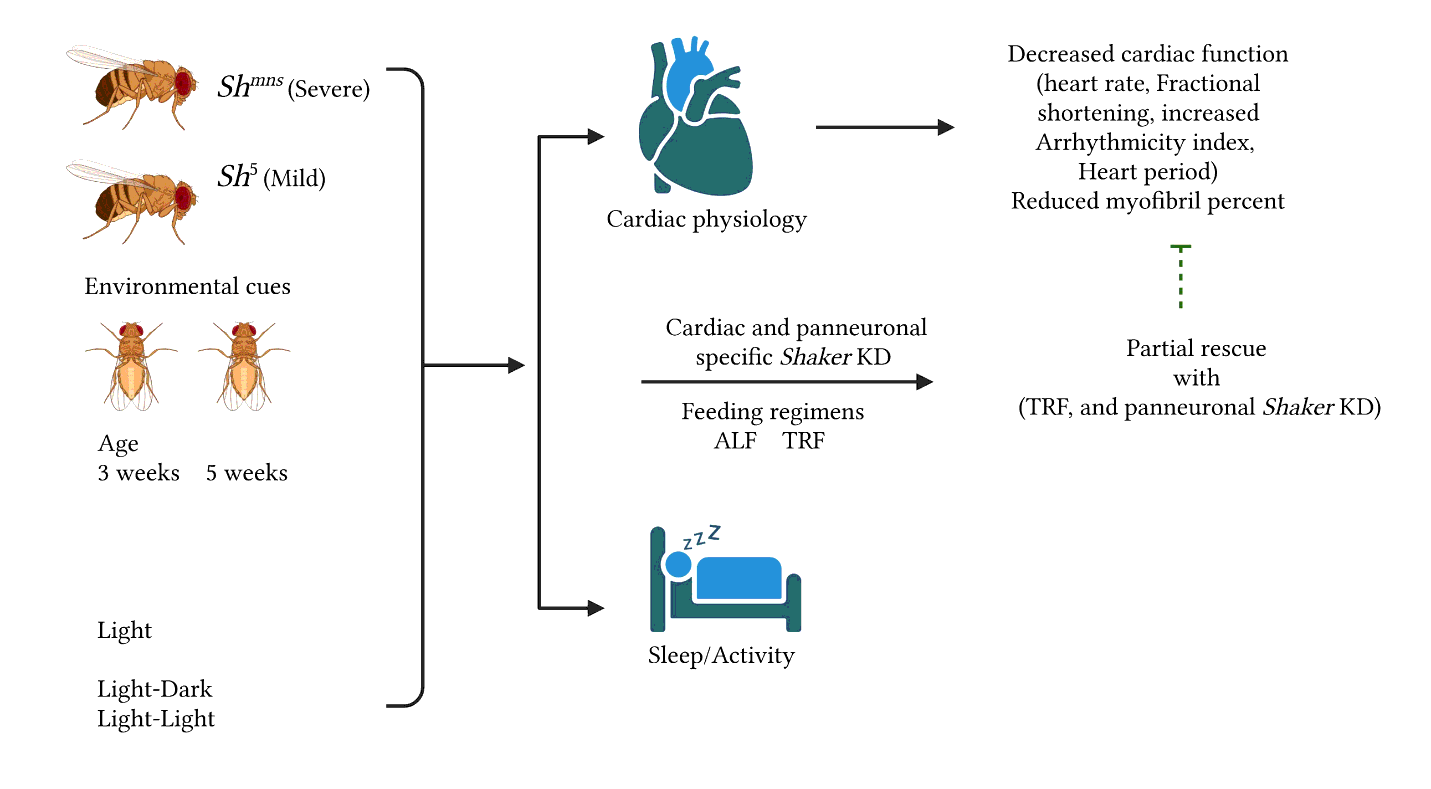
2.1. Shaker Shmns mutant allele led to severely compromised cardiac physiology, whereas Sh5 mutant allele has a subtle impact on cardiac performance in age age-dependent manner in both male and female flies:
Shakermns is a specific mutant allele of the Shaker gene responsible for shortened sleep duration. These flies need significantly less sleep compared to wild-type flies. This occurs because K+ channels play a critical role in regulating neuronal excitability, and their dysfunction leads to hyperactivity and reduced sleep (Kim et al. 2020). The heart physiology and sleep/activity of flies were analyzed for the Shmns and Sh5 and compared to that of the age and sex-matched Drosophila control line w1118. Different variables of heart function were measured and represented in individual graphs: A. Heart rate (HR) B. Heart period (HP), C. Arrhythmicity index (AI), D, E. Diastolic (DI) and Systolic intervals (SI), F, G. Diastolic diameter (DD) and Systolic diameter (SD), and H. Fractional shortening (FS). (Figure. 1A-H) represents data collected from three-week and five-week-old male flies. Shmns showed an increase in HP, AI, DI, and SI than w1118 and Sh5, as well as significantly decreased FS and HR compared to w1118. Sh5 shows a significant reduction in FS and an increase in HR compared to w1118. DD and SD did not find any significant difference between the control and mutants. The Shmns five-week flies showed an increased HP, DI, and SI than w1118, and Sh5 and AI, DD, and SD showed no change, but FS was significantly reduced compared to w1118 in both Shmns and Sh5. The HR was reduced in Shmns compared to w1118 and Sh5. Whereas Sh5 showed reduced SI, DD, and FS compared to Sh5 OC and w1118. (Figure. 1I-J). Phalloidin staining of the heart showed a significant difference between w1118 and Shmns heart muscle density, where Shmns heart was found with reduced myofibril percentage than the control w1118. (Figure. 1K-P), showed sleep/activity analysis w1118 and Shmns, with significantly increased activity and reduced sleep in Shmns compared to w1118 for three weeks and five weeks of age. Shmns severely impairs cardiac function and reduces sleep, with age-related worsening in both sexes. Sh5 shows milder, age-dependent cardiac effects. These results highlight Shaker K⁺ channels' critical role in regulating heart function and sleep.
2.2. Trans heterozygous (Shmns/+: Sh5/+Shaker mutants do not aggravate cardiac physiology defect linked with the Shmns mutant:
We have investigated the impact of both Shmns and Sh5 alleles on female flies. (A-H) represents cardiac data collected from three and five-week-old females. Shmns showed a significant increase in HP, DI, and SI compared to controls and Shmnsx Sh5 flies. AI, DD in Shmnsx Sh5 than Shmns flies. Sh5 showed an increase in HP and DI compared to w1118, and with Shmns HP, SI. Sh5 showed a significant difference with Shmns x Sh5 in HP, DI, and SI. SD and FS did not show any significant difference among the groups. At five weeks of age, only Shmns flies HP, AI, DI and SI increased than w1118. Sh5 flies AI, DI, SI, SD, and FS are reduced than Shmns. Shmnsx Sh5 flies showed decreased HP, AI, DI, and SI than Shmns flies, and reduced SD and increased FS compared to Sh5 flies. The HR was reduced in Shmns flies at both ages, and there was no significant difference in Shmnsx Sh5 and Sh5 flies, but Shmnsx Sh5 flies showed a significant increase than Shmns flies. Trans-heterozygous Shmns/Sh5 mutants do not exacerbate Shmns-induced cardiac defects. Instead, they partially rescue heart function, showing improved parameters like HP, DI, SI, and FS compared to Shmns alone, suggesting a non-additive or compensatory genetic interaction between Shaker alleles.
2.3. Circadian disruption further deteriorates cardiac physiological and sleep/circadian dysregulation linked with Shmns mutant:
Light significantly impacts sleep-wake cycles and heart function. Since the Shmns mutant flies are genetically predisposed to have shorter sleep cycles compared to w1118 flies, we performed heart physiology and sleep/activity analysis to understand the impact of light-light cycle changes in male flies. (Figure. 3A-H) represents the impact of light/dark (LD) and light/light (LL) cues-induced circadian cycle disruption on cardiac physiology and sleep/activity patterns of three-week-old flies. (A-H) HP, AI, DI, SI, DD, and SD did not show any statistically significant difference, but FS was reduced in LL than LD w1118. Similarly, LD vs LL conditions did not show a statistically significant difference in heart parameters of Shmns flies. HP, AI (p < 0.05), DI, SI, DD, and SD showed a significant increase in LD Shmns than LD w1118. HP, DI, and SI significantly increased in LL Shmns flies compared to LL w1118, whereas FS was reduced. The HR was reduced in LD Shmns flies and LL Shmns flies compared to respective controls, suggesting the light-light cycles regulate heart functions differently in mutant flies than w1118. In females (Fig. 3I-P) at 3 weeks HR, FS was reduced, and HP, AI significantly increased in LL compared to LD in w1118 flies. In Shmns flies SD was reduced and FS increased significantly in LL compared to the LD condition. LD Shmns flies showed increased HP, DI, SI, DD, and reduced HR than LD w1118. During LL Shmns flies showed increased HP, DI, SI, FS, and decreased DD and SD were observed compared to LL w1118. Phalloidin staining (Figure. 3Q, R) indicates reduced organization of F-actin containing myofibrillar percent in heart muscles of LL w1118 and LL Shmns than LD w1118, with no significant difference with other genotypes. We further checked the impact of heart physiology on sleep/activity parameters (Fig. 3S-X), we found day activity, night activity, and total activity were increased, and day sleep, night sleep, and total sleep were reduced in LD Shmns than LD w1118 flies. During LL condition, day activity, night, and total activity increased, and sleep significantly decreased in LL Shmns flies than w1118 flies at 3 weeks of age. We have not observed any significant difference between LL and LD w1118 and Shmns flies, respectively. Shmns flies under LL conditions showed elevated HP, AI, reduced HR, and sleep, with increased activity levels compared to w1118. These results indicate that disrupted light cues worsen Shmns-associated physiological and behavioral impairments, highlighting the interaction between circadian regulation and Shaker channel function.
2.4. Time-restricted feeding altered cardiac physiology and sleep/activity dysregulation linked with Shmns mutant flies:
To understand the impact of feeding cues on heart physiology and sleep/activity, we further employed well-studied feeding patterns in our lab, i.e., time-restricted feeding (TRF) and ad libitum feeding (ALF) patterns on Shmns male and female flies for heart physiology (Figure. 4A-H) in males and (I-P) in females and sleep/activity analysis using male flies at 3 weeks of age (Figure. 4Q-V). The male heart physiology did not show a significant difference between ALF Shmns and TRF Shmns male flies. Whereas in female flies, HP, AI, and DI decreased, and HR was increased in TRF Shmns flies, and SI, DD, SD, and FS did not show a significant difference compared with ALF Shmns flies. In males (Q-S) activity was increased, and sleep was reduced significantly in TRF than in ALF Shmns flies. TRF partially rescues cardiac dysfunction and sleep/activity disruptions in Shmns mutant flies. TRF improved heart function in females and increased activity with reduced sleep, in males, indicating feeding timing modulates Shaker-linked physiological outcomes. Based on our observation in female flies, TRF improved cardiac parameters such as reduced HP, AI, and DI, and increased HR. In males, TRF led to elevated activity and reduced sleep without major cardiac changes. These findings suggest that feeding timing can partially rescue Shaker-linked cardiac and behavioral impairments through circadian-aligned interventions.
2.5. Cardiac-specific knockdown of the Shaker gene led to compromised cardiac function:
We also revealed the role of the Shaker gene using the Gal4-UAS expression system to understand cardiac cardiac-specific role using the Hand-Gal4 driver. Briefly, progeny of 3-week-old male and female Hand-Gal4 flies crossed with w1118, Shaker RNAi (BL#53347, BL#31680) genes and empty vectors for 2nd (attP40) and 3rd (attP2) chromosomes as internal controls. Compared to the Hand/+ experimental control AI, SI, DD, and FS showed a significant decrease in BL#53347. Whereas BL#31680 showed a significant increase in HP, DI, and a decrease in HR, AI, FS, and DD compared to the Hand/+ control. Female flies at 3 weeks (Fig. 5I-P), BL#53347 showed a significant decrease in AI, DD, and SD, compared to Hand/+ controls. Whereas BL#31680 showed a significant increase in SI, compared to the w1118 control. The HR was not showing any significant difference. Cardiac-specific knockdown of the Shaker gene using Hand-Gal4 disrupts heart function, with BL#53347 and BL#31680 showing altered intervals, diameters, and reduced FS. These results confirm a direct, cardiac-intrinsic role for Shaker in maintaining normal heart physiology. Based on observation of both BL#53347 and BL#31680 flies showing altered intervals, diameters, and reduced fractional shortening. These results demonstrate that Shaker function in cardiomyocytes is essential for maintaining proper cardiac rhythm, contraction strength, and structural integrity, underscoring its intrinsic role in Drosophila heart physiology.
2.6. Panneuronal knockdown of the Shaker gene led to altered cardiac physiology:
We have revealed the significance of the Shaker gene in a non-cell-autonomous manner upon its knockdown in neuronal cells using the Elav-Gal4 driver. Briefly, the progeny of 3-week-old male and female flies after crossing with the Elav-Gal4 driver with w1118, Shaker RNAi (BL#53347, BL#31680) genes and empty vectors for 2nd (attp40) and 3rd (attP2) chromosomes as internal controls were used for cardiac physiology. As shown in Fig. 6. (A-H) Cardiac physiology of males. BL#53347 flies showed a significant decrease in AI, DD, and FS compared to w1118, and BL#31680 flies showed a significant decrease in SI, AI, FS, and an increase in SD compared to w1118, and HR did not show any significant difference. Figure 6 (I-P) represents female flies at 3 weeks of age. BL#53347 flies showed a significant decrease in AI and FS, and BL#31680 flies showed a significant decrease in HR and AI and a significant increase in HP, DI, and SI compared to w1118. (Q-V) Sleep/activity analysis at 3 weeks showed no difference in activity, but day sleep, night sleep, and total sleep in BL#53347 were reduced compared to w1118. Whereas we did not observe a significant change in BL#31680 in sleep/activity parameters. Both RNAi lines showed disrupted cardiac parameters, particularly reduced arrhythmicity index and fractional shortening. Additionally, Shaker knockdown via BL#53347 reduced sleep without affecting activity, highlighting the neural influence of Shaker on heart function and sleep regulation.