Cyanobacteria, amylolytic enzymes and yeast
Synechococcus elongatus UTEX 2973 was obtained from the UTEX Culture Collection of Algae (Austin, TX, USA) and used as the biomass source because this cyanobacterial strain has been reported to accumulate glycogen in the cells during proliferation [21]. S. elongatus UTEX 2973 was maintained photoautotrophically in a 200 mL Erlenmeyer flask containing 100 mL BG-11 medium [36] at 42°C with shaking at 120 rpm under continuous illumination by LED lamps at a light intensity of 170 µmol⸱m− 2⸱s− 1 with bubbling air containing 3% CO2 at a flow rate of 1 vvm.
Amylase mixture consisting of α-amylase and glucoamylase (Magnax JW101, powder) was kindly provided by Rakuto Kasei Industrial Co., Ltd. (Otsu, Japan) and was used for the hydrolysis of cyanobacterial glycogen to glucose. The α-amylase and glucoamylase activities of the amylase mixture were determined to be 560 U/g and 370 U/g, respectively, by the α-amylase assay kit and the saccharification capacity assay kit (Kikkoman Biochemifa Company, Tokyo, Japan) using 2-chloro-4-nitrophenyl-65-azide-65-deoxy-β-maltopentaoside and 4-nitrophenyl-β-D-maltoside, respectively, as substrates. Glucoamylase (30 U/mg) was purchased from TOYOBO Co., Ltd. (Osaka, Japan) and was used for glycogen content measurement and enzyme accessibility assay.
The yeast Kluyveromyces marxianus NBRC 1777 was obtained from the Biological Resource Center, NITE (NBRC, Kisarazu, Japan) and used for fermentation of glucose to ethanol. K. marxianus NBRC 1777 was maintained in yeast extract-peptone-dextrose (YPD) media (10 g/L yeast extract, 20 g/L peptone, 20 g/L glucose) at 30°C.
Preparation of yeast inoculum for fermentation
To prepare the yeast inoculum for fermentation, K. marxianus NBRC 1777 was cultured aerobically at 30°C for 48 h in a Sakaguchi flask containing 50 mL of YPD medium with shaking at 150 rpm. Yeast cells were collected by centrifugation (16,000 ×g for 5 min at 4°C) and washed three times with distilled water. The resulting yeast pellets were used as inoculum for the ethanol fermentation described in the following section 2.5.
Culture of cyanobacterial biomass as feedstock
The experimental culture of S. elongatus UTEX 2973 was performed photoautotrophically for 7 days in a flattened flask containing 500 mL of BG-11 medium at 42°C under continuous illumination by LED lamps at a light intensity of 350 µmol⸱m− 2⸱s− 1, with bubbling air containing 3% CO2 at a flow rate of 1 vvm. The initial optical density at a wavelength of 730 nm (OD730) was 0.05. After 7 days of culture, cyanobacterial cells were harvested by centrifugation (16,000 ×g for 5 min at 4°C) to obtain wet pellets in 50 mL centrifuge tubes, each containing 0.5 g dry cell weight equivalent. Harvested cyanobacterial pellets were stored at -25°C until use.
Pretreatment of cyanobacterial biomass
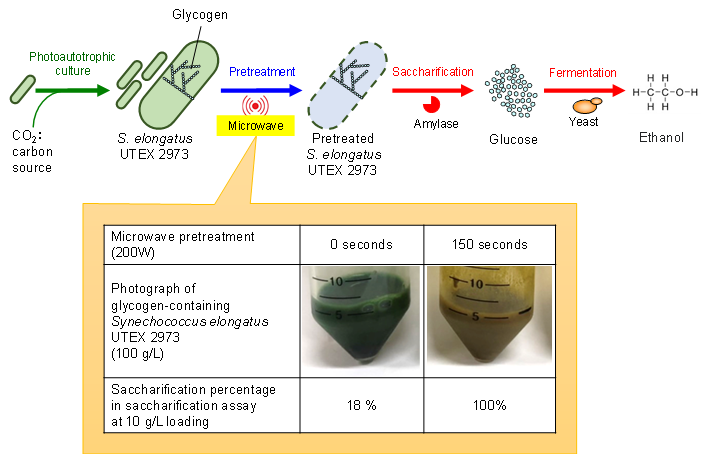
For microwave pretreatment of cyanobacterial biomass, cyanobacterial wet pellet of 0.5 g dry cell weight equivalent was suspended with pure water to prepare 5 mL of 100 g dry cell weight/L suspension. The cyanobacterial suspension was transferred to a 25 mL sealed reaction vessel for microwave oven (P-25, San-ai Kagaku Co. Ltd., Nagoya, Japan) and reacted for 0-200 seconds using a home microwave oven with a fixed input power of 200 W. In the case of saccharification and fermentation for bioethanol production, 5 mL of the pretreated mixture was transferred to a 50 mL centrifuge tube after microwave pretreatment.
For ultrasonic pretreatment of cyanobacterial biomass, 5 mL of cyanobacterial suspension (100 g dry cell weight/L in water) was transferred to a screw-capped glass vial (diameter, 30 mm; volume, 30 ml) and sonicated for 30 minutes using a 38 kHz sonoreactor (QUAVA mini, Kaijo Corporation, Tokyo, Japan) with a fixed input power of 24 W. The glass vial was positioned at a height of 50 mm from the bottom of the sonoreactor.
For lysozyme pretreatment of cyanobacterial biomass, 5 mL of cyanobacterial suspension (100 g dry cell weight/L in water, pH approximately 7) was transferred to 50 mL centrifuge tubes. Lysozyme (chicken egg white, Nacalai Tesque, Inc. Kyoto, Japan) was added at a final concentration of 1 g/L. The tubes were incubated for 24 hours at 37°C in a shaker at 120 rpm.
Saccharification and ethanol fermentation from pretreated cyanobacterial biomass
Saccharification was performed in 50 mL centrifuge tubes containing 5 mL of pretreated cyanobacterial suspension (100 g dry cell weight/L suspension) by adding an amylase mixture at a final concentration of 0.1 g/L (α-amylase and glucoamylase activities were 56 U/L and 37U/L, respectively). The tubes were incubated for 48 hours at 50°C in a shaker at 120 rpm. At 48 hours after the start of saccharification, simultaneous saccharification and fermentation was performed for an additional 24 hours in the same 50 mL centrifuge tube by inoculating yeast to achieve a final OD600 of 20 (equivalent to approximately 10 g dry cell weight/L). No other nutrients, such as peptone and yeast extract, were added. Tubes were sealed with a silicone stopper with a gas check valve to release CO2. Tubes were incubated at 40°C in a shaker at 120 rpm.
Samples were taken from the tube at 0, 12, 24 and 48 hours during the enzymatic reaction for 48 hours and at 54, 60, 66, and 72 hours during the simultaneous saccharification and fermentation for an additional 24 hours. Samples were centrifuged at 21,500 ×g for 1 minute, and the supernatant was frozen until used for glucose and ethanol measurements by high-performance liquid chromatography (HPLC) as described below.
Analysis
Yeast cell concentration
For K. marxianus NBRC 1777, cell concentration was assessed by measuring the OD600 value. The dry cell concentration of K. marxianus NBRC 1777 was estimated using a conversion coefficient of 0.50 g-dry cell weight/L per OD600, which was determined experimentally from a correlation between the OD600 value and the dry cell weight of K. marxianus NBRC 1777.
Cyanobacterial cell concentration and glycogen content
For S. elongatus UTEX 2973, cell concentration was assessed by measuring the OD730 value. The dry cell concentration of S. elongatus UTEX 2973 was estimated using a conversion coefficient of 0.35 g-dry cell weight/L per OD730, which was determined experimentally from a correlation between the OD730 value and the dry cell weight of S. elongatus UTEX 2973.
The glycogen content of S. elongatus UTEX 2973 was determined by the previously described method [22] with some modifications. Specifically, a cyanobacterial wet pellet of 3.5 mg dry cell weight equivalent (OD730unit of 10) in a 1.5 mL tube was suspended in 300 µL (30% w/v) KOH aqueous solution, followed by incubation in a heat block at 95°C for 90 min. Ethanol (1.2 mL) was added to the suspension, and the mixture was incubated on ice for 2 h. After centrifugation at 16,000 ×g for 5 min at 4°C, the resulting pellet was solubilized with 250 µL water. Ethanol (1 mL) was then added to the suspension again, and the mixture was incubated on ice for 2 h. After centrifugation at 16,000 ×g for 5 min at 4°C, the resulting pellet was washed three times with 1 mL ethanol, and then vacuum dried at 60°C for 30 min. The dried sample was reconstituted with 270 µL of 400 mM sodium acetate buffer (pH 4.8). Then, 270 µL of the sample was mixed with 30 µL of glucoamylase solution (133 U/mL) in 100 mM sodium acetate buffer (pH 4.8) in a 1.5 mL tube. This resulted in 300 µL of reaction mixture with an enzyme concentration of 13.3 U/mL (enzyme amount of 4 U/assay). The 1.5 mL tube was incubated at 55°C for 30 minutes. The sample was then heated to 90°C for 5 minutes to inactivate the enzyme. The heated samples were centrifuged at 21,500 ×g for 1 minute and the supernatant was used for glucose measurement. Glucose concentrations were measured by the mutarotase GOD method (LabAssay™ Glucose, FUJIFILM Wako Pure Chemical Corporation, Osaka, Japan). The amount of glycogen was calculated from the glucose contents multiplied by the anhydro correction factors of 162/180. The glycogen content was evaluated as the percentage of the amount of glycogen relative to the dry cell weight of the cyanobacteria.
Enzyme accessibility to glycogen in cyanobacteria
A low biomass loading (10 g dry cell weight/L) saccharification assay was performed to evaluate the accessibility of the amylolytic enzyme to the glycogen in pretreated cyanobacterial biomass. Specifically, a sample was taken from the pretreated cyanobacterial suspension (100 g/L solid loading) and diluted nine times with 100 mM sodium acetate buffer (pH 4.8). Then, 270 µL of the diluted sample was mixed with 30 µL of glucoamylase solution (133 U/mL) in 100 mM sodium acetate buffer (pH 4.8) in a 1.5 mL tube. This resulted in 300 µL of reaction mixture with a substrate concentration of 10 g/L with an enzyme concentration of 13.3 U/mL (enzyme amount of 4 U/assay). The 1.5 mL tube was incubated at 55°C for 30 minutes. The sample was then heated to 90°C for 5 minutes to inactivate the enzyme. The heated samples were centrifuged at 21,500 ×g for 1 minute and the supernatant was used for glucose measurement. Glucose concentrations were measured by the mutarotase GOD method (LabAssay™ Glucose). Glycogen saccharification was evaluated as the percentage of glycogen hydrolyzed to glucose relative to glycogen in the initial cyanobacterial biomass.
The morphology of the pretreated cyanobacterial biomass was observed under a microscope (BZ-X700, KEYENCE, Osaka, Japan).
Glucose and ethanol concentrations during saccharification and fermentation
Glucose and ethanol concentrations were determined by HPLC equipped with a refractive index detector (Shimadzu Co., Kyoto, Japan) using a CARBOSep CHO-682 column (Tokyo Chemical Industry Co., Ltd, Tokyo, Japan). The column was run at 85°C with a water mobile phase and a flow rate of 0.4 mL/min.
Glycogen saccharification was evaluated as the percentage of glycogen hydrolyzed to glucose relative to glycogen in the initial cyanobacterial biomass. Ethanol yield was determined as the ratio of the amount of ethanol produced to the amount of initial cyanobacterial biomass.