Materials
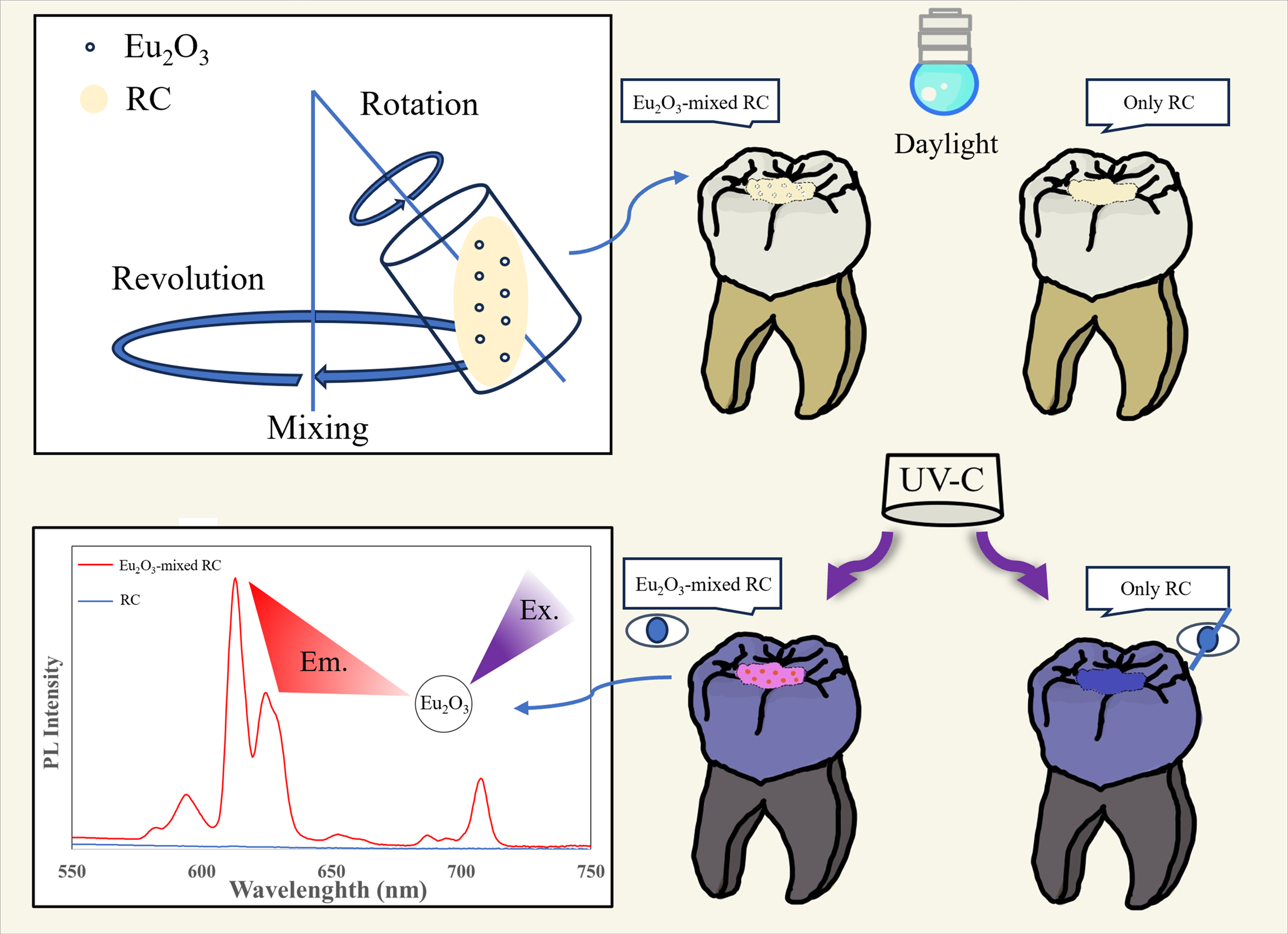
The RC (Clearfil Majesty ES Flow Universal High; Kuraray Noritake Dental Inc., Tokyo, Japan) and red-light-emitting Eu2O3 (99.9 % Europium oxide; Kojundo Chemical Laboratory, Saitama, Japan) was mixed using a planetary centrifugal mixer (ARE-310; Thinky Corporation, Tokyo, Japan). This system could mix the samples uniformly and efficiently with a consistent deformation process. 19 Eu2O3 was mixed with RC at concentrations of 5, 10, 15, 20, and 25 wt%, and an RC sample without Eu2O3 was also prepared.
Visual evaluation
The Eu2O3-mixed RC samples at each concentration were filled into disc-shaped molds (φ16 mm; thickness = 2.0 mm). The mixtures in these molds were light-cured using a light-emitting diode (LED) curing unit (PenCure 2000; Morita, Osaka, Japan) with a radiant intensity of 2000 mW/cm. The RC parts were irradiated at the center, moving 5 s each to the top, bottom, left, and right to overlap with previously irradiated RC parts. The RC samples were removed from the molds, inverted, and again light-cured for 25 s. The fluorescence of the RC samples retrieved from the molds was observed in a dark box under 254 and 365 nm UV lamps. 21 Additionally, a colorimeter (VITA Easyshade V; Hakusui Trading Corporation, Osaka, Japan) capable of quantifying subtle color differences, ΔEab, was used to measure the color differences under a fluorescent lamp with a black background. The differences in fluorescence with UV light and color variations under a fluorescent bulb were assessed for the RC samples at each concentration.
Crystal structure, particle size, and photoluminescence properties
The crystal structure, particle size, and photoluminescence properties of the Eu2O3-mixed RC samples were evaluated using X-ray diffraction (XRD), scanning electron microscopy (SEM), and spectrofluorometry, respectively. The XRD measurements were conducted using an X-ray diffractometer (Mini Flex 600; Rigaku Corporation, Tokyo, Japan). 22 The particle morphology of Eu2O3 and its dispersion in RC samples were examined using SEM (SU3500; Hitachi High-Tech Corporation, Tokyo, Japan). The particle diameters of Eu2O3 were measured using ImageJ software (National Institutes of Health, Bethesda, Maryland, USA) with SEM images. 23 The photoluminescence spectra of the Eu2O3-mixed RC samples were measured at 23 °C using a spectrofluorometer (FP-8550; Jasco Corporation, Tokyo, Japan) equipped with a Xe lamp as the excitation source. 24
Mechanical properties
The flexural strength (Fs) and modulus (Fm) were measured via a three-point bending test using a tabletop testing machine (EZ-SX; Shimadzu Corporation, Kyoto, Japan). Initially, the RC samples were filled into beam-shaped silicon molds (1.0×1.0×10.0 mm3). 25 The RC samples in the mold were exposed to an LED curing unit. The RC samples were irradiated by moving them from the center to the left and right for 5 s each, ensuring an overlap with the pre-irradiated part, which resulted in a total light-curing time of 25 s. The samples were then removed from the molds, inverted, and again light-cured for 25 s. After immersion in pure water at 37 °C for 24 h, all the beam-shaped RC samples underwent the three-point bending test, where Fs and Fm were measured using a tabletop testing machine at a displacement speed of 1 mm/min.
Fm was calculated as follows:
Fm = L3ΔP/4bh3Δd (1),
where L represents the span between the support rods (5 mm), h represents the height of the RC samples, b represents the width of the RC samples, and ΔP and Δd represent the incremental changes in load and deflection, respectively, between specific points within the elastic region of the curve.
Fs was determined as follows:
Fs = 3FL/2bh2 (2),
where F represents the load at the point of failure.
The samples used for Vickers microhardness measurements were prepared similarly to those for visual evaluation. After immersion in pure water at 37 °C for 24 h, they were polished with 240, 400, and 800 grit sandpaper. The Vickers microhardness tests were performed using a Microhardness Tester (MVK-E; Akashi Seisakusho Ltd., Tokyo, Japan) with a load of 2.942 N applied for 10 s. 26
The Vickers hardness (Hv) was calculated as follows:
Hv = 0.1891 × F/d2 (3),
where F represents the load (N) and d represents the diameter (mm).